
| Ashish Kolte | Data & Databases, Business, Artificial Intelligence
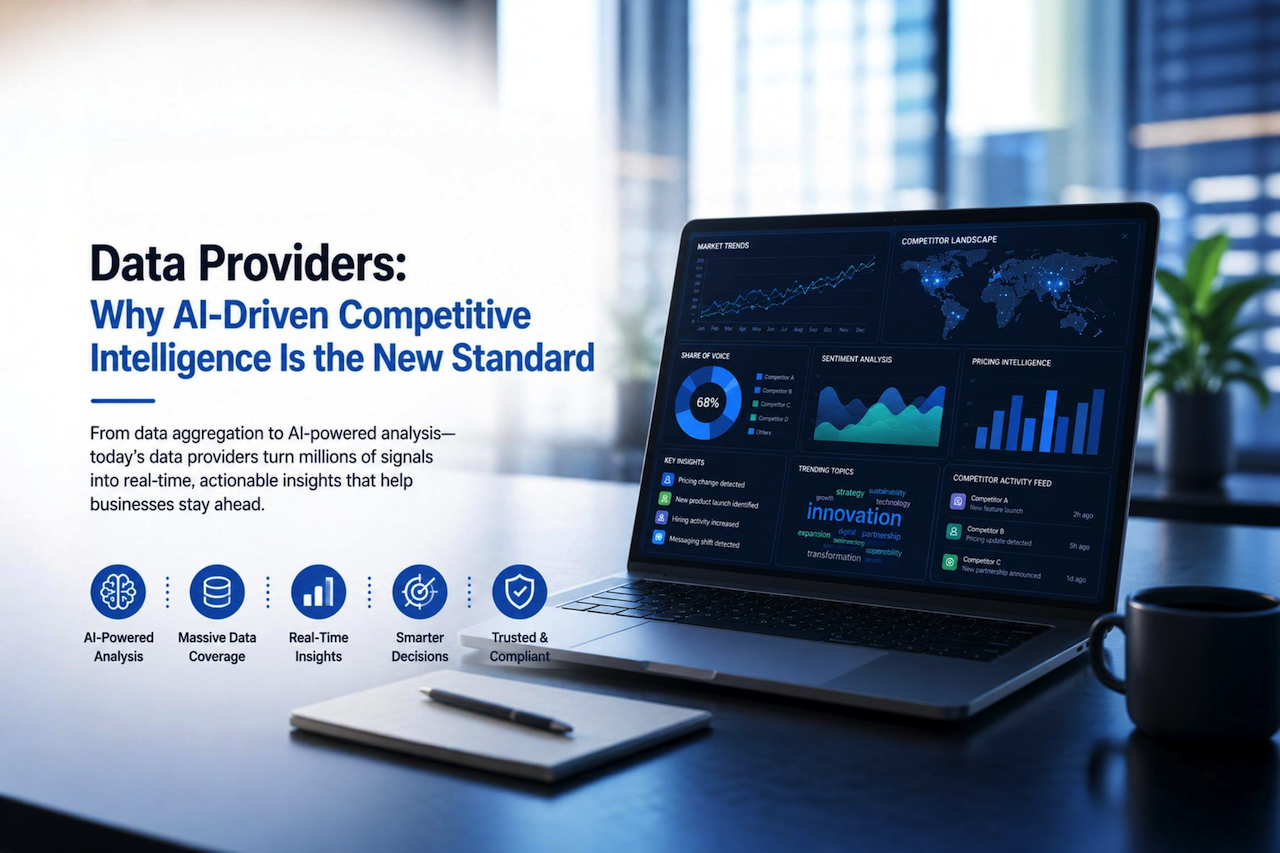
This is the model of competitive intelligence for many years that involved someone discreetly looking up the competitor’s website, taking screenshots of the pricing page, and putting together a presentation once every three months. This process is still used by some organizations, but it is fast becoming outdated. The data providers behind these competitive intelligence tools are no longer just data aggregators but have become analysis engines powered by AI, which has become a basic requirement today.
This transformation is no small feat. This is based on the sheer volume of data available, the speed at which data is produced, and how little use a static spreadsheet will be if your competition suddenly changes their prices or a new player enters an established market.
From Data Aggregation to Data Interpretation
While initially the role of the data provider was rather simple — gather data from open sources, such as web pages, press releases, job listings, social media, and reviews — that is still part of the job; it is no longer what makes the difference. What really counts now is the ability to interpret the information — take thousands of separate data points and create a concise list of actionable items for the marketing/sales/product teams.
This is where artificial intelligence turns the tables. The natural language processing capabilities of these platforms allow them to scan unstructured text, such as a competitor's blog, a customer review, or an online forum discussion, and identify sentiment, intent, and trending topics without requiring a human to read every word. Some platforms analyze data from more than 340 million online sources simultaneously, while others analyze sentiment in 150 or more languages, an operation that would be impractical for a human research team to perform manually.
Machine learning algorithms are able to identify shifts in pricing, sudden hiring sprees, or a shift in messaging strategy that would have gone unnoticed in the noise otherwise. Predictive models try their hand at going the extra mile and forecasting what the competitor is expected to do next on the basis of its past actions. A survey of industry representatives puts the percentage of companies that believe AI is critical to getting maximum value from CI platforms at about 71 percent.
New Developments Shaping the Space
Here are several recent developments that show how quickly this segment has evolved.
AI-driven market intelligence platforms have gained significant trust among investors. AlphaSense, an enterprise search platform that allows searching across earnings calls, filings, broker reports, and expert transcripts using natural language, raised $350 million in 2026 at a $7.5 billion valuation, up from $4 billion the previous year. It was reported that the company exceeded $600 million in annual recurring revenue in Q1 2026, up from $500 million the year before. This growth came after AlphaSense's acquisition of the expert transcript provider Tegus for $930 million in order to bolster its primary research capabilities. As a result, the firm grew its average revenue per customer from $28,000 to $66,000.
Consolidation is also on the rise in the competitive enablement vendor space. Competitive enablement and data collection platform Klue acquired a sales enablement tool based on agentic AI marketing in September 2025, with automated go-to-market capabilities, expanding its user base to over 250,000 users. Prices in this segment range from $300 yearly to over $60,000 annually, depending on the type of solution chosen: budget tools cost $300 a year, mid-range competitive enablement solutions $20,000-$40,000 a year, while high-end market intelligence solutions cost over $60,000 a year per license. Larger software vendors keep integrating competitive intelligence capabilities into their comprehensive BI/analytics platforms, a practice that began several years ago and has not yet ended.
On the other hand, there has been an introduction of another category of monitoring tools that specifically monitors the visibility of brands within AI-powered answers; monitoring visibility within outputs of chatbots and AI-based search assistants instead of SERPs. The reason is the realization that competitive monitoring must be adapted to how people get their information today, which involves AI and conventional search.
Market Overview: An Emerging Category That Is Yet to Peak
There is evidence to suggest that this is much more of a real transformation than just another fleeting trend. The global market size for competitive intelligence tools, as per a competitive intelligence tools market research report by Dataintelo, stood at around $6.2 billion in 2025 and is expected to touch $14.8 billion in 2034, registering a compound annual growth rate of slightly more than 10 percent over the forecasted period. Software solutions account for a larger share of the above-mentioned market size, and cloud-based deployment accounts for more than two-thirds of the overall market.
Currently, North America is the leading region in adoption, with about 38.5 percent of the total market share. Europe comes second at 27.2 percent, followed by Asia-Pacific at 21.8 percent. Latin America, the Middle East, and Africa account for 7.6 percent and 4.9 percent of the balance market share, respectively. In terms of components, software constitutes 62.3 percent of the total investment, with an estimated value of $3.87 billion in 2025 and an annual growth rate of 10.8 percent. Services account for the remaining 37.7 percent, with an annual growth rate of 9.2 percent.
Despite this, large companies are responsible for about 68.4 percent of total expenditures, while small and medium firms remain the most rapidly developing category, which grows at an average annual rate of 12.4 percent, which is even twice faster than software, mostly owing to the emergence of relatively cheap subscription services based on clouds (the cost of such services varies from $500 to $2,000 per month), and there is no need to have analysts on staff to run these services. As far as industries are concerned, financial services and insurance remain the most demanding sector of end users (about 24.2 percent of total expenditure).
What Is Driving the Growth
There are a few specific factors that serve as key drivers for this evolution.
Digital Transformation and Evidence-Based Decision Making
Companies across industries have shifted away from relying solely on intuition when making strategic decisions, instead using current competitive intelligence data to guide planning. This trend influences marketing, sales, product development, executive decision-making, and other business functions.
Growing Role of AI and Machine Learning
Advances in AI and machine learning have improved the ability to analyze unstructured information, allowing competitive intelligence platforms to generate insights that previously required hours of manual research. Capabilities such as sentiment analysis, anomaly detection, and pattern recognition are increasingly being used to automate competitive intelligence workflows.
Increasing Competition and Market Consolidation
As mergers, acquisitions, and market expansion continue across industries, organizations face greater pressure to understand both traditional competitors and emerging rivals. Digital marketplaces have also increased competition from businesses operating in different regions and sectors.
Cloud-Based Delivery Models
Subscription-based, cloud-delivered platforms have reduced the need for large upfront software investments, making competitive intelligence tools more accessible to organizations of different sizes.
Increasing Data Privacy and Regulatory Requirements
Evolving regulations governing the collection and use of personal and consumer data continue to influence how competitive intelligence providers gather and analyze information. As a result, transparency, responsible data practices, and regulatory compliance have become increasingly important considerations.
Insights for Organizations Selecting Data Providers
There are some important insights that businesses considering the selection of data providers should take into account.
Firstly, while a broad coverage of data sources may have been an important criterion in the past, nowadays it is less important as a standalone characteristic. It does not really matter how many sources a provider uses if it is unable to process the huge volumes of raw data into an actionable insight. The filtration and prioritization stage, which has become mostly automatic due to artificial intelligence, plays a much bigger role today.
Secondly, the ability to easily deploy the solution has become an absolute requirement rather than an optional feature. Platforms that have cloud-based solutions with simple integrations into CRM or marketing systems tend to be adopted much faster.
Thirdly, industry specialization is becoming increasingly relevant. Banking, healthcare, and retail industries have unique competition rules; platforms with built-in industry-specific content — financial regulatory filings, healthcare trial data, retail price and assortment information — will provide better insights than a general one-size-fits-all solution.
Fourthly, data provenance and compliance are no longer an afterthought. With privacy regulations tightening in various jurisdictions, the vendor's ability to demonstrate how its data is obtained and its compliance becomes a real selection factor, not just a detail in the sales presentation.
Looking Forward
Competitive intelligence is no longer just an auxiliary research tool but something close to an infrastructure, which means an ongoing feed affecting marketing, sales, and strategy teams at the same time, not a one-off report reviewed quarterly. In terms of evaluating the companies behind the transformation, the amount of data they are able to generate has become secondary to the ability to interpret it effectively right away when the data emerges. With the further development of artificial intelligence and its implementation in small and medium-sized enterprises, the standard is likely to become even higher, making AI-powered analysis a baseline requirement for all serious providers of data.
Author

Ashish Kolte
0 Comments
Comments are moderated to keep the discussion useful and respectful. Spam, automated submissions, and low-value promotional comments are removed.
Leave a Comment