
| Parmesh Shah | Development, Business, Mobile App Development

Ask five agencies what a mobile app costs and you’ll get five different numbers, sometimes off by a factor of ten. That’s not agencies being cagey; it’s because mobile app development cost isn’t one number. There is a stack of decisions: what the app should do, who will build it, where it is going to be based, and what polish it has to be on day one.
Here’s the useful way to think about it: cost estimation isn’t guesswork if you break the build into the six variables that actually move the number. Once you know which levers you’re pulling, a range appears fast, and you stop anchoring on a headline figure some other founder quoted you at a meetup.
What Actually Drives Mobile App Development Cost
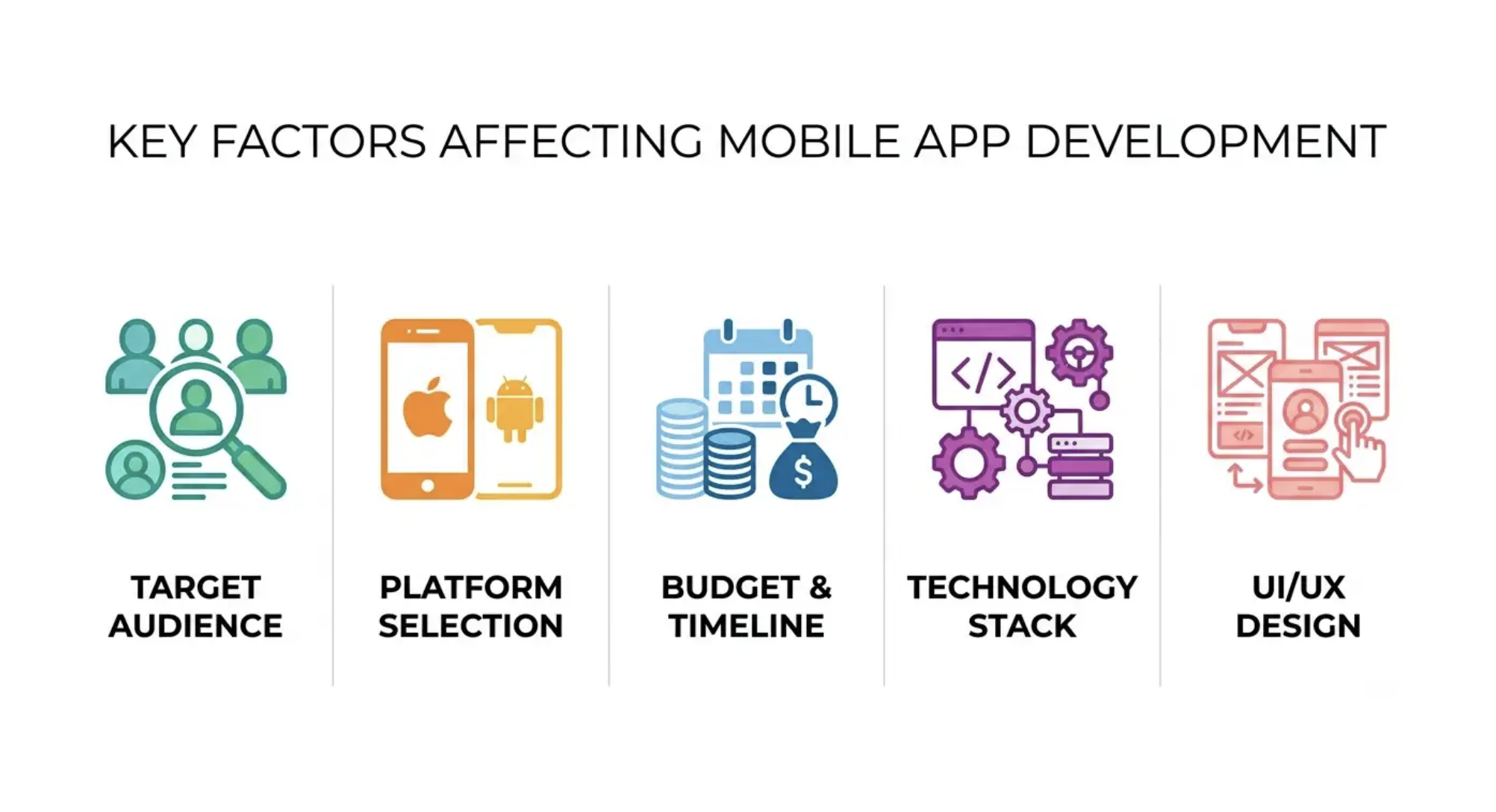
App Complexity and Features Are the Biggest Driver
Features are where budgets balloon or stay tight, more than any other single factor. A login screen and a chat window aren’t remotely the same engineering lift, and the price tag reflects that:
- Basic authentication: $2K–$5K
- Payments or in-app purchases: $5K–$15K
- Real-time chat: $8K–$25K+
- GPS and maps integration: $5K–$15K
- Video streaming or calling: $15K–$65K
- AI/ML features: $20K–$60K+
- Admin panel and analytics dashboard: $8K–$30K
Stack three or four of these into a single MVP and the estimate compounds fast — a marketplace app with payments, maps, and an admin panel is a fundamentally different build than a single-feature utility app.
Platform Approach Sets the Baseline
Cross-platform frameworks like React Native and Flutter give you one codebase targeting both app stores, which is why most startups treat that as the baseline estimate. Going dual native, separate Swift and Kotlin codebases, runs roughly 1.5 to 2 times the cross-platform cost, since you’re maintaining two feature sets in parallel. A single-platform build, iOS or Android only, comes in lower but caps your addressable market from day one.
Design and UX Shape the Middle of the Budget
Standard UI components and off-the-shelf design systems sit at the lower end of any estimate. A custom design system with tailored animations adds $10K–$50K, or roughly 15–25% of total budget, depending on scope. Even with a shared cross-platform codebase, platform-specific polish — the small interactions that make an app feel native to iOS versus Android — typically adds another 5–10% on top.
Backend, Infrastructure and Team Costs
Backend, Integrations and Infrastructure
A simple backend built on Firebase or another BaaS platform keeps costs down and works fine for MVPs with modest data needs. The moment you need custom APIs, horizontal scaling, or real-time servers — think live chat, live location tracking, or multiplayer features — that line item jumps to $30K–$120K or more. Layer in third-party services like Stripe, mapping APIs, analytics, or a CDN, and you’re looking at both upfront integration cost and an ongoing subscription line in your budget.
Team Location and Hourly Rates
This is the lever founders have the most control over. Mid-level mobile developer hourly rates vary enormously by region in 2026:
- North America (US/Canada): $70–$150+/hr, often $100–$200+ for senior talent
- Western Europe, UK, Australia: $50–$110/hr
- Eastern Europe (Poland, Ukraine, and similar): $65–$90/hr
- India and Southeast Asia: $30–$70/hr, with India often landing around $25–$50/hr for mid-level remote talent
That spread is one reason many startups consider development teams outside their home market instead of building an in-house team from scratch. Working with developers in a lower-cost region can significantly reduce development costs without necessarily changing the scope of the application.
If the product roadmap is already defined and additional React Native expertise is needed, businesses can consider external developers or development teams to expand their technical capacity without going through a lengthy in-house recruitment process.
Compliance, QA and Ongoing Costs
Regulated industries add a cost layer that’s easy to underestimate. HIPAA, PCI, or GDPR compliance work typically adds $20K–$100K depending on how deep the audit and controls need to go. Testing, QA, project management, and discovery aren’t optional line items either — budget 20–40% of the total project cost for them, spread across the build rather than bolted on at the end.
After you launch your app, you will probably have to spend around 15 to 25% of what you spent to build it every year. This money will go towards keeping the app working, updating it for new operating systems, fixing problems, and making sure the framework is up to date. There are also some costs that you will have to pay no matter what.
For example, Apple charges a fee of $99 every year to developers. You will also have to pay for hosting and for using third-party APIs. Then there is the cost of marketing, which is necessary to get your app in front of people who might want to use it. Maintenance is another key cost, including bug fixes and framework upgrades, and it can add up over time.
How to Estimate Startup App Development Cost
A Typical $100K Budget Allocation
For founders trying to reverse-engineer a realistic number, a $100K project is a useful reference point for how the money typically splits:
- Discovery and planning: ~10%
- UI/UX design: ~15%
- Development, frontend and backend combined: ~50%
- QA and testing: ~15%
- Deployment and launch: ~10%
Half the budget goes to actual development, which is exactly why team location and hourly rate, the lever from the previous section, swings your final number more than almost anything else on this list.
Building a Realistic Estimate for Your Own App
Startup app development cost estimates go wrong in one of two directions: founders either lowball scope to hit a number they saw online, or they gold-plate an MVP with features that belonged in version two. The fix is the same either way — list your must-have features against the ranges above, pick a platform approach, price out a team location, and add the 20–40% QA and PM buffer before you call the number final. That process takes an afternoon and gets you within striking distance of what an agency or freelance quote will actually say.
A Worked Example: Pricing a Simple Marketplace App
Numbers land better with a concrete example. Say you’re scoping a two-sided marketplace app, such as a local services booking platform, with basic auth, payments, GPS-based search, and a lightweight admin panel. Add those feature ranges together, and you’re looking at roughly $20K–$65K in core feature development before backend and design costs are even factored in.
Layer on a standard Firebase-style backend, a moderate design system, and QA at 25% of the build, and a cross-platform version of that app could land somewhere between $45K and $110K. The final cost can vary considerably based on factors such as development region, technical complexity, integrations, design requirements, and testing needs. Regional rate differences can have a significant impact on the overall budget even when the feature set remains unchanged.
That’s the real value of breaking cost into variables instead of asking for a single number up front: it turns “how much does an app cost” into a budget that can be evaluated and adjusted based on specific project requirements.
Conclusion
Mobile app development costs can vary widely because no two projects have exactly the same requirements. Features, platform choice, design complexity, backend infrastructure, development rates, testing, compliance, and ongoing maintenance can all influence the final budget.
Instead of relying on a single average cost, businesses can build a more realistic estimate by defining the required features, evaluating each major cost variable, and accounting for both development and post-launch expenses. A clear breakdown makes it easier to prioritize the right features, control the budget, and plan for the long-term costs of maintaining and improving the app.
Author

Parmesh Shah
0 Comments
Comments are moderated to keep the discussion useful and respectful. Spam, automated submissions, and low-value promotional comments are removed.
Leave a Comment