
| Mike | Digital Marketing, Business, Technology

Gartner surveyed 378 senior marketing leaders in the spring of 2024 and found that only 52% of them could prove marketing's value and get credit for its contribution to business outcomes. Asked who was most skeptical, respondents named the CFO (40%) and the CEO (39%), and 47% said marketing gets treated inside their own company as an expense rather than an investment.
Those numbers describe a translation failure more than a performance failure. A lot of the marketing behind that survey worked fine. It just arrived in a format the person holding the budget couldn't act on.
I spent years building analytics and client reporting at Lighthouse Insights before starting Ontevo, and the pattern held across nearly every account. The monthly report was the most polished thing we produced and the least-read thing we produced. It answered “what happened” for a reader whose only live question was “what should I do about it, and what's it worth.”
Traffic usually isn't the bottleneck
Most reporting still opens with sessions, users, and rankings, because those are the numbers that move fastest and chart most cleanly. They're also the numbers furthest from the bank account.
Baymard Institute maintains a running average of documented cart abandonment across 50 separate studies, and it currently sits at 70.22%. Its checkout research, built on 25 rounds of usability testing and benchmarking of 344 leading e-commerce sites, estimates that a large-scale site can improve conversions by around 35% through checkout design alone, with an average of 32 discrete fixes available per site.
Read those two figures together and the priority order changes. For a site with an existing traffic base, the cheapest revenue available is usually sitting behind a form, a checkout step, or a product page, not in front of the ad account. A traffic report that leads with a 12% session increase is describing the least valuable variable in the room.
Traffic work still matters. The fix is to report the traffic number next to the thing it's supposed to produce, so the client can see whether the two were actually connected this month.
What a report costs the reader
A report is a description. It tells a client what happened over a period and leaves the interpretation to them. That's a reasonable format when the reader is a marketing manager who already knows the account, and a bad one when the reader is a founder, a finance lead, or a board member who has thirty minutes and four other departments to review.
The vocabulary is where it breaks down first. “Opportunity to improve,” “room for growth,” “the trend may be shifting,” and “consider optimizing” all share a property: none of them can be wrong, and none of them can be acted on. They're hedges, and finance readers are trained to discount hedges.
Gartner's 2025 CMO Spend Survey put marketing budgets flat at 7.7% of company revenue for the second year running, with 59% of the 402 CMOs surveyed saying that isn't enough to execute their strategy. When the budget is fixed and contested, hedged language is a losing move. Every hedge hands the reader a reason to defer the decision.
Three rules for writing a receipt instead of a report
A receipt is a different artifact from a report. It states a specific finding, prices it, and names what to do about it. Three rules get you most of the way there, and none of them need new software.
1. Name the gap as something a skeptic could check
Write findings as verifiable facts about the business rather than as themes. Say the finding is that the checkout asks for a phone number before it asks for an email, and that a large share of mobile sessions end on that step. Written that way, it's checkable, and somebody can go and look. “Mobile UX could be stronger” gives them nowhere to go.
The test I use is whether a client could forward the line to somebody hostile and have it survive. If the sentence needs the author present to defend it, it isn't finished.
2. Price the gap and show the arithmetic beside it
A number without its formula gets challenged once and then ignored forever. Write the math inline: sessions times the conversion gap times average order value, with each input labeled and dated. The client's finance person will either accept the inputs or correct them, and both of those outcomes are useful to you.
Where the inputs aren't available, say so and mark the figure as directional. A finding that's honest about its confidence level survives cross-examination. A figure presented as precise when it isn't will destroy the credibility of everything around it the first time it's checked.
3. Attach the fix, the owner and the effort
A finding without a prescribed fix pushes the work back onto the client, which is the opposite of what they're paying for. Each item should carry what to change, who does it, and roughly how much effort it takes. That single addition converts the document from a status update into a work order the client can approve.
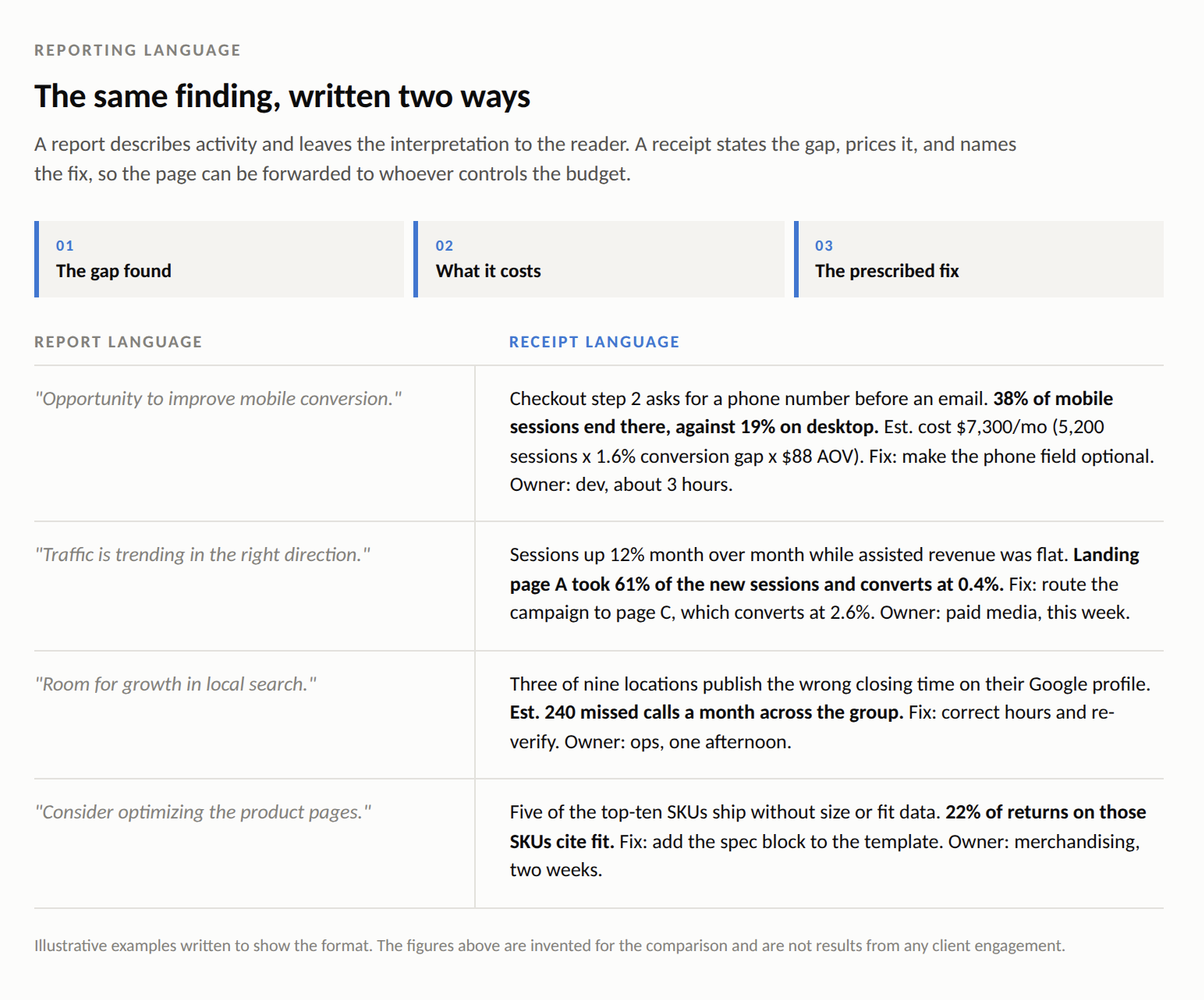
The same finding written in report language and in receipt language. Examples are illustrative, and the figures are invented to show the format.
The reporting problem is also a margin problem
For agencies, this stops being a communication question and starts being a P&L question. Planable's 2026 Agency Profitability Report, drawn from 186 SEO, social and multi-service agencies, found that 21.5% of them are losing money, up from 13% in the previous year's report.
Client concentration tracks with it. In the same dataset, 53.3% of single-client agencies were loss-making, against 6.5% of agencies with 20 or more clients. Retention and the ability to defend a retainer sit underneath both figures, and the monthly deliverable is the main surface where that defense either happens or doesn't.
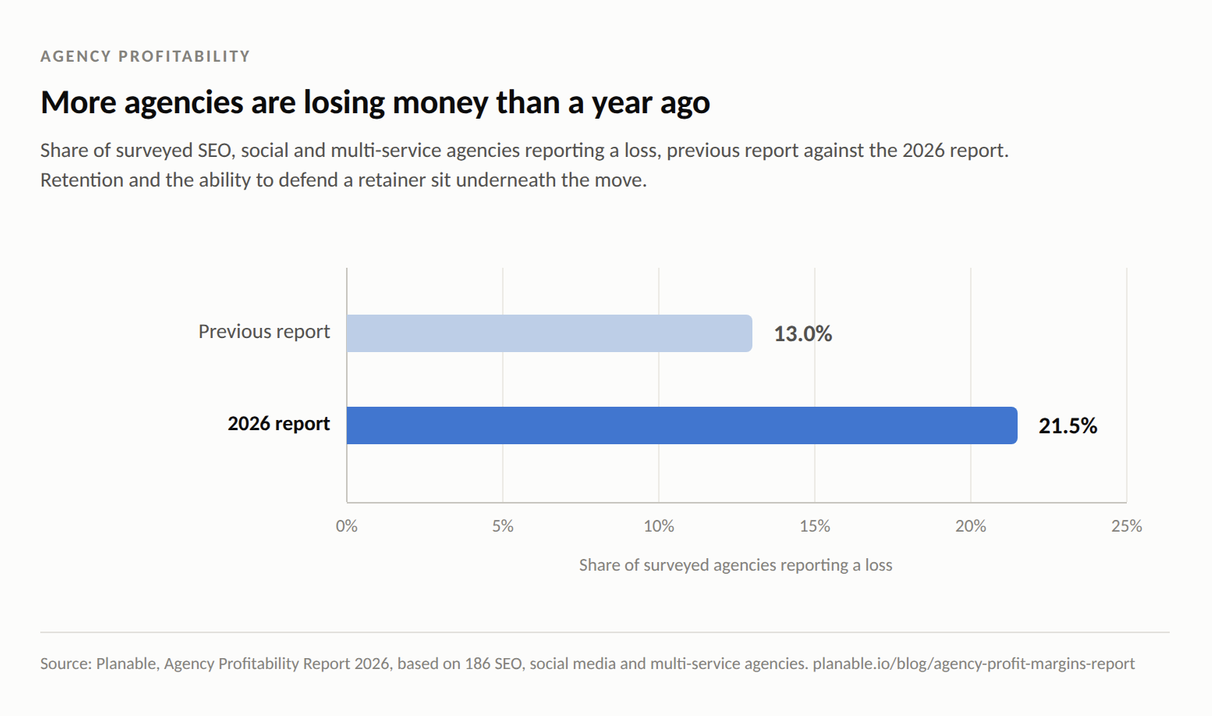
Share of surveyed agencies reporting a loss. Source: Planable, Agency Profitability Report 2026 (186 agencies).
There's a second cost that rarely gets counted. Assembling a monthly report is skilled labor spent on a document that generates no billable value of its own. Rebuilding it as a priced, prescriptive deliverable doesn't take much more time, and it changes what the client is buying from a summary of your activity into a plan they can act on.
Building the artifact without overclaiming
The discipline that makes this work is mostly a refusal. If the evidence for a claim isn't there, the claim doesn't ship. Every value carries its source, every dollar figure carries its method, and anything modeled rather than measured gets labeled as modeled on the page where it appears.
That format rule is one I've been working with at Ontevo, and the anatomy is outlined publicly in how we define the Truth Card: the gap found, the dollar cost with the loss math shown, and the prescribed fix, presented on a single page that can be shared with an accountant. The specific format matters less than the constraint behind it. Any team can adopt that constraint using the tools they already pay for.
Where to start
Take last month's report for your largest account and rewrite the first page. Pull out the three findings that have a plausible dollar consequence, write each as a checkable fact, put the arithmetic underneath it, and name the fix and the owner. Delete everything else from page one and push the channel tables into an appendix.
Then send it and watch what comes back. In my experience, the reply changes shape almost immediately: fewer acknowledgments, more questions about the inputs, and occasionally a forward to somebody in finance who has never once opened a marketing dashboard. That forward is the whole point of the exercise.
Traffic growth is still the work. The receipt is just the part of the work that gets renewed.
Author

Mike
0 Comments
Comments are moderated to keep the discussion useful and respectful. Spam, automated submissions, and low-value promotional comments are removed.
Leave a Comment