
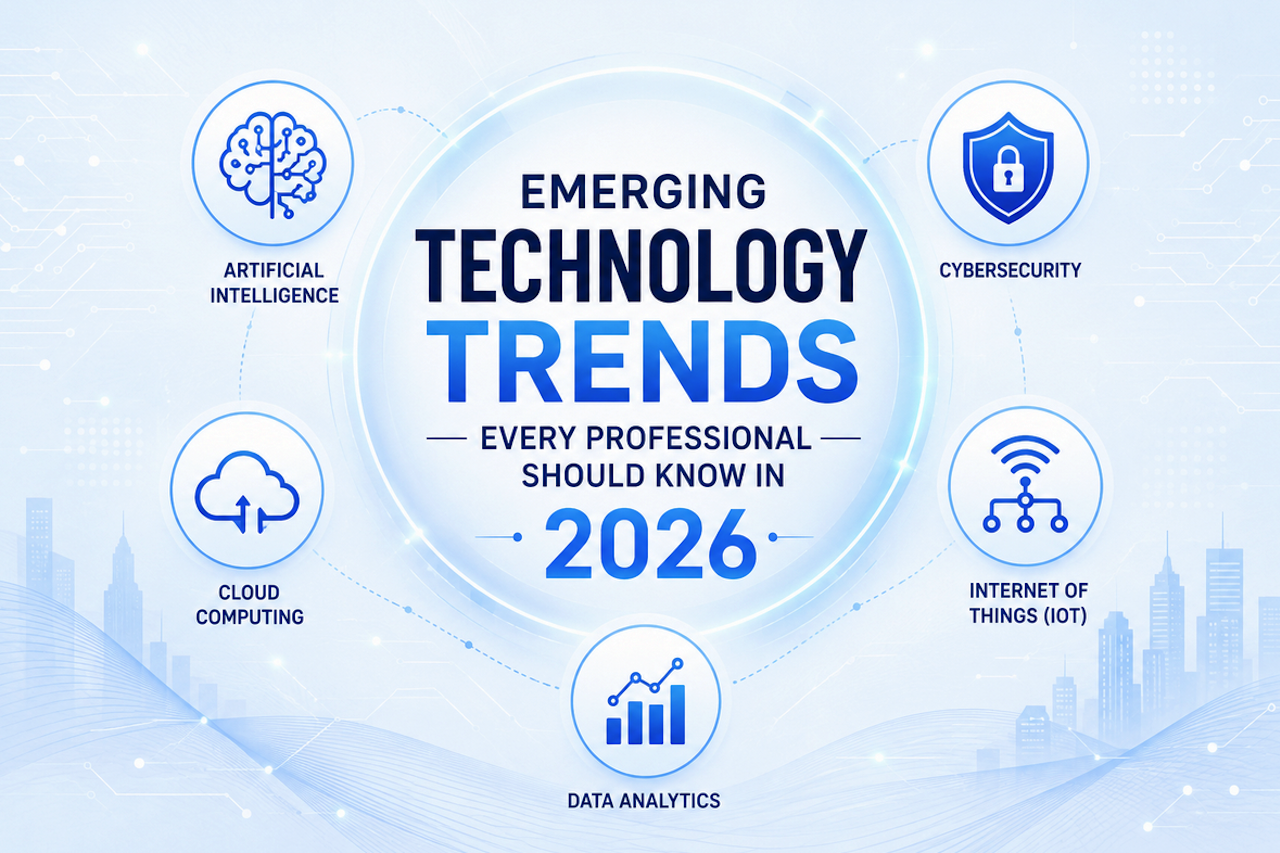
Technology continues to evolve at an extraordinary pace, transforming industries, reshaping business models, and redefining the skills professionals need to succeed. Organizations worldwide are embracing digital transformation to remain competitive, while professionals are expected to adapt to new tools and technologies that enhance productivity and innovation.
Understanding emerging technology trends is essential for staying relevant in today's fast-changing workplace. From artificial intelligence and cloud computing to cybersecurity and sustainable technology, these innovations are creating new opportunities and challenges across every sector.
This article explores the most significant emerging technology trends that every professional should know in 2026 and beyond.
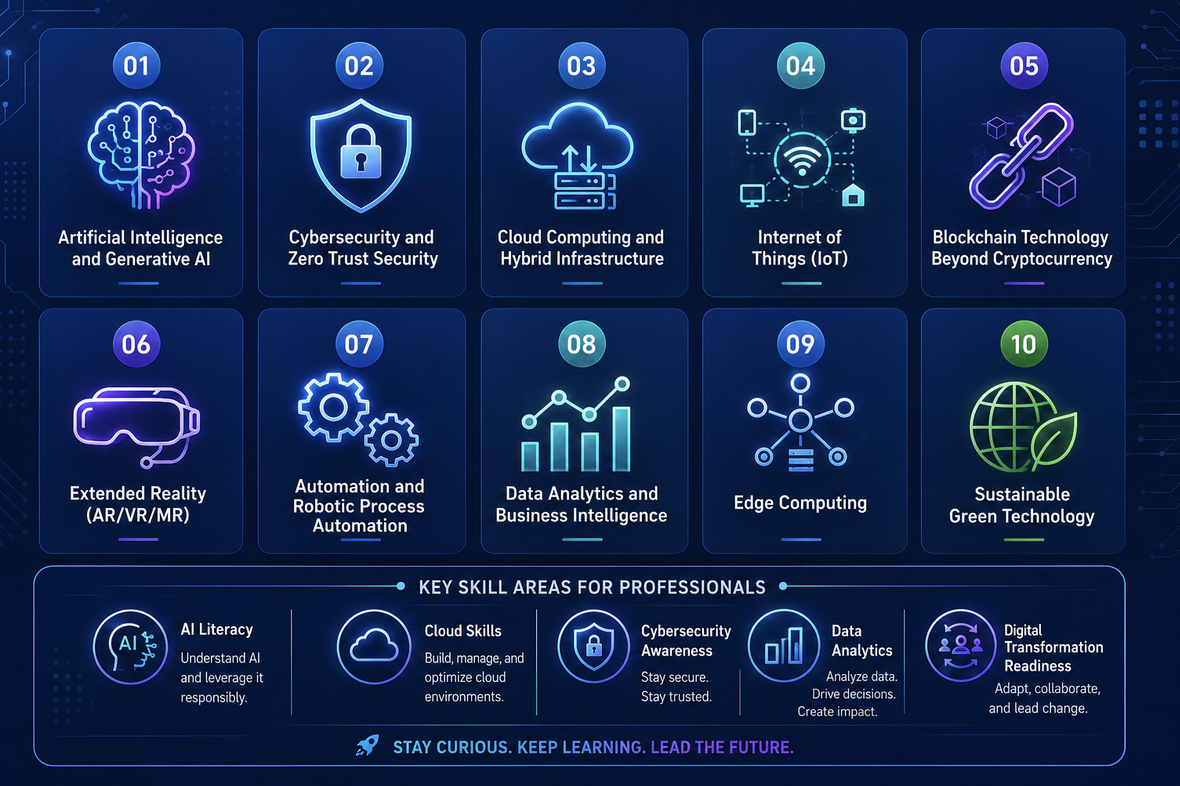
Artificial Intelligence and Generative AI
Artificial Intelligence (AI) has become one of the most influential technologies of the modern era. Businesses are using AI to automate routine processes, analyze vast amounts of data, and improve decision-making. The rapid advancement of generative AI has further expanded the possibilities, enabling organizations to create content, generate code, produce visuals, and streamline workflows with unprecedented efficiency.
As AI technologies continue to mature, professionals who understand how to work alongside intelligent systems will gain a significant competitive advantage. AI is no longer limited to technology companies; it is now transforming healthcare, finance, education, marketing, and manufacturing.
Cybersecurity and Digital Protection
As digital adoption increases, organizations face growing cybersecurity threats. Data breaches, ransomware attacks, and sophisticated cybercrime activities have made cybersecurity a top priority for businesses worldwide.
Modern organizations are implementing advanced security measures such as Zero Trust Architecture, Multi-Factor Authentication, and AI-driven threat detection systems. Professionals across all industries must develop cybersecurity awareness to help protect sensitive information and reduce organizational risk.
The growing importance of cybersecurity has also created a strong demand for skilled professionals to secure digital assets and maintain compliance with evolving regulations.
Cloud Computing and Hybrid Infrastructure
Cloud computing remains a key driver of business innovation and operational efficiency. Organizations are increasingly adopting hybrid and multi-cloud environments to enhance flexibility, scalability, and business continuity.
Cloud technology allows businesses to access computing resources on demand, reducing infrastructure costs while supporting remote work and global collaboration. The continued expansion of cloud services is enabling organizations to deploy applications faster, improve data management, and accelerate digital transformation initiatives. In the same evolving digital ecosystem, businesses also rely on affordable software to equip teams with cost-effective tools that support cloud adoption and improve overall productivity.
Professionals with cloud computing expertise are becoming increasingly valuable as businesses continue migrating to cloud-based environments.
Internet of Things (IoT)
The Internet of Things (IoT) is transforming the way devices communicate and share information. Connected sensors, machines, and smart devices collect real-time data that organizations can use to improve operations, enhance customer experiences, and optimize resource utilization.
Industries such as healthcare, manufacturing, transportation, and logistics are increasingly relying on IoT solutions to gain actionable insights and improve efficiency. Smart homes, wearable technology, and industrial automation systems demonstrate how IoT is becoming an integral part of everyday life and business operations.
As IoT adoption expands, professionals must understand how connected technologies impact their industries and create new opportunities for innovation.
Blockchain Technology Beyond Cryptocurrency
Blockchain technology is often associated with digital currencies, but its applications extend far beyond cryptocurrency. Blockchain provides a secure, decentralized, and transparent method for recording transactions and sharing information.
Organizations are exploring blockchain solutions to improve supply chain visibility, verify digital identities, automate contracts, and enhance data security. The technology's ability to establish trust and transparency makes it valuable in industries where accuracy and accountability are critical.
As blockchain adoption grows, professionals who understand its business applications will be better equipped to contribute to future innovation initiatives.
Extended Reality and Immersive Experiences
Extended Reality (XR), which includes Augmented Reality (AR), Virtual Reality (VR), and Mixed Reality (MR), is revolutionizing the way people interact with digital content. These immersive technologies are creating new possibilities for training, collaboration, education, and customer engagement.
Organizations are using XR to deliver realistic training simulations, virtual product demonstrations, and enhanced remote collaboration experiences. As hardware becomes more accessible and software capabilities continue to improve, immersive technologies are expected to become increasingly common in professional environments.
Understanding the potential of XR can help professionals identify innovative ways to improve communication, learning, and business outcomes.
Automation and Intelligent Workflows
Automation is transforming workplaces by eliminating repetitive tasks and improving operational efficiency. Businesses are leveraging Robotic Process Automation (RPA) and AI-powered systems to streamline processes that previously required significant manual effort.
From data entry and customer support to financial reporting and supply chain management, automation is helping organizations reduce costs and improve accuracy. Rather than replacing human workers entirely, modern automation technologies often allow employees to focus on higher-value activities that require creativity, critical thinking, and strategic decision-making.
Professionals who understand automation technologies can help organizations improve productivity while driving innovation and growth.
Data Analytics and Business Intelligence
Data has become one of the most valuable assets in the digital economy. Organizations are increasingly relying on advanced analytics and business intelligence tools to make informed decisions and identify growth opportunities.
Modern analytics platforms enable businesses to monitor performance in real time, predict future trends, and uncover valuable insights from complex datasets. The integration of artificial intelligence into analytics tools has further enhanced the ability to extract meaningful information from data.
Professionals with strong data literacy skills are highly sought after because they can translate information into actionable business strategies and competitive advantages.
Edge Computing and Real-Time Processing
The growing number of connected devices has created a need for faster data processing and reduced network latency. Edge computing addresses this challenge by processing data closer to its source rather than relying solely on centralized cloud servers.
This approach improves performance, enhances reliability, and supports applications that require real-time decision-making. Industries such as healthcare, manufacturing, telecommunications, and autonomous transportation are increasingly adopting edge computing solutions to improve efficiency and responsiveness.
As organizations generate larger volumes of data, edge computing is expected to play a critical role in future technology infrastructures.
Sustainable Technology and Green Innovation
Sustainability is becoming a central focus for businesses around the world. Organizations are investing in green technologies that reduce environmental impact while improving operational performance.
Innovations such as energy-efficient data centers, renewable energy systems, smart energy management platforms, and sustainable manufacturing processes are helping businesses achieve their environmental goals. Regulatory requirements and consumer expectations are also driving increased investment in sustainable technology initiatives.
Professionals who understand sustainability trends and environmental technologies will be well-positioned to contribute to long-term organizational success.
Preparing for the Future of Technology
The rapid pace of technological advancement means that continuous learning is essential for career growth. Professionals who embrace innovation and develop digital skills will be better prepared for future workplace demands.
Building expertise in areas such as AI software development, artificial intelligence, cybersecurity, cloud computing, data analytics, and automation can significantly improve career prospects. Staying informed about emerging technologies, participating in professional development programs, and gaining hands-on experience will help individuals remain competitive in an increasingly technology-driven world.
As the role of emerging technologies continues to evolve, adaptability, critical thinking, and a willingness to learn will become even more important. Professionals and organizations that embrace technological change will be best positioned to thrive in the future digital economy.
Conclusion
Emerging technologies are transforming the way businesses operate and how professionals perform their work. Artificial intelligence, cybersecurity, cloud computing, IoT, blockchain, automation, data analytics, edge computing, and sustainable technology are among the most influential trends shaping the future.
Professionals who understand these innovations and actively develop relevant skills will be better equipped to thrive in a rapidly evolving digital landscape. By staying informed and embracing continuous learning, individuals can unlock new opportunities, drive innovation, and build successful careers in the technology-driven economy of the future.
Featured Image generated by ChatGPT.
Share this post
Author

Leave a comment
All comments are moderated. Spammy and bot submitted comments are deleted. Please submit the comments that are helpful to others, and we'll approve your comments. A comment that includes outbound link will only be approved if the content is relevant to the topic, and has some value to our readers.
Comments (0)
No comment