
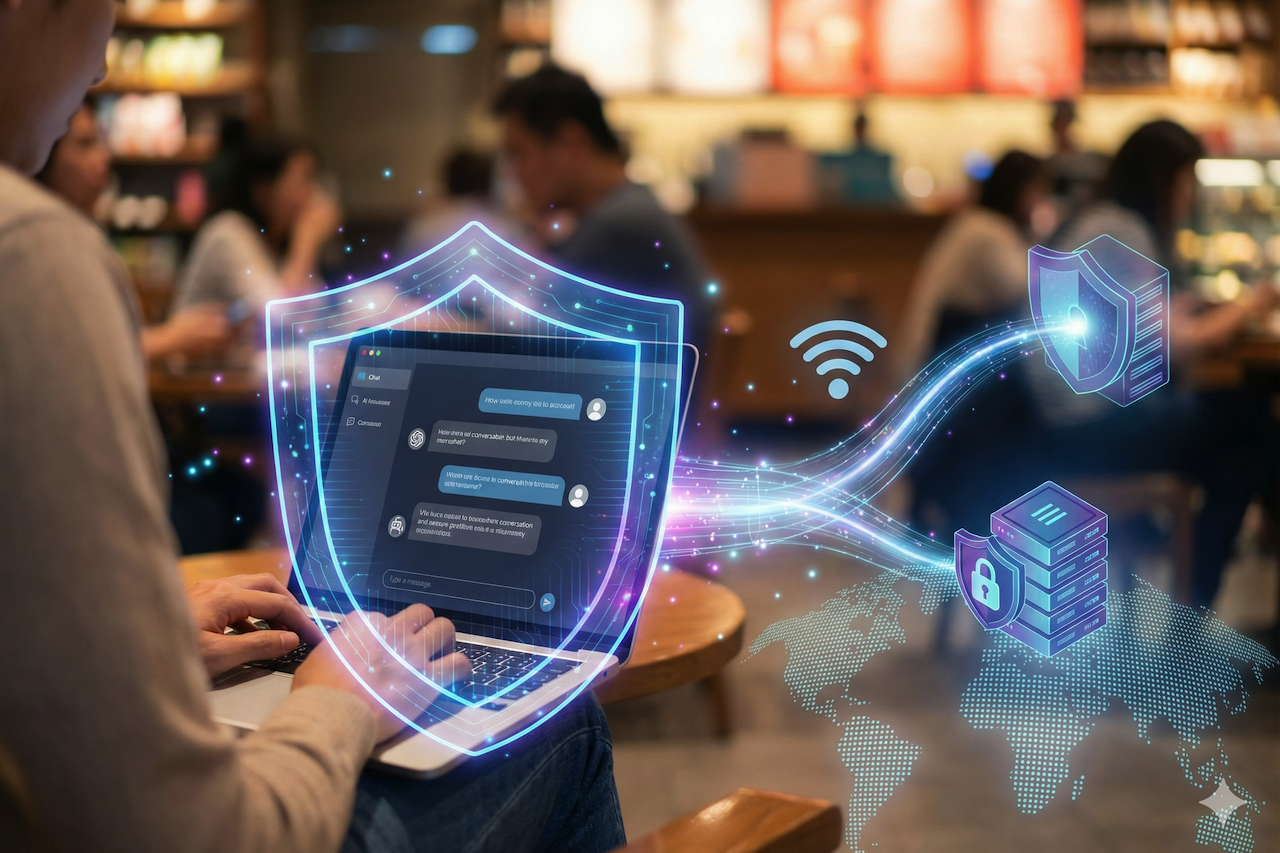
ChatGPT has become part of daily life for many people. It’s commonly used for answering questions, generating ideas, drafting emails, and supporting both personal and professional tasks. Over time, users may share a significant amount of information through these interactions, which naturally raises questions about digital privacy.
While ChatGPT is a powerful and useful tool, its use, like any online service, comes with general privacy considerations. This is where a VPN can be helpful. A VPN does not change how ChatGPT works, but it can add an extra layer of privacy, security, and network stability in certain situations.
Using ChatGPT with a VPN is similar to having an added privacy buffer for your internet connection, especially when accessing the service from shared or unsecured networks.
Below is a breakdown of the key benefits.
1. Better Privacy While Using ChatGPT
When you browse the internet without a VPN, your IP address can reveal:
- Your approximate location
- Your internet service provider
- Your network identity
A VPN masks your real IP address and assigns you a different one. When using ChatGPT with a VPN:
- Your real location is less visible
- Your activity is harder to associate with your personal network
- You gain an additional layer of privacy
This does not mean ChatGPT itself is unsafe, but a VPN can act as an extra privacy safeguard, particularly on unsecured networks.
2. Safer Use on Public Wi-Fi
Public Wi-Fi networks, such as those in airports, cafés, hotels, or guest offices, carry higher security risks. Data transmitted over these networks can be more vulnerable.
A VPN encrypts your internet connection, making it harder for others on the same network to monitor your activity. This is especially useful when using ChatGPT for:
- Work-related ideas
- Learning or research
- Personal projects
Encryption helps keep your connection more secure in public environments.
3. More Stable Access on Certain Networks
Sometimes ChatGPT feels slow or may fail to connect properly due to:
- Network routing issues
- ISP throttling
- Local network restrictions
A VPN can sometimes improve reliability by changing how your data is routed. While it won’t guarantee faster speeds, some users find it helps when access is unstable on a specific network.
4. Helpful in Restricted or Limited Regions
In some regions or institutions, access to AI tools may be limited or unreliable. A VPN can help by routing your connection through another location where access is more consistent.
This can be useful for:
- Travelers
- Remote workers
- Students
5. Separation Between Work and Personal Use
If you use ChatGPT for work, freelancing, or research, a VPN can help keep that activity separate from your personal browsing identity. This is useful when:
- Using shared devices
- Managing multiple accounts
- Maintaining cleaner digital boundaries
Think of it as basic digital hygiene.
What a VPN Will Not Do
It’s important to be clear about limitations. A VPN:
- Will not make ChatGPT smarter
- Will not unlock paid features
- Will not change how responses are generated
Its role is limited to privacy, security, and network access—not AI functionality.
Final Thoughts
Using a VPN with ChatGPT can offer meaningful benefits, especially for privacy-conscious users and those who frequently rely on public or shared networks. While it isn’t required for everyone, a VPN can be a practical tool for maintaining safer and more private access to online services.
Featured Image generated by Google Gemini.
Share this post
Leave a comment
All comments are moderated. Spammy and bot submitted comments are deleted. Please submit the comments that are helpful to others, and we'll approve your comments. A comment that includes outbound link will only be approved if the content is relevant to the topic, and has some value to our readers.
Comments (0)
No comment