
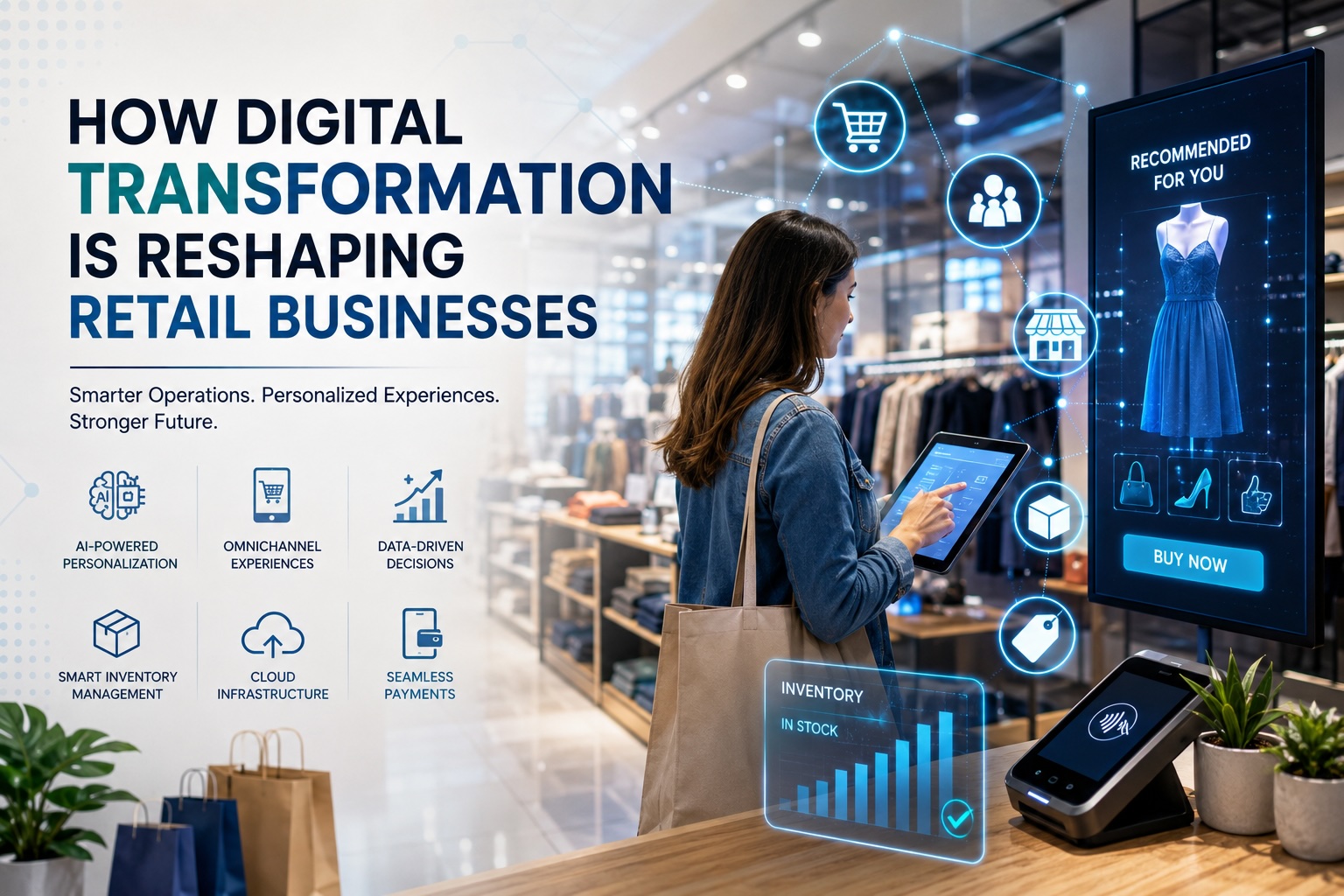
Today, every industry is on the edge of growth and innovation, thanks to the integration of modern technologies like AI, ML, IoT, and more. This event has also helped deliver more seamless customer experiences. In fact, investing in technologies also enables more streamlined operations and better decision-making for professionals.
That being said, the retail industry too has experienced immense growth due to these innovations. In fact, it also helps teams build more connected, analytics-driven systems that are faster, more responsive, and highly scalable.
For business leaders, this means that adopting newer technologies can directly improve retail operations, customer engagement and loyalty, operational performance, and better chances of future growth. With this perspective, this blog helps teams understand how digital transformation is reshaping retail businesses, thereby allowing them to build a stronger competitive advantage in an increasingly digital marketplace.
What is Digital Transformation for Retail Businesses?
Well, digital transformation in retail is an AI-focused innovation wherein companies rely on modern technologies to deliver better user experiences while also optimizing their operations and driving growth.
Largely, it involves integrating technologies like artificial intelligence, cloud computing, data analytics, automation, and more across the retail ecosystem to get these outcomes.
For teams, this is not a simple process where technology can be integrated. Rather, it aims to simplify this framework while focusing on the good that can come from this transformation. This is why it is a critical strategy for retail leaders in 2026.
Why Leaders Should Invest in Retail Digital Transformation?
As we understand the essence of this innovation in the retail sector, let us now explore the dynamics of why investing in it can help with your future growth.
Here is a more elaborate explanation for this subject:
1. Evolving Customer Expectations
Essentially, modern users today expect that companies will deliver personalized, convenient, and seamless shopping experiences through their apps and websites. This is why retailers need to invest in these digital technologies to meet these expectations.
2. Rise of Omnichannel Commerce
Additionally, customers use various channels for purchasing products online. This can be the company’s website, apps, social media platforms, and more. That is why providing an omnichannel commerce experience to users is a must for retail businesses.
3. Increasing Demand for Personalization
As we know, personalization has become a key differentiator for every brand today. For retailers, this means delivering AI-ready tailored product recommendations, targeted promotions, and individualized shopping experiences.
4. Growing Importance of Data-Driven Decision-Making
Lastly, retailers have a lot of data that AI can process faster and more accurately. So, by strategically investing in analytics, they can gain actionable insights that support teams work smarter and allow for improved business performance.
How Digital Transformation Is Reshaping Retail Businesses?
Definitely, digital transformation is fundamentally changing how retailers interact with customers and manage their operations online.
That being said, this section explores how retail digital transformation happens practically in enterprises.
1. Creating Seamless Omnichannel Experiences
Well, digital transformation in the retail segment means integrating AI technologies into a brand’s websites, mobile apps, social commerce channels, marketplaces, and more to create a unified experience for customers.
Here, brands work on connecting customer data and shopping journeys so that AI systems can process those data points and help people enjoy a consistent brand experience.
2. Enhancing Customer Engagement Through Personalization
Undoubtedly, retailers understand how powerful AI is and how it can impact their operational performance. This is why they are increasingly integrating analytics into their systems to understand evolving customer buying patterns and behaviors.
Furthermore, this can help the brand share more relevant product recommendations, promotions, offers, and content based on individual shopping habits. Overall, this helps improve customer engagement and loyalty in the long term.
3. Optimizing Retail Operations and Supply Chains
Through automation and analytics, retail leaders can easily monitor their inventory while forecasting demand accurately. Overall, it also helps improve their supply chain visibility, automate procurement processes, and identify disruptions before they affect operations.
Practically, in this manner, supply chain operations can be optimized, and delays can be avoided as well.
4. Enabling Faster and Smarter Business Decisions
As we can understand, retailers can use modern technologies to collect and analyze large volumes of operational, customer, and sales data. Technically, this helps them process loads of information faster and better, thereby making more market-ready decisions.
In this manner, digital transformation helps companies improve customer experiences, thereby allowing them to be more responsive in a highly competitive retail environment. Thus, planning this transformation can actually help retailers create faster, more personalized, and customer-friendly shopping experiences.
Key Technologies Driving Retail Digital Transformation
Largely, there are various technologies that can help retail business leaders ensure a connected and unified user experience.
These are shared more descriptively in the following table:
| Technologies | How They Help Transform Retail Operations |
|---|---|
| Artificial Intelligence and Machine Learning | Enables retailers to analyze customer behavior, forecast demand, and optimize the brand’s pricing strategies. |
| Generative AI in Retail | Supports creative content creation, writing product descriptions, and marketing campaigns. |
| Data Analytics and Business Intelligence | Evaluates customer, sales, and operational data to understand insights that also support smarter business decision-making. |
| Cloud Computing | Enables a scalable infrastructure, centralized data access, improved collaboration, and enhanced security that a modern retail business needs. |
| Internet of Things (IoT) | Helps connect all the devices, including inventory systems and warehouses, to provide real-time visibility and support operational monitoring. |
| Augmented Reality (AR) and Virtual Try-On Experiences | Allows customers to visualize products digitally before the purchase, which also helps improve their buying confidence. |
| Retail Automation and Robotics | Enables automating repetitive tasks such as inventory tracking, warehouse operations, order fulfillment, and more. |
| Digital Payment Technologies | Helps provide users with secure, seamless, and contactless payment experiences while improving checkout efficiency. |
Overall, this can actually help retail brands to remain competitive in the market while adapting more effectively to evolving customer expectations.
Final Thoughts
Wrapping up, we can say that digital transformation in retail can enable teams to bring a big shift in their operations and outcomes. What’s more, it allows them to create an increasingly connected and customer-driven market altogether.
However, what is a necessary part of this shift is that technologies alone don’t make the difference that brands look for. The right planning and implementation count. Moreover, retail leaders must place customer experience at the center of their transformation efforts, while leveraging their data and AI to make faster and more informed decisions. And the balance between the cost and innovation expected must always be clear in all cases. These are all a must for achieving long-term success.
Thus, working on digital transformation strategies for retail is a necessary move if brands want to build a secure, scalable, and agile ecosystem today.
Featured Image generated by ChatGPT.
Share this post
Author

Read the latest articles from Riley Brooks
Why Cybersecurity Should Be Part of Your Web Development Process

June 19, 2025
Data integrity is a primary concern for businesses and their users. However, with modernizing times, the concern has turned into a necessity under compliance regulations. This has led businesses and entrepreneurs to make it an utmost priority when building a user-focused website. They focus on securing the vulner [...]
Learn moreLeave a comment
All comments are moderated. Spammy and bot submitted comments are deleted. Please submit the comments that are helpful to others, and we'll approve your comments. A comment that includes outbound link will only be approved if the content is relevant to the topic, and has some value to our readers.
Comments (0)
No comment