
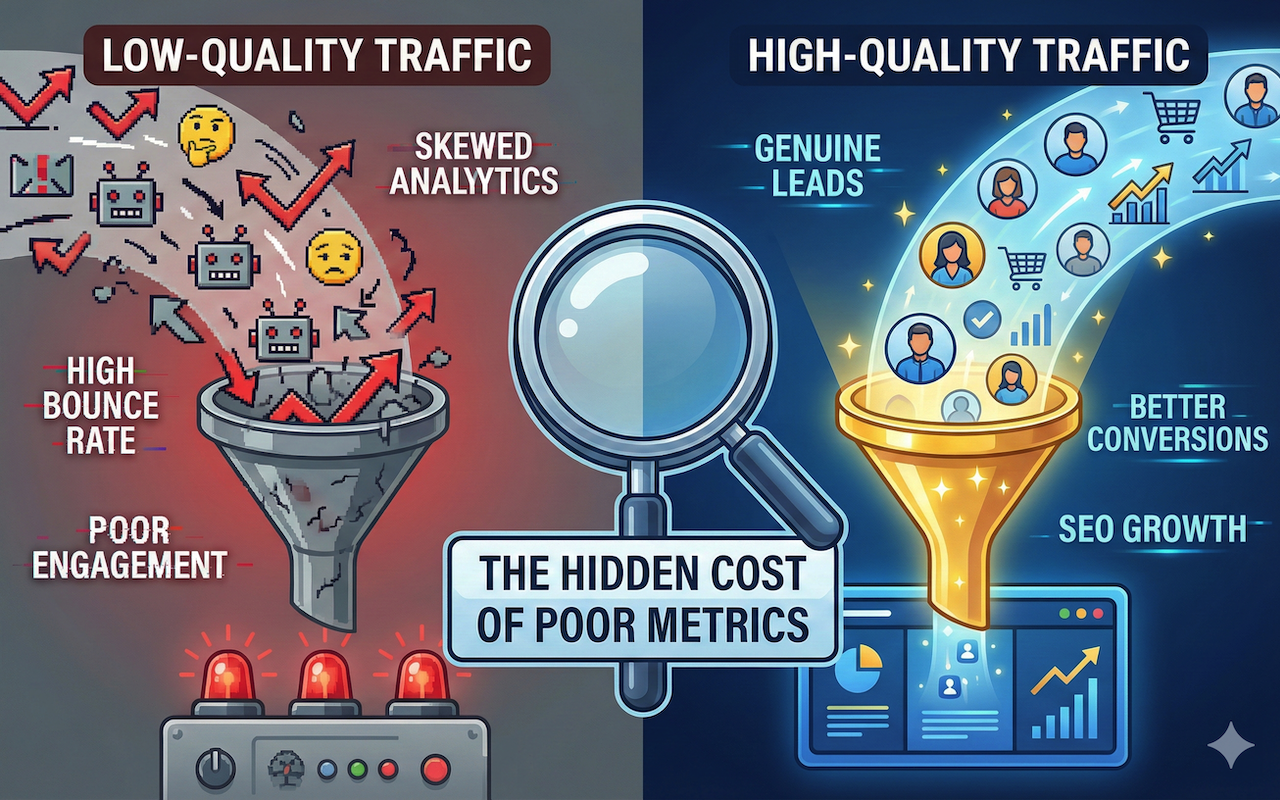
In the digital marketing environment, traffic may seem like the end game. Marketers and website owners rejoice when many people visit the site, assuming that the more visitors they have, the more successful they are. The traffic is not created equal, though. Poor traffic—such as visitors who are uninterested, unengaged, or automated—can cause significant harm to your website metrics. The effects are important for understanding that leads to improved website performance and real growth.
What Is Low-Quality Traffic?
Low-quality traffic is the traffic that gives minimal or no real value to your site. These may include automated bots, unintentional clicks, irrelevant geographic locations, or people who exit shortly after viewing your content. Low-quality traffic can increase the number of visitors, whereas high-quality traffic can interact with your site, read your materials, or count as leads or sales.
The Effect on Engagement Measures
Engagement metrics are an important measurement of the quality of the reverberation of your content. The user behavior metrics include average time spent per session, number of pages visited per session, and bounce rate, which assist the marketer in evaluating the effectiveness of the content. These measures may be distorted when the traffic on your site is low-quality. Poor user engagement can be indicated by high bounce rates and very short session durations, which are detectable by both you and search engines. This complicates the task of measuring content performance and makes effective marketing decisions more difficult.
Effect on Conversion Rates
The ultimate aim of most websites is conversions, be it making a purchase, subscribing to a newsletter, or downloading a resource. Poor traffic will hardly convert, and such traffic may reduce your overall conversion rate. Although you might get high traffic, the percentage of visitors who take significant actions might decrease, and the performance report will no longer be accurate. In the long run, this may render it difficult to know which marketing campaigns are actually working.
SEO Performance Impact
User behavior is a ranking factor of search engine optimization (SEO). Dwell time, bounce rate, and user interaction are metrics that search engines such as Google consider when evaluating the relevance and quality of a web page. A site flooded with poor traffic may exhibit high bounce rates and low interaction indicators, which may damage search rankings. That is, the emphasis on quantity rather than quality may negatively affect organic visibility and inhibit long-term development.
Faulty Analytics and Decision Making
Proper data would be required to make effective marketing choices. Low-quality traffic may distort the analytics report, leading the marketer to make incorrect inferences about audience behavior and the effectiveness of the campaigns. For example, you can make a wrong investment in channels that seem to generate traffic, only to find the users are irrelevant and disengaged. Such a misunderstanding may lead to the wastage of resources and the loss of the opportunity to find the actual interest.
Plans to Find and Eliminate Low-Quality Traffic
Traffic constitutes one of the most negative aspects that should be reduced by starting with detecting the traffic. The detection of metrics such as an atypical high bounce rate, short sessions, and unusual geographical traffic patterns may indicate problematic visitors. The number of visitors with low values can also be lowered by filtering analytics and adding CAPTCHA or other authentication tools. When targeted marketing campaigns and high-quality referral sources are given attention, it is guaranteed that your website will attract visitors who are genuinely interested in your content and what you offer.
Conclusion
Poor traffic may end up being very detrimental to the metrics of your website, including engagement, conversions, SEO, and even the general accuracy of analytics. It is essential to focus on quality rather than quantity when building a site that delivers significant outcomes. Accurate analytics, with a precise representation of actual user behavior, is enabled by identifying and mitigating low-value traffic to enhance marketers' informed decision-making and sustainable growth. Knowing the difference between traffic with high quality and low quality is the initial measure in designing a site that creates actual value and sustainability in the long run.
Featured Image generated by Google Gemini.
Share this post
Author

Read the latest articles from Ryan Jason
The Hidden Power of Packaging in Tech Product Success

November 14, 2025
In today’s tech world, packaging is far more than a simple protective cover. It plays a major role in marketing, shaping brand perception, and influencing how customers feel about a product before they even use it. The way an electronic device is presented can be powerful enough to impact buying decisio [...]
Learn moreThe Role of AI in Shaping the Future of Digital Marketing

September 30, 2025
AI is no longer just a buzzword in the technology community; it has become the foundation of modern digital marketing efforts. From personalized recommendations to automated customer service, AI is transforming how brands discover, engage with, and retain customers online. As user expectations continue to rise, o [...]
Learn moreLeave a comment
All comments are moderated. Spammy and bot submitted comments are deleted. Please submit the comments that are helpful to others, and we'll approve your comments. A comment that includes outbound link will only be approved if the content is relevant to the topic, and has some value to our readers.
Comments (0)
No comment