
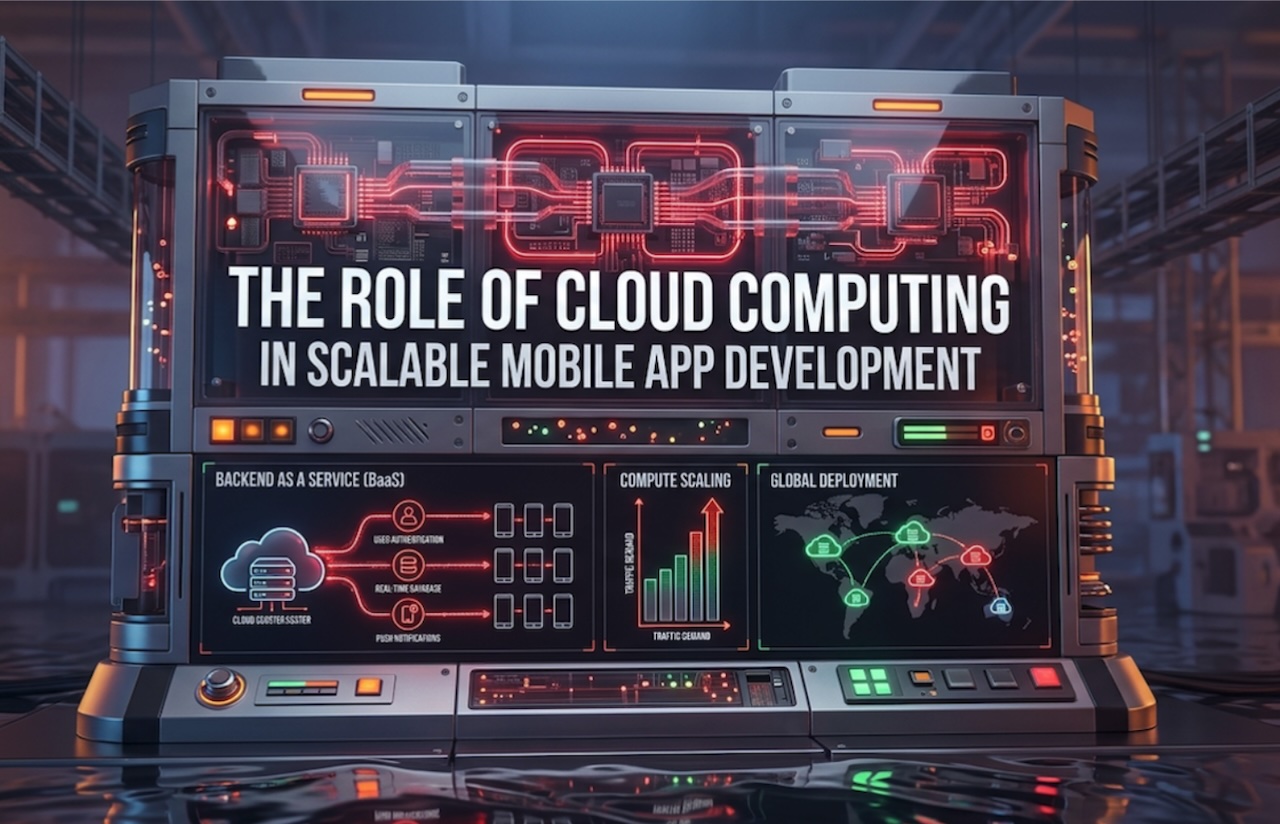
Just imagine: Your mobile app going viral overnight, thousands of users signing up every second, data streaming like a digital tsunami, and expectations reaching sky high. Sounds fun, right? But it's all useless without the right foundation. A faulty foundation can lead to big losses in the future.
That’s where cloud computing comes into play. It is the app’s secret weapon, handling massive traffic, scaling efficiently, and keeping performance smooth. In today’s post, we will discuss the role of cloud computing in scalable mobile app development and understand why it’s the engine behind truly scalable mobile app success.
What Do You Know About Cloud Computing Architecture?
Cloud computing is the backbone of modern digital applications. They combine frontend and backend components to provide services over th internet. It gives businesses access to scalable, on-demand resources without managing physical infrastructure. Let’s look at the types of cloud architecture and how they work: cloud computing is the backbone of modern digital applications.
1. Public Cloud Architecture
Public cloud is a computing model operated by third-party providers, such as Google Cloud Platform, that share resources across multiple users.
- It is cost-effective and highly scalable
- Public Cloud is ideal for startups and growing applications
- You need no infrastructure management
2. Private Cloud
A private cloud is among the dedicated computing environments where a single organization uses its hardware and software resources. It offers enhanced control and security. Companies often use solutions from Microsoft Azure for private deployments.
- High data security and customization
- Suitable for enterprises with strict compliance needs
- Greater control over infrastructure
3. Hybrid Cloud
As the name suggests, the hybrid cloud is an infrastructure that combines public and private cloud computing solutions and on-premises systems into a single, flexible, and secure system.
- It allows flexible workload management
- Optimized performance and cost
- Ideal for businesses with dynamic requirements
What are the Key Benefits of Cloud Computing in Mobile App Development?
Cloud computing enables scalable, high-performing app development. Cloud computing enables companies to develop high-performing programs, save costs, and improve user experience. These are the advantages of cloud computing for contemporary mobile applications.
1. Demand-driven Scalability
According to the web development company, scalability is essential for mobile apps. They can quickly scale up or down resources in response to demand thanks to cloud apps. It guarantees that the system runs efficiently during times of heavy traffic without charging extra fees for capacity not used.
2. Cost-Efficiency
Cloud computing reduces the cost of development (upfront costs) for startups and bigger companies. Thy offers pay-as-you-go pricing, eliminating hardware costs and minimizing maintenance costs.
3. Faster Time-to-Market
Cloud services quicken development and deployment by providing pre-made infrastructure and tools. ready-made APIs, backend services, ongoing integration, and deployment tools are provided by platforms such as Google Cloud Platform.
4. Global Accessibility
Global accessibility is one of the major benefits. The design of Cloud makes apps accessible for global users with less latency. It offers seamless user experience for various devices and locations.
Role of Cloud Computing in Mobile App Development
Curious to know why cloud computing matters in mobile app development? You’re not alone. Read the following points to understand the crucial role Cloud plays in developing mobile applications.
1. Smooth Flexibility and Scalability
In order to manage expanding user bases without raising upfront hardware costs, Cloud uses pay-as-you-go models in the app. It is a flexible approach that provides continuous performance and efficient use of resources.
- It manages an abrupt spike in traffic.
- It continues to operate consistently.
- Clouds quickly adjust to the influx of users.
2. Economic Development
You don't require costly infrastructure or hardware while using cloud services. Physical servers, data centers, and maintenance staff are not necessary for businesses. It lowers both initial and ongoing expenditures.
- Pay-as-you-go pricing structure
- Lower operating expenses
- Perfect for both businesses and startups
3. Quicker Development and Implementation
Pre-built tools are used by cloud providers such as Google Cloud Platform to fasten up the development. Experts can use serverless computing, pre-made databases, authentication methods, and APIs to construct apps faster.
- Backend services that are already built
- Pipelines for CI/CD for rapid releases
- Shorter time to market
4. Improved Data Management and Storage
Massive amounts of both organized and unstructured data may be stored securely and scalably thanks to cloud computing. It enables applications to effectively store user information, media files, and transactions while guaranteeing simple retrieval.
- Organize and store big datasets.
- Make real-time data access possible.
- Make backup and recovery easier.
5. Enhanced Performance of the App
Applications can function well on devices with less processing capacity by shifting complicated operations, like AI processing or heavy graphics, to the Cloud. It enables applications to effectively store user information, media files, and transactions while guaranteeing simple retrieval.
- Load balancing to ensure seamless operations
- Quicker response times for apps
- Improved user experience in all areas
6. Strong Security Protocols
In the event that a device is lost or hacked, user data is safeguarded by server-side data backups, user authentication, and security procedures. Data encryption, firewalls, multi-factor authentication, and identity access management are some of the security mechanisms.
- Data security and encryption
- Safe methods of authenticating
- adherence to industry norms
7. Updates and Sync in Real Time
Cloud computing offers real-time data sync across multiple platforms and devices. It is crucial for apps that need real-time data updates, such as banking, gaming, and messaging apps.
- Real-time data updates.
- A smooth user experience
- Push alerts.
8. Simple Third-Party Service Integration
Cloud platforms make it easier to add third-party services and APIs. It improves how the app functions. Besides that, it reduces development time and efforts while increasing the app's capabilities.
- Gateways for payments
- Logins to social media
- Tools for monitoring and analytics
9. Support for Advanced Technologies
Cloud computing lets apps use cutting-edge tools and technologies such as machine learning, AI, and the Internet of Things. Using these platforms, developers can build intelligent, self-regulating, and data-driven applications that enhance user experience and innovation.
- Artificial Intelligence (AI)
- Machine Learning (ML)
- Internet of Things (IoT)
10. Backup and Disaster Recovery
Cloud platforms like Amazon Web Services keep your app data safe by automatically saving backups. It also helps with data recovery if something goes wrong, ensuring smooth and flawless performance. It reduces the risk of data loss and keeps your app running reliably at all times.
- Minimal data loss with frequent backups
- Quick recovery during unexpected failures
- High reliability for uninterrupted app performance
Most Used Cloud Service Models for Mobile App Development
Cloud service models specify how developers offer mobile app development services and create and maintain mobile applications. Each og the models given below offers different ranges of flexibility and control.
1. Infrastructure as a Service (IaaS)
Over the internet, IaaS provides virtual computing resources. It may include servers, storage, and networking. Platforms such as Amazon Web Services provide complete IaaS.
- Total command over setups and servers
- Perfect for unique app designs
- Scalable with ease for expanding user bases
2. PaaS, or platform as a service
With PaaS, developers are able to create, test, and launch apps in a flexible environment. They don't have to worry about the maintenance of infrastructure. It works well for developers who focus on writing and app functions over infrastructure management.
- Using pre-built frameworks
- No requirement to maintain databases
- Simplified deployment procedure
3. Software as a Service (SaaS)
Through browsers or apps, users can access fully working apps that are delivered over the internet by SaaS. Best for companies looking for pre-made solutions, such as CRM and analytics.
- Software solutions that are ready to use
- Simple mobile app integration
- Very little setup and upkeep
What are the Most Popular Cloud Platforms for Creating Mobile Apps?
Choosing the best platform is crucial for performance, speed, and scalability while developing a mobile application. The following are the most widely utilized choices among developers worldwide:
1. AWS, or Amazon Web Services
AWS is among the most trusted and used web services. It provides databases, processing, storage, and AI technologies, among other things. Apps can manage heavy traffic and provide quick performance to users anywhere in the world, thanks to AWS's global infrastructure.
2. Azure from Microsoft
Azure offers adaptable solutions for enterprise and hybrid apps. It is perfect for sensitive data or intricate workflow handling. why? because it connects with Microsoft products like Office 365. It also has strong security and supports AI and analytics technologies.
3. Google Cloud Platform, or GCP
When it comes to clever and data-driven apps, GCP shines. It offers serverless computing, AI, and machine learning capabilities. Applications developed on GCP are extremely responsive and interactive because of Google's worldwide network and real-time data processing capabilities.
Conclusion
With cloud computing, you can develop scalable, high-performance, cost-effective, and adaptable mobile apps. From enabling on-demand scalability and faster deployment to strengthening security and supporting advanced technologies, the cloud provides the infrastructure that modern mobile apps depend on to succeed.
By leveraging the right cloud architecture and service models, businesses can build applications that are not only resilient and high-performing but also adaptable to future demands. Whether it’s managing traffic spikes, integrating AI capabilities, or ensuring real-time data synchronization, cloud computing empowers developers to focus on innovation rather than limitations.
As mobile ecosystems continue to evolve, organizations that embrace cloud-driven development will be better positioned to deliver seamless user experiences, maintain operational efficiency, and scale confidently in an increasingly competitive digital landscape.
Share this post
Leave a comment
All comments are moderated. Spammy and bot submitted comments are deleted. Please submit the comments that are helpful to others, and we'll approve your comments. A comment that includes outbound link will only be approved if the content is relevant to the topic, and has some value to our readers.
Comments (0)
No comment