
| Anand Subramanian | Business
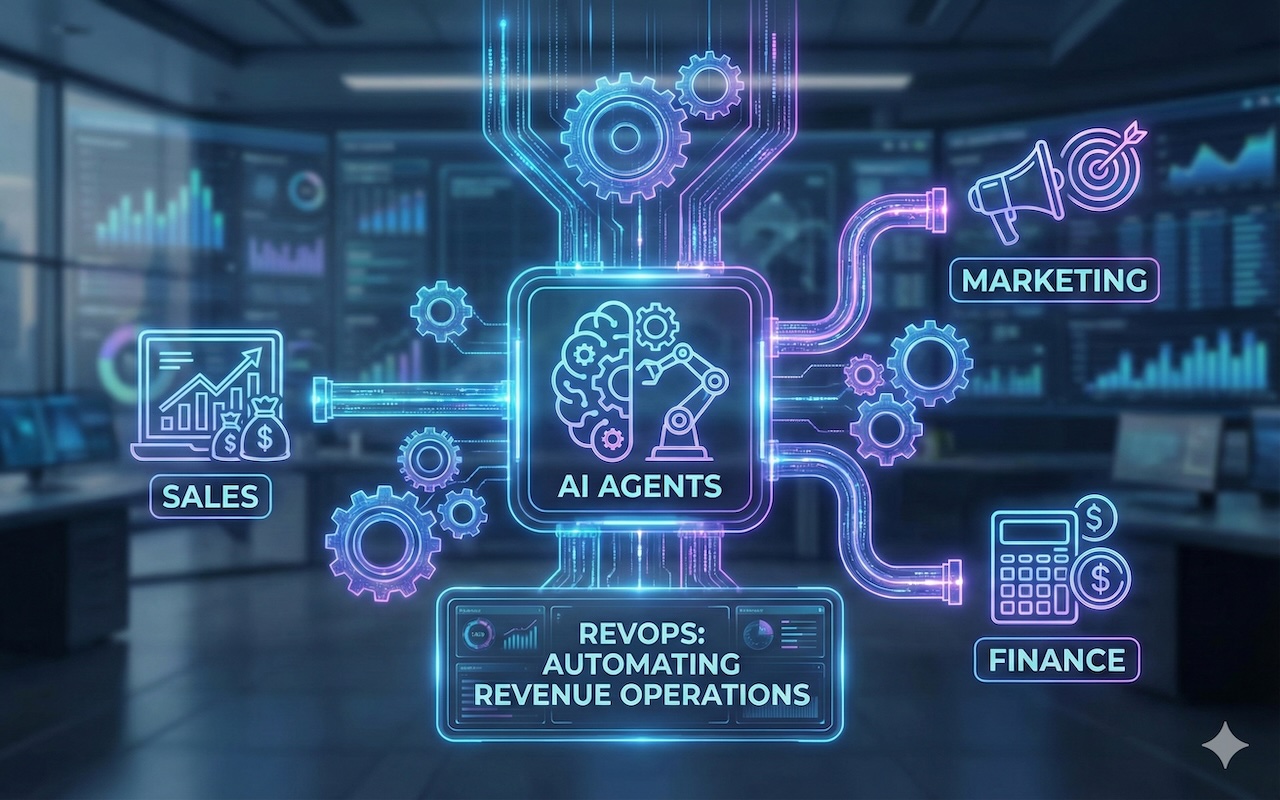
Revenue Operations (RevOps) was developed to address a core business challenge: misalignment between Sales, Marketing, and Finance. While the RevOps model improved visibility and coordination, most teams still rely heavily on dashboards, manual handoffs, and reactive decision-making.
This model is now evolving with the introduction of AI agents.
Instead of analyzing revenue data after outcomes occur, AI agents actively manage revenue processes, deliver real-time recommendations, and initiate actions across the entire revenue engine. This shift is transforming RevOps from a reporting function into a continuous optimization system.
This article explains what AI agents are in RevOps, how they automate sales, marketing, and finance workflows, key use cases, an implementation roadmap, and why AI-agent-led RevOps is becoming a competitive advantage.
What Are AI Agents for RevOps?
AI agents for RevOps are autonomous, goal-driven systems designed to continuously manage and optimize revenue operations.
Unlike traditional analytics platforms or AI copilots, these agents monitor revenue data in real time, understand context across multiple systems, and take or recommend actions without constant human input.
AI agents for RevOps typically monitor CRM, marketing automation, and finance systems continuously; understand revenue context across tools such as Salesforce, HubSpot, Marketo, NetSuite, and Stripe; trigger workflows and alerts automatically; and learn from outcomes to improve decisions over time.
By operating 24/7 across systems, AI agents eliminate delays and organizational silos that slow traditional RevOps teams.

Why Traditional RevOps Breaks at Scale
As organizations grow, even mature RevOps teams face increasing challenges. Forecasts become outdated quickly, lead scoring models fail to reflect real buyer behavior, revenue numbers diverge between Sales and Finance, and manual handoffs slow execution.
Most importantly, decision-making remains reactive. Dashboards explain what already happened, while AI agents help determine what should happen next.
As revenue complexity increases, human-driven analysis struggles to keep up. This is where AI-powered RevOps automation becomes essential.
How AI Agents Automate the RevOps Lifecycle
AI agents introduce intelligence and automation across every stage of the revenue lifecycle, beginning with sales operations.
AI Agents in Sales Operations
Sales-focused AI agents continuously monitor pipeline health and deal progression. Instead of periodic reviews, they identify risks and opportunities as they emerge.
These agents can predict deal slippage before it occurs, reassign leads in real time based on conversion probability, recommend next-best actions for sales representatives, and continuously update revenue forecasts.
For example, if an AI agent detects that deals in a specific industry are stalling mid-funnel, it can alert RevOps leaders, adjust forecast confidence, and recommend pricing or messaging changes without waiting for a manual review.
AI Agents in Marketing Operations
Marketing operations benefit from AI agents that directly connect campaign performance to revenue outcomes.
Instead of static lead scoring rules, AI agents dynamically rescore leads based on real behavioral data and downstream revenue impact. They optimize campaign spend using live pipeline insights, identify channels that generate actual revenue rather than just leads, and surface attribution gaps automatically.
In practice, an AI agent can pause underperforming paid campaigns and reallocate budget toward higher-converting channels in real time, eliminating the need for weekly or monthly reviews.
Finance and Revenue Intelligence AI Agents
Finance-focused AI agents prioritize accuracy, reconciliation, and risk reduction.
These agents automatically reconcile CRM, billing, and revenue recognition data, detect revenue leakage or pricing inconsistencies, and improve forecast accuracy by combining sales behavior with historical financial trends.
For example, an AI agent may identify discrepancies between booked and invoiced revenue, trace the root cause, and alert finance teams well before the close process, reducing last-minute surprises.
The Power of Multi-Agent AI Systems in RevOps
The true transformation occurs when multiple AI agents work together.
A mature AI-driven RevOps system includes Sales, Marketing, and Finance agents that share insights through a coordinating RevOps orchestration agent. This orchestration layer resolves conflicts, aligns decisions, and optimizes revenue across the entire lifecycle rather than within isolated stages.
This multi-agent collaboration enables fully automated, context-aware RevOps decision-making.
High-Impact RevOps Use Cases Powered by AI Agents
AI agents deliver measurable value across RevOps, including continuous forecast updates, real-time lead prioritization, deal risk detection, multi-touch revenue attribution, pricing and discount optimization, automated revenue leakage detection, and improved go-to-market alignment.
These capabilities elevate RevOps from operational support to a revenue intelligence leadership function.
AI Agents vs Traditional RevOps Tools
Traditional RevOps tools depend on manual analysis, periodic updates, and human-led optimization. AI agents, in contrast, operate autonomously, update insights in real time, optimize continuously, unify cross-functional context, and scale alongside revenue complexity.
This distinction is driving enterprise teams to move beyond dashboards toward agentic AI-driven RevOps systems.
Implementing AI Agents in RevOps: A Practical Roadmap
Successful implementation should be gradual to reduce risk and encourage adoption.
The foundation stage focuses on unifying CRM, marketing automation, and finance systems, defining core revenue KPIs, and identifying high-impact workflows.
The pilot stage introduces AI agents for specific use cases such as forecasting or lead scoring, with humans remaining in the loop while accuracy and impact are measured.
The scaling phase expands multi-agent coordination, automates actions rather than insights alone, and continuously retrains agents as revenue patterns evolve.
Regulation, Safety, and Trust in AI-Driven RevOps
Enterprise AI agents must be built with governance in mind.
This includes complete audit trails, explainable recommendations, role-based access controls, human override mechanisms, and compliance with regulations such as SOX, GDPR, and SOC 2. Without proper governance, AI can increase organizational risk rather than reduce it.
Why AI Agents Are the Future of RevOps
RevOps is no longer just an operational layer. It is becoming a real-time revenue intelligence system.
Organizations adopting AI-agent-led RevOps report improved forecast accuracy, shorter deal cycles, stronger go-to-market alignment, reduced revenue leakage, and increased confidence across both finance and revenue leadership.
AI-agent-driven RevOps is no longer a future concept. It is rapidly becoming a competitive necessity.
Author

Anand Subramanian

0 Comments
Comments are moderated to keep the discussion useful and respectful. Spam, automated submissions, and low-value promotional comments are removed.
Leave a Comment