
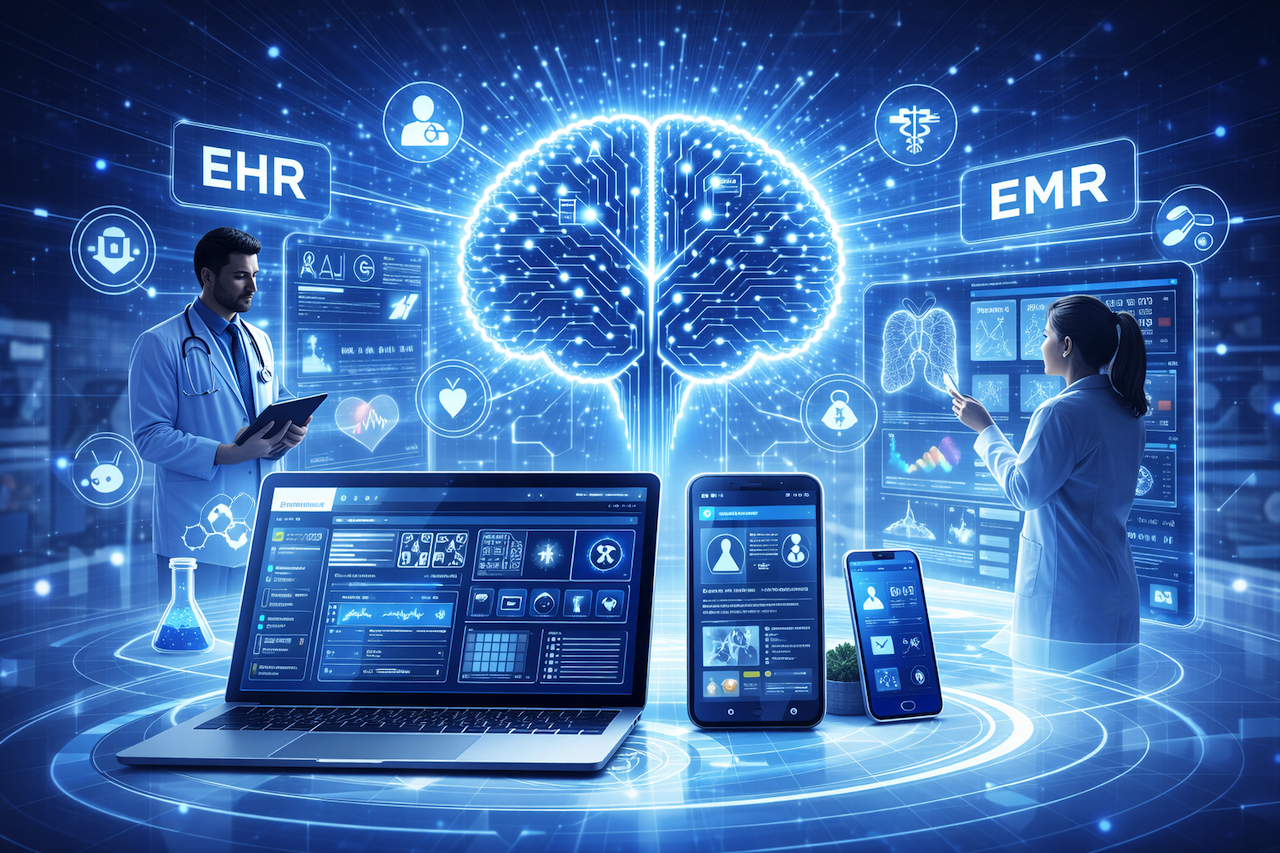
Electronic Health Records (EHRs) were introduced to digitize patient data and improve care coordination. Traditional EHR systems face difficulties because they receive excessive data that requires manual entry, users experience fatigue, and the system provides limited useful information.
Artificial Intelligence (AI) is changing how EHR and EMR systems function. AI-powered EHRs have evolved from their previous role as data storage systems into intelligent platforms that support clinicians, improve operational efficiency, and enhance patient care outcomes.
The following section presents the main advantages that AI brings to EHR and EMR systems through two elements: direct inquiry and short, summarized statements.
What Does AI Bring to Modern EHR and EMR Systems?
AI improvements in EHR and EMR through intelligent features that provide automated functions and predictive tools.
- The system employs machine learning, natural language processing (NLP), and predictive analytics in its operations.
- The process evaluates both organized and disorganized medical information.
- The system transforms basic medical information into practical medical insights.
- The system enables healthcare professionals to make immediate medical and administrative choices.
- The transformation process enables healthcare organizations to realize the full value of their digital health records.
How Does AI Improve Clinical Decision-Making?

Image generated by ChatGPT.
AI in EHR and EMR provides clinicians with research-based information that they can use to make decisions at the treatment location.
- The system evaluates the patient's medical background, laboratory results, medication records, and physician documentation.
- Discovers unusual patterns that might indicate medical conditions.
- It detects both drug–drug interactions and allergy dangers.
- The system provides treatment recommendations based on scientific evidence.
- The system enables medical professionals to identify diagnosis errors while maintaining their clinical decision-making ability.
Can AI Reduce Physician Burnout and Documentation Load?
The operational requirements that healthcare professionals must meet to complete their work pose a significant risk of burnout. The system employs voice recognition and natural language processing (NLP) to automate clinical documentation.
- Takes physician-patient dialogue and transforms it into organized medical documentation.
- It reduces the time required for healthcare professionals to complete manual data-entry tasks.
- It enables healthcare workers to achieve a better balance between professional and personal life.
- AI reduces administrative tasks, thereby enabling medical professionals to devote more time to patient care.
How Does AI Improve Data Accuracy and Consistency?
The healthcare system needs accurate data to deliver safe and effective medical services to patients. The system identifies patient record issues, including missing records, duplicate entries, and inconsistent records.
- It establishes standardized medical terminology together with coding systems.
- Detects unusual activities in addition to possible mistakes that may occur during data entry.
- It provides increased reliability across departments and systems.
- Organizations can achieve better healthcare outcomes and regulatory compliance through improved data quality.
Can AI Predict Health Risks Before They Escalate?
The most significant advantage of AI for EHR systems comes from its ability to perform predictive analytics. The system identifies patients at risk of readmission or developing new medical problems.
- AI in EHR and EMR uses historical data to predict future disease progression.
- Allows medical professionals to initiate treatment before symptoms appear, while implementing measures to protect patients from adverse health outcomes.
- Enables hospitals to identify patient health problems in their early stages, resulting in better treatment outcomes and fewer hospital admissions.
How Does AI Enable Personalized Patient Care?
AI enables healthcare providers to develop customized treatment programs that address each patient's specific requirements. The system examines patient demographic information, medical background, current health conditions, and genetic information.
- Generates customized treatment plans that include specific drugs for each patient.
- It develops customized health protection measures that match the patient's specific needs.
- It increases patient participation in treatment, resulting in better treatment outcomes.
- Personalized care increases treatment effectiveness and patient satisfaction.
Can AI Solve Interoperability Challenges in Healthcare?
Healthcare data is stored in separate systems that organizations use for their operations. The system creates standardized data elements that enable different EHR systems to meet their data requirements.
- Transforms unstructured data into formats suitable for analysis.
- It enables healthcare organizations to share information without restrictions.
- It helps eliminate unnecessary medical tests and procedures that doctors prescribe to patients.
- The healthcare system improves patient care through enhanced data exchange among healthcare providers.
How Does AI Support Population Health Management?
Population health requires insights that can be obtained through data analysis at multiple scales.
- It identifies patient groups at the highest risk of developing severe medical conditions.
- It monitors both disease development and changes in health patterns over time.
- Assists projects that aim to reduce health problems through preventive care.
- Enables public health organizations to develop their strategies through data analysis.
- Healthcare organizations use AI-powered EHR systems to transition from traditional care models to value-based care.
Can AI Improve Medical Coding and Billing Accuracy?
The research investigates whether artificial intelligence can enhance the precision of medical coding and billing. Billing problems pose two significant financial risks for businesses, resulting in lost income and rejected insurance claims.
- Extracts essential information from clinical documentation through automated processes.
- It generates medical codes through automated medical code assignment.
- Uses automated coding procedures to achieve better results than manual coding methods.
- The system processes payments more quickly than conventional methods.
- Better revenue cycle management, together with lower administrative expenses, leads to improved financial results.
How Does AI Enhance the Patient Experience?
The implementation of AI in EHR and EMR systems results in improved patient accessibility and enhanced patient engagement.
- The system delivers customized appointment notifications to users based on their individual needs.
- The platform provides users with straightforward methods to access their medical records, including laboratory results.
- The system employs chatbots together with virtual assistants to address common user inquiries.
- The system promotes treatment plan compliance through its design.
- Patients who actively participate in their healthcare process are more likely to achieve improved health outcomes.
Can AI Strengthen EHR Security and Compliance?
The healthcare organization considers patient data protection its highest priority. The system monitors primary system operations to detect any abnormal user access activities.
- Operates in real time to identify potential security breaches.
- It supports automated compliance auditing.
- The system prevents data misuse and unauthorized access to data by implementing security controls.
- Digital health systems enhance security through the use of artificial intelligence.
How Does AI Help Detect Clinical Errors Early?
Clinical errors can occur due to incomplete or conflicting data.
- Flags dosage discrepancies and contraindications.
- Identifies mismatches between diagnosis and treatment.
- Alerts clinicians before errors impact patient safety.
- Acts as a real-time clinical safety net.
- This reduces preventable harm and strengthens trust in healthcare systems.
Can AI Make EHR Systems Smarter Over Time?
The ability of AI in EHR and EMR to learn new information through their operational use distinguishes them from traditional EHR systems, which remain fixed in their current state.
- The recommendation system improves as it continues to gather additional information.
- The system maintains its ability to function through its continuous development of new knowledge about upcoming medical treatment standards.
- The system achieves a better understanding of its environment through its ongoing development.
- The system builds its operational capacity by integrating with existing business processes.
- The system will maintain its operational capability to provide effective service through its entire operational duration.
What Does the Future Hold for AI-Powered EHR Systems?
AI in EHR and EMR will expand its responsibilities across the healthcare sector.
- It provides continuous assessment of clinical risk through its real-time clinical risk scoring system.
- The system provides stronger integration capabilities for wearable devices and Internet of Things devices.
- Helps provide advanced decision-support tools.
- The system focuses on developing methods to identify health issues before they occur and to help people remain healthy.
- AI-powered EHR systems will serve as the foundation for future healthcare systems.
Conclusion
Artificial intelligence is transforming EHR and EMR systems from static record-keeping tools into intelligent platforms that actively support clinical care, operational efficiency, and patient engagement. By automating documentation, improving data accuracy, predicting health risks, and supporting personalized care, AI helps healthcare organizations extract real value from their digital health records.
At the same time, successful adoption depends on responsible implementation. Human oversight, strong data governance, and robust security controls remain essential to ensure that AI enhances decision-making without compromising trust, safety, or compliance.
As healthcare systems continue to evolve, AI-powered EHR and EMR platforms will play a central role in enabling proactive, data-driven care. Organizations that combine advanced technology with clinical expertise will be best positioned to improve outcomes while reducing administrative burden.
 FAQs
FAQs
The abbreviation AI in EHR systems denotes the implementation of machine learning and natural language processing technologies for automated patient data analysis, workflow automation, and clinical decision support.
An AI system detects potential dangers, flags clinical errors, and helps medical professionals take preventive measures, thereby reducing medical errors.
No. AI assists medical professionals in clinical decision-making by providing additional information while preserving human specialists’ ability to make decisions.
Yes. The security system benefits from AI because it monitors data in real time, detects anomalous activity, and provides automated support for compliance requirements.
The system requires a high initial investment, but organizations will save money in the long run due to improved efficiency, greater accuracy, and lower error rates.
Featured Image generated by ChatGPT.
Share this post
Leave a comment
All comments are moderated. Spammy and bot submitted comments are deleted. Please submit the comments that are helpful to others, and we'll approve your comments. A comment that includes outbound link will only be approved if the content is relevant to the topic, and has some value to our readers.
Comments (0)
No comment