
Quick Summary
AI automation is changing how organizations run day-to-day operations by improving workflow efficiency. This can reduce costs and support stronger ROI over time. By applying AI to routine processes, organizations can improve productivity, customer experience, and data-driven decision-making while staying scalable and resilient.
Key Takeaways
- Organizations save time and reduce errors by automating repetitive tasks.
- When routine work is automated, employees can spend more time on strategic and creative work, which can improve morale.
- AI-supported automation can surface insights that enable faster, better-informed decisions.
- AI-based tools can support faster and more personalized customer interactions at scale.
- AI automation can help organizations grow output and capabilities without increasing headcount at the same pace.
Speed, accuracy, and efficiency increasingly separate high-performing organizations from the rest. As a result, many teams are using AI automation to streamline workflows and improve ROI through smarter execution. Intelligent automation is not only a trend; it is becoming a practical requirement in competitive environments. By combining AI with automated workflows, organizations can reduce repetitive work, lower the likelihood of human error, and improve operational consistency. This article explains why AI automation matters for building smarter workflows and how it contributes to ROI.
What Is AI Automation for Business?
AI automation is the use of automation enhanced by artificial intelligence to handle tasks that previously required continuous human effort. These systems may use machine learning, natural language processing (NLP), and predictive analytics to analyze data, make decisions, and execute steps within a workflow with less manual intervention.
Unlike traditional automation—often limited to fixed “if-then” rules—AI-supported automation can adapt as data patterns and requirements change. Over time, it can become more accurate and more useful as it learns from outcomes, feedback, and context.
In practice, this can reduce manual workload while improving speed and consistency in common processes.
1. Reducing Operational Costs Through Smarter Workflows
One of the most visible impacts of AI automation is cost reduction through efficiency. Manual workflows such as data entry, scheduling, and repetitive validation are time-consuming and prone to error. Automating parts of these processes can reduce rework and prevent costly mistakes.
A common example is invoice processing. Automating invoice intake and reconciliation can reduce large amounts of manual effort, especially for organizations handling high invoice volume.
Another example is using automated routing for customer inquiries, where routine questions are categorized and handled quickly, allowing employees to focus on higher-value tasks. Over time, cost savings come not only from reduced labor hours but also from fewer errors and faster turnaround.
2. Enhancing Productivity and Employee Satisfaction
When repetitive tasks are reduced, employees can spend more time on work that benefits from judgment, creativity, and strategy. This often leads to stronger productivity because people are focused on high-impact activities rather than routine, repetitive tasks.
AI-driven workflow analysis can also identify bottlenecks and inefficiencies in how work moves through teams. This supports a feedback loop where processes improve continuously, and human expertise is applied where it matters most.
3. Accelerating Decision-Making With Data Insights
AI automation can improve decision-making by turning operational data into usable insight. Through real-time analytics, organizations can generate actionable recommendations, detect patterns, and respond to changes faster.
For example, predictive analytics can help teams anticipate customer behavior, optimize resource allocation, and adjust planning based on emerging trends. AI-enabled monitoring can also track key performance indicators (KPIs) and trigger alerts when metrics move outside expected ranges, enabling faster intervention when problems appear.
4. Improving Customer Experience Through Intelligent Automation
Customer expectations now include both speed and personalization. AI-driven automation can help scale customer interactions without sacrificing responsiveness.
AI chat systems can handle high volumes of questions simultaneously, respond instantly, and improve with ongoing use. Recommendation systems can tailor suggestions based on user behavior, which may improve engagement and conversion rates. Over time, better experiences often lead to stronger loyalty, and loyalty supports revenue stability and ROI.
5. Supporting Scalability and Resilience
As organizations grow, workflows become more complex and harder to manage manually. AI automation can help scale operations by handling routine workload increases and keeping processes consistent as volume rises.
Automation can also improve resilience during disruptions, such as sudden demand spikes or operational constraints. When core workflows can continue with fewer manual dependencies, organizations reduce downtime risk and maintain service continuity.
6. ROI of AI Automation in Practice
Many industries already use AI-supported automation in measurable ways:
- Finance teams: Automate reconciliation and reporting to shorten close cycles.
- Marketing teams: Automate segmentation and campaign refinement to improve performance.
- Support teams: Automate triage and responses for routine questions to handle high inquiry volumes efficiently.
These impacts are typically reflected in operational metrics such as faster cycle times, fewer errors, improved throughput, and reduced overhead—clear contributors to ROI.
Best Practices for Adopting AI Automation
To maximize long-term results, organizations benefit from a structured approach:
- Start small: Begin with workflows where automation can create the clearest impact.
- Prioritize data quality: AI depends on reliable data; cleaning and standardizing inputs improves outputs.
- Plan for integration: Automation is more effective when it fits naturally into existing tools and workflows.
- Review and optimize regularly: Measure performance, refine processes, and adjust as needs change.
Treat AI automation as an ongoing initiative rather than a one-time project to sustain improvement over time.
Conclusion: The Strategic Value of AI Automation
AI automation can improve workflow efficiency, support faster decision-making, enhance customer experiences, and reduce repetitive workload across teams. These benefits often translate into better ROI through lower operating costs, improved productivity, and more consistent execution.
As organizations adapt to a more data-driven economy, AI automation is becoming less about experimentation and more about operating intelligently at scale. With thoughtful implementation and continuous optimization, it can support long-term performance, agility, and growth.
 FAQs
FAQs
AI can improve ROI by reducing operational costs, decreasing errors, improving employee productivity, and supporting better customer experiences. These effects combine to improve efficiency and strengthen financial outcomes over time.
Yes. AI-supported automation can help scale workflows without requiring proportional increases in staffing, especially during peak workloads or rapid growth phases.
It reduces repetitive work so employees can focus on higher-value tasks that require judgment and creativity, often improving satisfaction and productivity.
In many cases, yes. AI systems can learn from new data and outcomes, allowing workflows to be refined over time as processes and needs evolve.
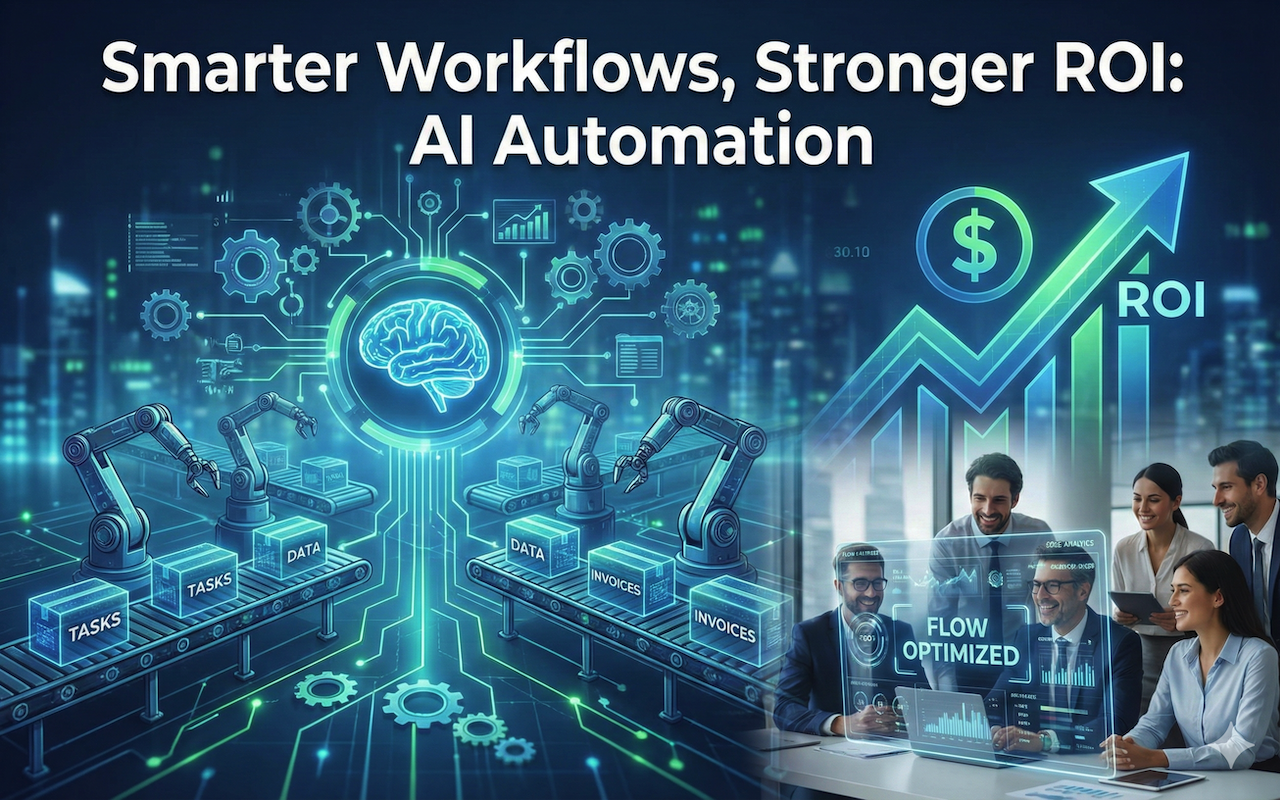
Featured Image generated by Google Gemini.
Share this post
Author

Leave a comment
All comments are moderated. Spammy and bot submitted comments are deleted. Please submit the comments that are helpful to others, and we'll approve your comments. A comment that includes outbound link will only be approved if the content is relevant to the topic, and has some value to our readers.
Comments (0)
No comment