
Customer Relationship Management (CRM) systems have come a long way beyond mere contact databases. In 2026, modern CRM solutions serve as intelligent business platforms that streamline sales, automate marketing, improve customer care, and provide predictive insights.
Today’s CRM platforms are expected to be scalable, AI-driven, cloud-based, and seamlessly integrated with broader digital ecosystems. As a result, many organizations adopt custom CRM software development approaches to tailor features, workflows, and integrations to their specific business processes while maintaining the flexibility to adapt to future changes.
This article explores the important technologies that drive the development of modern CRM systems.
Technologies Driving Development in Modern CRM
1. Cloud Computing
Cloud technology forms the foundation of modern CRM platforms. On-premise systems are gradually being replaced as organizations move toward cloud-based solutions because of their flexibility, scalability, and cost efficiency.
Why cloud matters in CRM:
- Accessibility from any device and location
- Real-time data synchronization
- Automatic updates and maintenance
- Reduced infrastructure costs
- Scalability to support business growth
Cloud-native CRM systems also enhance collaboration across departments. Sales, marketing, and customer support teams can access unified customer data, improving alignment and decision-making.
Common cloud platforms used in CRM development include AWS, Microsoft Azure, and Google Cloud. Cloud architecture allows CRM systems to remain flexible and capable of supporting growing customer data volumes without performance challenges.
2. Artificial Intelligence (AI) and Machine Learning (ML)
Artificial Intelligence has transformed CRM systems from reactive tools into predictive intelligence platforms.
AI-driven CRM capabilities:
- Predicting customer behavior
- Automated lead scoring
- Personalized marketing campaigns
- Churn detection
- Intelligent recommendations
Machine Learning applications analyze historical customer data to identify trends and recommend next-best actions.
AI chatbots are often integrated into CRM systems to automate interactions. These solutions:
- Handle routine customer inquiries
- Qualify leads
- Schedule appointments
- Provide real-time responses
AI-powered CRM improves efficiency, enhances personalization, increases customer satisfaction, and reduces operational workload.
3. Big Data and Advanced Analytics
Modern CRM platforms process large volumes of structured and unstructured customer data. Big data technologies help organizations turn this information into actionable insights.
Key capabilities include:
- Real-time dashboards and reporting
- Predictive sales forecasting
- Customer segmentation
- Behavioral pattern analysis
- Performance tracking
Advanced analytics tools convert raw data into visual insights, enabling faster and more informed decision-making. By combining data warehouses and analytics engines, CRM platforms support evidence-based strategies rather than assumptions.
4. API-First Architecture and Integrations
Most organizations rely on multiple digital tools, including ERP platforms, marketing automation, payment systems, and helpdesk software. CRM platforms must integrate seamlessly with these environments.
API-first architecture enables:
- Faster third-party integrations
- Secure data exchange
- Real-time synchronization
- Modular customization
Modern CRM systems are often built using microservices and RESTful APIs, ensuring flexibility and scalability.
5. Microservices Architecture
Microservices are gradually replacing monolithic CRM systems.
Benefits of microservices in CRM:
- Independent module development
- Faster updates and feature releases
- Improved scalability
- Reduced downtime
- Easier maintenance
Each CRM function, such as sales, analytics, marketing, and support, can operate independently while communicating through APIs. This approach makes CRM platforms more adaptable and future-ready.
6. Robotic Process Automation (RPA)
RPA automates repetitive workflows and improves operational efficiency.
Common automation tasks:
- Data entry
- Email follow-ups
- Lead assignment
- Report generation
- Workflow triggers
By reducing manual errors and saving time, RPA allows teams to focus on high-value activities such as relationship building and strategic planning.
When combined with AI, RPA enables intelligent automation that responds dynamically to customer behavior.
7. Omnichannel Communication Technology
Customers interact with brands across multiple channels, including email, chat, social media, phone, SMS, and websites. Modern CRM platforms unify these interactions into a single view.
Omnichannel CRM features:
- Centralized conversation tracking
- Social media integration
- Email automation
- Live chat
- SMS marketing
This ensures consistent messaging and provides a comprehensive customer profile.
8. Blockchain for Data Security
As data privacy and regulatory compliance become increasingly important, blockchain technology is emerging as a potential solution in CRM.
Benefits:
- Secure and transparent data storage
- Immutable audit trails
- Fraud prevention
- Enhanced trust
Industries such as finance, healthcare, and e-commerce benefit from blockchain-supported CRM environments.
9. Internet of Things (IoT) Integration
IoT enables CRM systems to collect data from connected devices.
Examples include:
- Smart appliances transmitting usage data
- Wearables updating health records
- Fleet management systems monitoring vehicle performance
IoT-driven CRM provides real-time insights and supports proactive customer service.
10. Low-Code and No-Code Development
Low-code and no-code tools accelerate CRM customization and deployment.
Benefits:
- Faster development cycles
- Lower costs
- Rapid workflow adjustments
- Greater accessibility for non-technical users
These platforms increase flexibility while supporting ongoing innovation.
11. Data Security and Compliance Technologies
Security remains a top priority in CRM environments.
Modern CRM systems typically include:
- End-to-end encryption
- Role-based access control
- Multi-factor authentication
- Data masking
- Compliance management
Regulations such as GDPR and HIPAA require secure handling of customer data, and these technologies help ensure trust and compliance.
12. Mobile-First and Progressive Web Applications (PWA)
Mobile-first CRM improves productivity and accessibility. Progressive Web Applications offer app-like experiences within browsers, enabling:
- Real-time updates
- Offline functionality
- Improved usability
- Faster decision-making
Mobile-first design supports adoption across teams.
13. Natural Language Processing (NLP)
NLP enhances customer interactions by analyzing language and intent.
Applications include:
- Sentiment analysis
- Email intent recognition
- Smart reply generation
- Voice-based CRM interactions
This technology improves communication and personalization.
14. Personalization Engines
Personalization tools enable CRM systems to deliver tailored customer experiences.
Examples:
- Personalized email campaigns
- Dynamic website content
- Product recommendations
- Targeted offers
By analyzing behavior and preferences, CRM platforms improve engagement, conversion rates, and loyalty.
The Future of CRM Technology
The future of CRM lies in hyper-personalized, predictive, and autonomous systems. Emerging trends include:
- Generative AI for automated content
- Revenue intelligence platforms
- Real-time predictive analytics
- Advanced customer journey orchestration
- Zero-trust security frameworks
As organizations become more data-driven, CRM platforms will continue evolving into intelligent decision-support systems.
Final Thoughts
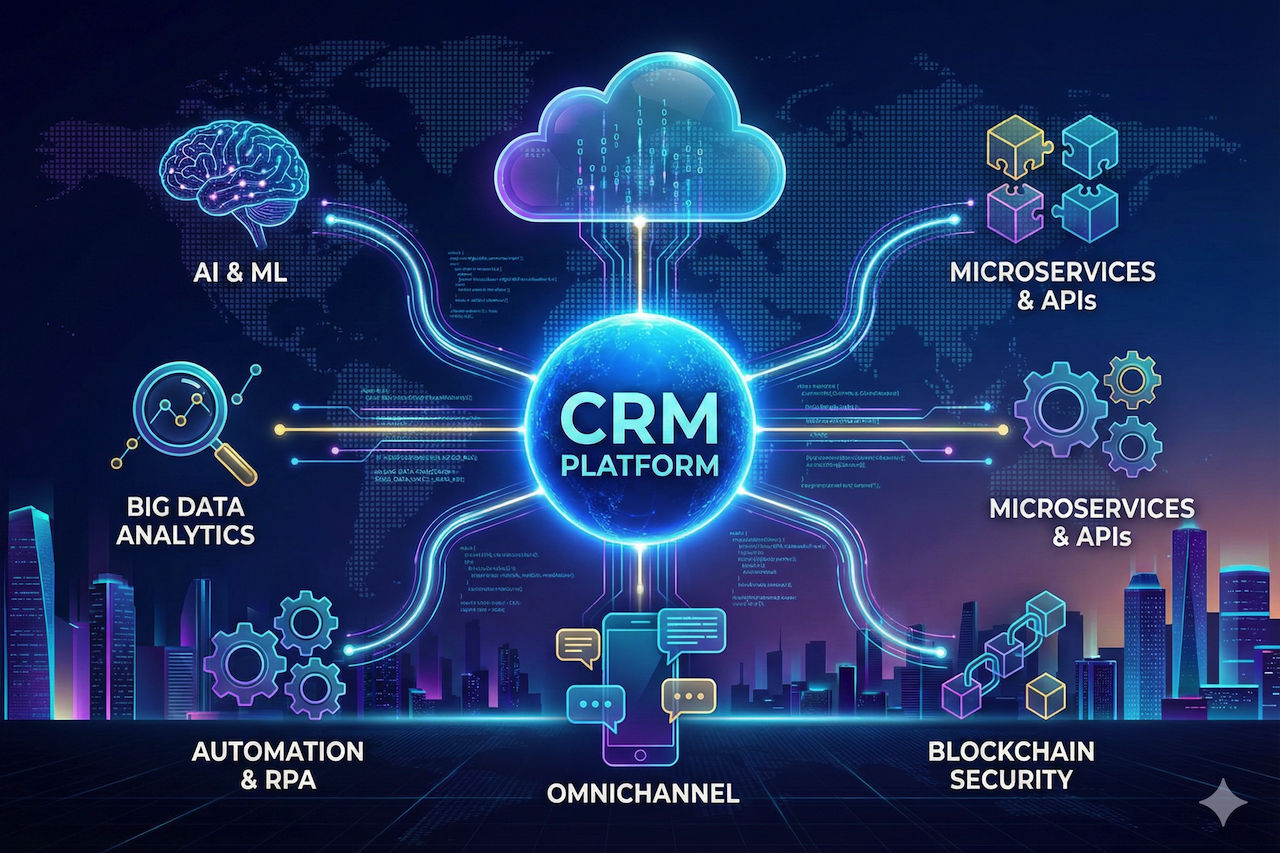
Modern CRM development is driven by the convergence of cloud computing, artificial intelligence, big data analytics, automation, security, and omnichannel communication. These technologies transform CRM platforms from simple record systems into strategic growth engines.
In 2026 and beyond, organizations that leverage advanced CRM technologies will gain a strong competitive advantage by improving customer experiences, increasing efficiency, and supporting long-term growth.
Featured Image generated by Google Gemini.
Share this post
Leave a comment
All comments are moderated. Spammy and bot submitted comments are deleted. Please submit the comments that are helpful to others, and we'll approve your comments. A comment that includes outbound link will only be approved if the content is relevant to the topic, and has some value to our readers.
Comments (0)
No comment