
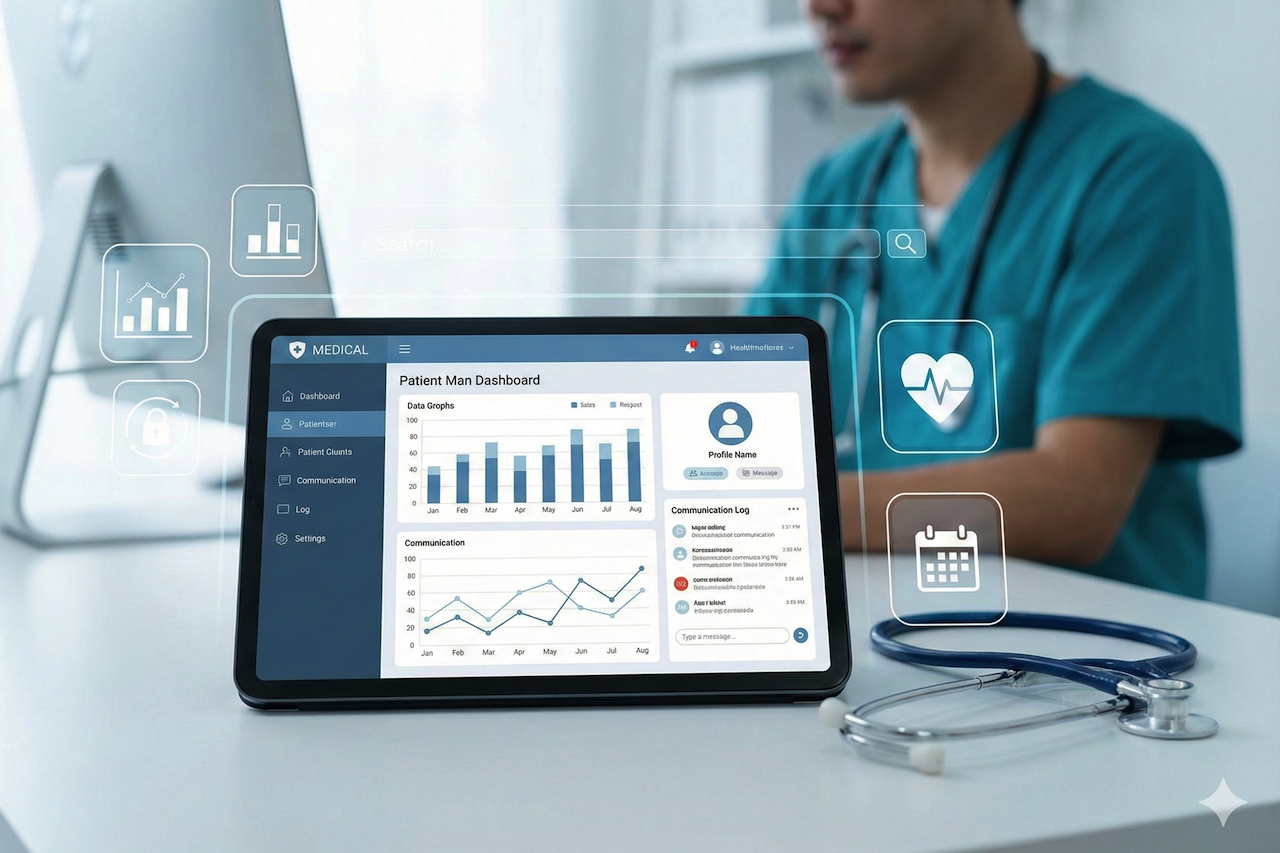
Healthcare organizations handle thousands of patient interactions each day. Medical facilities must organize appointments, follow-up visits, treatment plans, and communication records systematically to operate smoothly. As care delivery becomes more complex, many providers adopt patient relationship management systems to improve coordination, communication, and patient engagement.
The platform helps medical organizations centralize patient data, improve communication, and support care coordination. Many providers introduce these systems as part of broader digital health initiatives, often as part of healthcare software development efforts to ensure secure architecture, regulatory compliance, and long-term scalability. Unlike traditional business systems, these platforms are designed to support clinical workflows, protect sensitive medical information, and comply with healthcare regulations.
What Is Healthcare CRM Software?
A CRM software is a digital system that manages patient relationships across every stage of care. It securely stores patient profiles, communication records, appointment details, and engagement history in one centralized environment.
Unlike sales-focused systems that prioritize transactions, these platforms emphasize continuity of care. They help providers build lasting patient relationships while improving operational efficiency and maintaining regulatory compliance.
Types of Healthcare CRM Systems
CRM systems vary based on organizational structure and service models. Most solutions fall into three categories:
Operational
Operational systems support daily administrative and communication tasks. They handle appointment scheduling, reminders, follow-ups, and internal coordination. These tools reduce manual workload and improve response times.
Analytical
Analytical systems focus on data collection and reporting. They evaluate patient engagement, service utilization, and operational performance. Organizations use these insights to refine workflows and improve outcomes.
Collaborative
Collaborative systems enable information sharing between departments and care teams. They improve coordination among front-office staff, clinicians, and support services to ensure a consistent patient experience.
Many modern platforms combine features from all three types.
Key Features
The effectiveness of a system depends on selecting features that support both patient engagement and internal efficiency.
Patient Data Management
The system centralizes patient records, contact details, communication history, and treatment preferences. Unified data access reduces errors and improves service consistency.
Communication and Appointment Tools
Automated reminders, notifications, and follow-up messages are delivered via email, SMS, or patient portals. These tools reduce no-shows and enhance patient satisfaction.
Workflow and Task Automation
The platform manages referrals, follow-up activities, and care coordination processes. Automation helps ensure important tasks are not overlooked.
Integration With Healthcare Systems
Modern platforms integrate with EHR, billing, telemedicine, and laboratory systems. Seamless integration helps ensure accurate and real-time access to patient data.
Security and Compliance Controls
Security is essential in medical environments. Key controls typically include:
- Encryption: Protects data in transit and at rest.
- Role-based access control (RBAC): Limits data visibility based on user roles and responsibilities.
- Audit logs: Tracks activity for accountability and compliance monitoring.
These measures help organizations meet regulatory standards such as HIPAA and GDPR.
Implementation Considerations
Successfully introducing such a system requires careful planning and alignment with organizational needs.
Workflow Alignment
The platform should match existing clinical and administrative workflows rather than forcing teams to change processes unnecessarily.
User Experience
Interfaces must be intuitive and role-specific to support adoption among administrative staff and clinical professionals.
Integration Strategy
Seamless integration with existing medical software helps ensure accurate data flow and avoids duplication.
Ongoing Optimization
CRM systems benefit from continuous monitoring, updates, and refinements to adapt to regulatory changes and evolving patient expectations.
Custom vs Ready-Made Solutions
Organizations typically choose between ready-made platforms and tailored solutions.
Pre-built systems offer faster deployment and lower upfront costs but may limit customization. Tailored solutions provide greater flexibility and scalability, especially for organizations with complex operational needs.
The right choice depends on budget, regulatory requirements, workflow complexity, and long-term growth plans.
Benefits of CRM Systems
These platforms deliver measurable value across clinical and administrative functions. Key benefits include:
- Improved patient engagement and communication
- Better coordination among care teams
- Reduced administrative burden
- Increased operational transparency
- Support for data-driven decision-making
When implemented effectively, these systems improve efficiency and enhance the overall patient experience.
Challenges
Despite the benefits, organizations may encounter challenges such as:
- Complex data migration
- Integration difficulties
- User adoption resistance
- Ongoing compliance management
Addressing these challenges early improves implementation success and cost control.
Conclusion
These systems have become essential tools in modern medical operations. They help providers manage patient relationships more effectively while improving coordination, efficiency, and compliance.
As healthcare continues to digitize, CRM platforms will play a central role in strengthening patient engagement and supporting sustainable organizational growth.
Featured Image generated by Google Gemini.
Share this post
Author

Read the latest articles from Yuliya Melnik
Why Cloud Optimization Is Critical for SaaS Growth
June 10, 2026
Cloud infrastructure powers nearly every modern SaaS product. It offers the flexibility to launch quickly, expand across regions, and deliver services without relying on physical hardware. However, simply deploying a SaaS platform in the cloud does not automatically guarantee efficiency.
Learn moreThe Difference Between MVP and First Product Version: A Founder’s Guide
June 10, 2026
Many founders use the terms MVP and first product version almost interchangeably. But in reality, they represent two different stages of product development. An MVP (Minimum Viable Product) is used to validate a business idea with a small investment. The first product version follows that validation and o [...]
Learn moreLeave a comment
All comments are moderated. Spammy and bot submitted comments are deleted. Please submit the comments that are helpful to others, and we'll approve your comments. A comment that includes outbound link will only be approved if the content is relevant to the topic, and has some value to our readers.
Comments (0)
No comment