
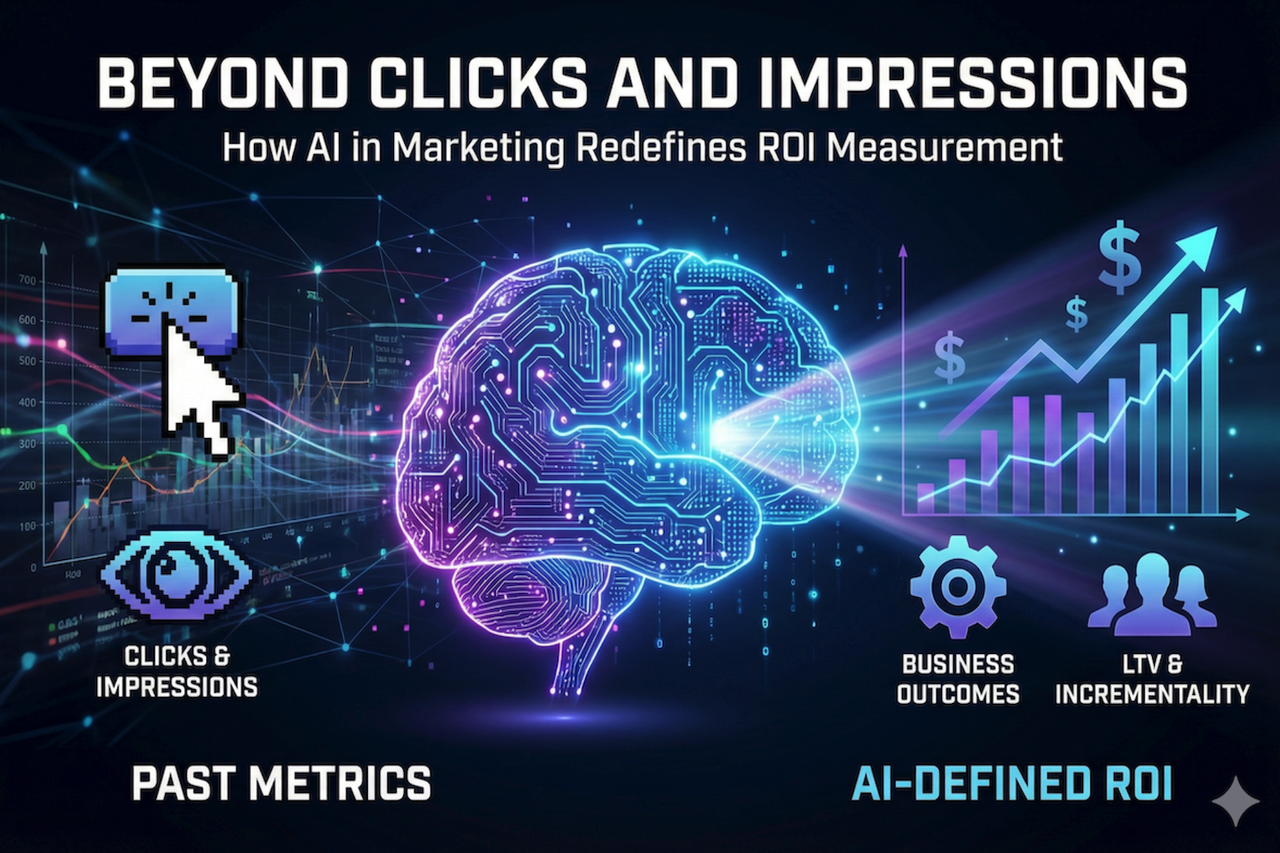
Marketing measurement is moving beyond surface-level indicators. Clicks and impressions remain useful, but artificial intelligence is shifting attention toward measurable business outcomes such as revenue growth, customer lifetime value, cost-to-serve, and true incrementality. Organizations that approach AI in marketing as a system for understanding outcomes, rather than simply a productivity aid, are better positioned to assess return on investment with greater confidence.
This article examines why this shift in measurement is happening now and how intelligence-driven marketing increasingly requires a more precise, outcome-focused approach to evaluating ROI.
Why Does the Shift Matter Now?
Adoption of AI across organizations accelerated rapidly in 2023–24, and its use is no longer limited to experimental projects. Industry surveys consistently show that a majority of organizations now use AI in at least one business function. As AI becomes embedded in everyday operations, including AI in marketing functions such as campaign optimization and customer analysis, it becomes essential to evaluate its impact through financial and causal lenses rather than relying solely on vanity metrics.
AI automates repetitive tasks—such as content drafting, audience segmentation, and bidding adjustments—allowing teams to reallocate time toward strategic and creative work. This change increases the need to understand whether automation and optimization translate into sustained, higher-margin outcomes.
What AI Changes About Measurement
Traditional digital metrics such as click-through rate, cost per thousand impressions, and raw impressions primarily reflect exposure and activity. AI alters several core assumptions behind how performance is measured.
- From proxy metrics to causal impact: AI enables scalable personalization, creative optimization, and predictive targeting. Measurement therefore shifts toward determining whether these changes produce incremental results, rather than simply coinciding with improved performance.
- From single-touch attribution to lifetime value: Marketing efforts increasingly influence extended customer journeys. Beyond first-touch or last-click conversions, ROI assessment must account for effects on customer lifetime value, retention, and repeat behavior.
- From static reporting to continuous experimentation: Because AI systems adapt over time, effective measurement depends on ongoing experimentation, including holdouts, automated A/B testing, and near-real-time lift analysis to validate changes.
Evidence That AI Influences Marketing Performance
Recent industry analyses suggest that AI-driven approaches can influence marketing effectiveness when applied deliberately. Independent reports have identified improvements in areas such as content quality, search visibility, and overall marketing ROI, with many organizations reporting higher ROI on content and search efforts after introducing AI capabilities.
Marketers using generative AI often report stronger content performance, indicating that AI can support both scale and effectiveness when paired with human oversight and editorial judgment.
Search behavior is also evolving. AI-driven answer experiences and automated summaries now appear in a growing share of queries, changing how visibility, and therefore value, is realized online.
In these environments, visibility may depend on being represented as a single authoritative source rather than one of many competing links. This shift requires new ways of measuring exposure and influence.
At the same time, researchers and practitioners caution that improved ROI is not automatic. Structured measurement, appropriate experimentation, and thoughtful scaling are what determine whether early gains translate into sustained business impact.
Practical Measurement Framework
Applying AI to ROI measurement benefits from a structured approach. A three-layer framework is commonly used to organize this effort:
Layer 1 — Foundation
Reliable measurement begins with clean, unified data. This includes consolidating first-party data, advertising signals, and CRM interactions into consistent identifiers. Without dependable inputs, analytical outputs become difficult to interpret.
Layer 2 — Signal Modeling
Attribution, uplift, and propensity models help translate activity into insight. Controlled experiments, such as A/B tests and holdouts, remain the most reliable methods where feasible. In cases where experimentation is impractical, causal inference techniques can provide additional context.
Layer 3 — Value Translation
Analytical outputs must ultimately be expressed in financial terms, such as incremental revenue, margin impact, or changes in customer lifetime value. This step allows insights to be evaluated in relation to broader business performance.
Together, these layers convert abstract signals into metrics suitable for executive decision-making, including adjusted acquisition costs, cohort-level lifetime value projections, and measured lift in incremental conversions.
Governance and Human Oversight
More advanced measurement systems can reveal deeper insights, but they also introduce risks such as bias, overfitting, or misinterpretation if left unchecked. As organizations expand their use of AI-driven automation, governance becomes increasingly important.
Effective oversight typically includes regular model validation, transparency around how key metrics are derived, and defined review processes. Maintaining human involvement in high-stakes decisions helps ensure that AI supports informed judgment rather than replacing it.
Common Pitfalls
- Measuring the wrong outcomes: Overreliance on exposure metrics such as CTR or impressions can obscure real impact. Metrics should be tied directly to business value.
- Using time horizons that are too short: The effects of AI-driven changes may emerge over months rather than weeks, particularly for retention and repeat behavior.
- Omitting holdouts or controls: Without randomized comparisons, claims of uplift remain uncertain. Experimental design is critical for credible measurement.
Conclusion
AI is reshaping how marketing performance is evaluated by shifting attention from activity-based indicators to measurable business outcomes. While evidence suggests that AI in marketing solutions can influence efficiency and effectiveness, sustained value depends on disciplined measurement, strong governance, and ongoing experimentation. Organizations that approach AI as a tool for understanding impact, rather than a shortcut to results, are better equipped to move beyond clicks and impressions toward ROI that can be clearly interpreted and trusted.
Featured Image generated by Google Gemini.
Share this post
Leave a comment
All comments are moderated. Spammy and bot submitted comments are deleted. Please submit the comments that are helpful to others, and we'll approve your comments. A comment that includes outbound link will only be approved if the content is relevant to the topic, and has some value to our readers.
Comments (0)
No comment