
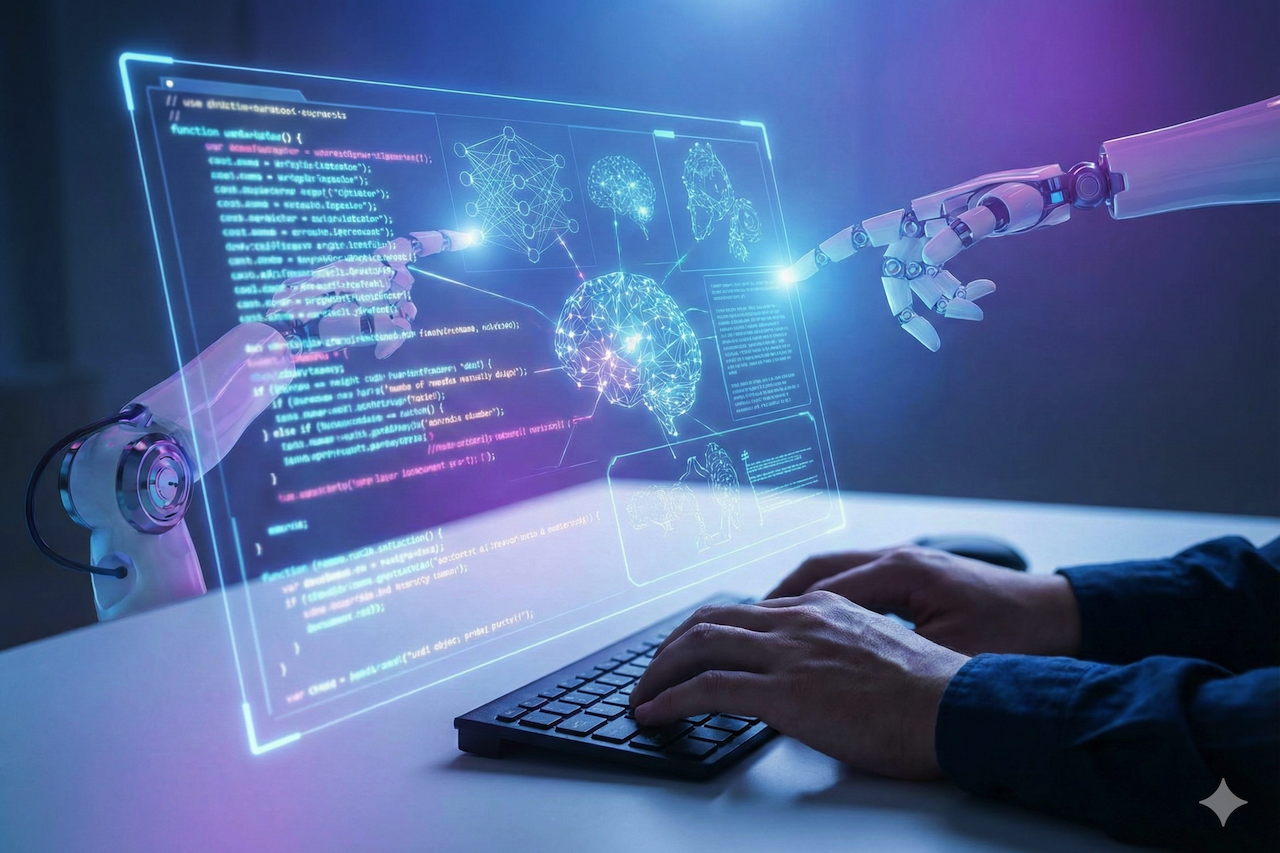
Artificial Intelligence (AI) is no longer a theoretical concept in the software development industry; it has become a practical, everyday force shaping application design, development, testing, and maintenance. AI is fundamentally transforming the software development lifecycle by automating repetitive tasks, anticipating system failures, and enabling more intelligent decision-making. As organizations strive to deliver faster, more scalable, and more flexible systems, AI has become a critical enabler of modern development practices.
AI-Powered Coding and Development Assistance
Code generation and assistance are among the most visible applications of AI in software development. With the emergence of AI-based development tools, code snippets and autocomplete suggestions can now be generated, syntax errors can be detected, and best practices can be recommended on demand. This enables developers to focus more on logic, architecture, and problem-solving rather than boilerplate code.
By leveraging knowledge from millions of open-source repositories and successful past projects, AI systems help software engineers produce cleaner, more consistent code more quickly. This not only increases productivity but also minimizes human error, particularly in large, complex codebases.
Smart Software Design and Architecture
AI is also transforming the structural design of software. Intelligent systems can analyze requirements, user behavior, and historical performance data to recommend optimal architectures and design patterns.
In user experience design, AI-based insights can help developers understand user interactions with applications and inform choices to enhance the application's usability, performance, and experience.
Automated Tests and Quality Testing
Testing has always been among the time-consuming processes of software development. AI is changing the quality assurance landscape by enabling automated test generation, execution, and optimization. Smart testing solutions can identify high-risk code areas, rank test cases, and adjust testing policies as the application evolves.
Anomalies in an application's behavior can also be identified using AI; edge cases that manual testing may miss can be detected, and repetitive regression testing can be minimized. As a result, development teams can release updates more quickly without compromising quality or stability.
Artificial Intelligence in Continuous Delivery and DevOps
Another significant change is the adoption of AI in DevOps initiatives, commonly known as AIOps. AI systems process logs, performance data, and deployment data to forecast potential failures, optimize resource use, and automate incident response.
By identifying patterns in system behavior, AI can detect potential issues early and alert teams before they affect users. This proactive approach improves uptime, reduces downtime costs, and strengthens continuous integration and continuous deployment pipelines.
Smart Maintenance and Bug Fixing
Software maintenance is as important as software development. AI is assisting teams in coping with this stage by pointing out bugs, proposing solutions, and even automatically fixing some issues. It is possible to predict the bugs most likely to occur and prescribe preventive measures using machine learning models trained on previous incidents.
This predictive maintenance tool reduces technical debt and extends the life of software systems, making them more resilient over the long run.
Data-Driven Decision-Making in Development
Contemporary software development produces large volumes of data—user interactions or system logs. AI transforms this information into action. With AI, development teams can make informed decisions about performance trends, adopted features, and development roadmaps to prioritize based on actual user requirements.
Teams can make decisions through smart analysis rather than assumptions or narrow feedback, resulting in more successful products.
Challenges of Responsible Artificial Intelligence Adoption
While AI offers tremendous advantages, it also has its own challenges. Data quality, model bias, security risks, and transparency are of utmost importance. Developers must ensure that AI-powered systems are transparent, secure, and ethically responsible.
Implementing AI requires a compromise between automation and human supervision. AI is not meant to take away developers' decision-making ability, but it should be more efficient.
The Future of AI in Software Development
Looking ahead, AI will continue to drive software development toward greater automation, adaptability, and intelligence. Future applications will not only respond to user input but will also learn, evolve, and improve over time.
The most successful development teams will be those that embrace AI as a collaborative partner—using it to accelerate innovation, deliver higher-quality software, and build smarter systems at scale.
Featured Image generated by Google Gemini.
Share this post
Leave a comment
All comments are moderated. Spammy and bot submitted comments are deleted. Please submit the comments that are helpful to others, and we'll approve your comments. A comment that includes outbound link will only be approved if the content is relevant to the topic, and has some value to our readers.
Comments (0)
No comment