
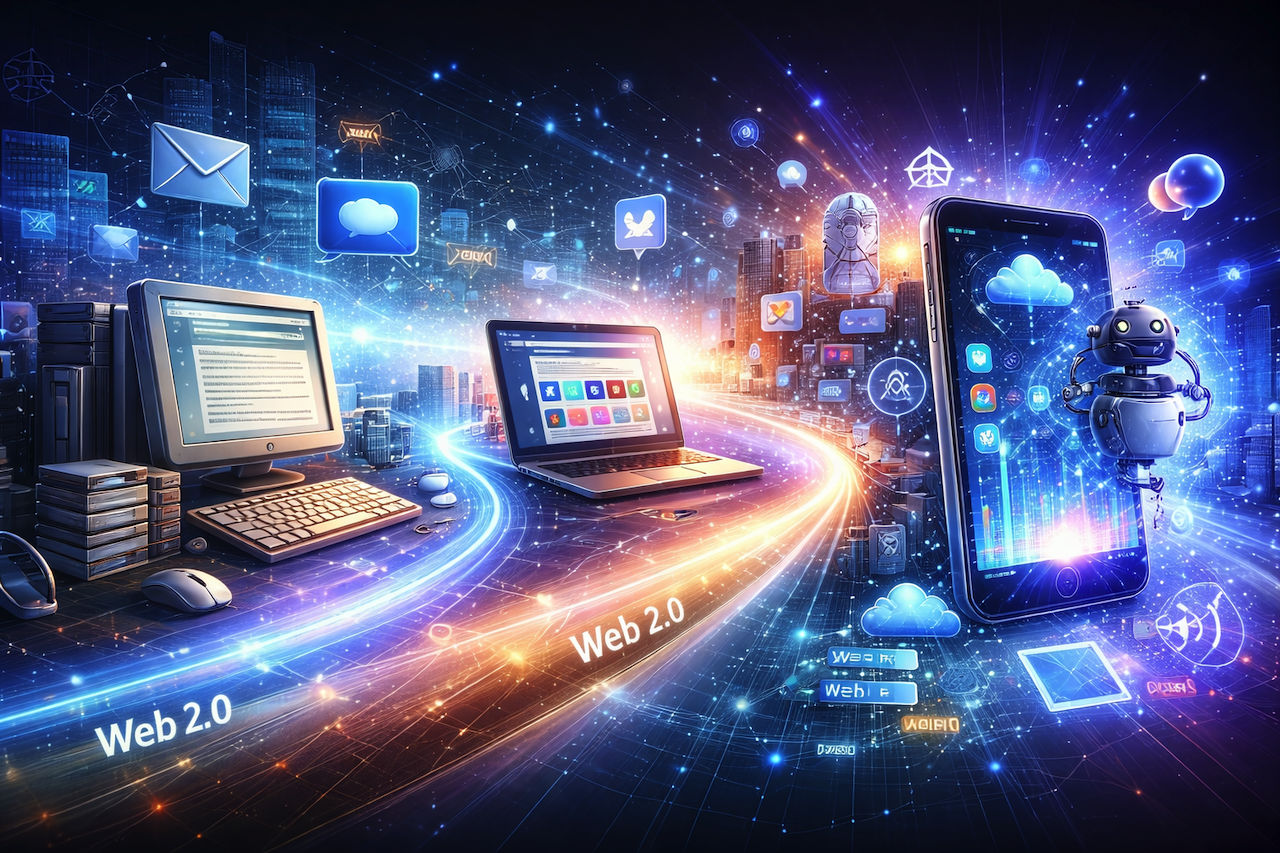
What we have on the internet today is hardly comparable to what it was like 30 years ago. What started as a basic tool for sharing text documents has evolved into a smart, vibrant ecosystem that drives both international business and individual innovation. The history of the web is one of the greatest technological journeys in human history, and it continues to evolve.
The Early Web: Web Brochures
Tim Berners-Lee was a visionary when he proposed the World Wide Web in 1989 as a way for researchers to exchange documents over a network. By the early 1990s, the first websites were online—and they were exactly what you would expect from that time. Simple text content, basic tools like a case converter, few images, and no interaction. They were essentially digital pamphlets, built using basic HTML and little else.
This period is now referred to as Web 1.0, a read-only experience. You visited a page, read the content, and moved on. There was no commenting, no logging in, and no personalization. Every visitor saw the same thing. Webmasters—a title that now feels almost outdated—had to manually edit HTML files whenever content needed updating. It was slow, static, and surprisingly powerful for its time.
The Dynamic Shift: Web 2.0 Changes Everything
A major shift took place in the late 1990s and early 2000s. JavaScript matured, databases connected to web servers, and pages began responding to user actions. Forms could be submitted, shopping carts could retain items, and websites started to behave like applications.
This marked the arrival of Web 2.0—the participatory web. Platforms like MySpace, Blogger, YouTube, and eventually Facebook transformed passive users into active contributors. People were no longer just consumers of content—they became creators. Community interaction, social sharing, and user-generated content became central to the web experience.
On the backend, technologies like AJAX enabled pages to update without full reloads, making the web feel faster and more fluid. CSS standardized design, and content management systems such as WordPress democratized publishing, allowing millions to create and manage websites without writing code.
The modern web economy—advertising platforms, analytics systems, and data-driven models—also emerged during this period and continues to shape the internet today. The web evolved from an information library into a social infrastructure.
The Mobile, Cloud, and the Always-On Web
The release of the iPhone in 2007 reshaped the web. Suddenly, it had to function on small touchscreen devices carried everywhere. Responsive design became essential. Page speed mattered more than ever. The competition between apps and mobile browsers forced developers to rethink how digital experiences were built and delivered.
At the same time, cloud computing transformed infrastructure. Instead of websites running on a single physical server, they began operating across distributed systems worldwide. This made the web faster, more reliable, and highly scalable. A startup could launch a product overnight and support millions of users within days.
Progressive Web Apps (PWAs) further blurred the line between websites and native apps by offering offline capabilities, push notifications, and near-native performance—all within a browser.
The Intelligent Web: AI, Personalization, and Beyond
The web is no longer just dynamic—it is intelligent. Machine learning algorithms now filter your news feed, recommend products, autocomplete search queries, and detect suspicious activity. Major platforms rely on models that learn from behavior and adapt in real time.
Personalization has reached unprecedented levels. Two users visiting the same website may see entirely different layouts, prices, content, and calls to action—all optimized using vast amounts of data. The internet no longer just reacts to users—it anticipates them.
Web interaction has also evolved through conversational interfaces and AI assistants. Users can ask questions and receive contextual responses instead of navigating menus. Customer service is handled by chatbots. Content creators use AI-powered tools. Even search is changing—from simple keyword matching to deeper semantic understanding.
Technologies like WebAssembly, edge computing, and real-time collaboration tools continue to expand the web’s capabilities, enabling experiences once considered futuristic—such as 3D environments in the browser, live collaborative editing, and near-instant global content delivery.
What Comes Next
The future of the web points toward greater immersion, intelligence, and interoperability. Concepts like Web3, decentralized systems built on blockchain, aim to give users more control over their data and digital assets. Spatial computing and augmented reality suggest a web that extends beyond flat screens into physical space.
What remains certain is that the web has never stood still. It has continuously transformed—from a network of static pages into a living, responsive, and intelligent global platform shaped by human needs, creativity, and technological progress. And its next chapter is already unfolding.
Featured Image generated by ChatGPT.
Share this post
Author

Read the latest articles from Aiyla Eylül
The Impact of Cloud Technology on Modern Web Applications

June 2, 2026
The internet has evolved dramatically over the past decade. Applications that once ran on physical servers in corporate basements now operate across vast networks of distributed infrastructure. Cloud technology has been one of the key forces behind this transformation, influencing how modern web applicati [...]
Learn moreEmerging Technology Trends Transforming the Digital World

June 2, 2026
Ten years ago, many of today’s technologies would have seemed like science fiction. Now, everything from wrist-worn computers to vehicles with advanced autonomous capabilities has become part of everyday life. Yet the pace of innovation continues to accelerate. The convergence of several major technology trends [...]
Learn moreLeave a comment
All comments are moderated. Spammy and bot submitted comments are deleted. Please submit the comments that are helpful to others, and we'll approve your comments. A comment that includes outbound link will only be approved if the content is relevant to the topic, and has some value to our readers.
Comments (0)
No comment