

Businesses no longer build mobile applications only for one platform. Users today demand that their digital experiences function seamlessly across all their devices, including iOS and Android devices, tablets, and desktop computers. To meet these expectations while reducing costs and accelerating releases, many companies invest in cross-platform mobile application development, enabling them to build scalable products with a shared codebase.
Software development processes have evolved significantly alongside modern mobile technologies. Many companies now adopt shared-code approaches that allow applications to run across multiple platforms, helping reduce development costs and accelerate product launches.
This approach enables companies to build a single application that operates across multiple operating systems using a shared codebase. Start-ups and SaaS businesses have increasingly adopted these methods because of their efficiency and scalability.
What Is Cross-Platform App Development?
Cross-platform mobile application development refers to creating mobile applications that run on multiple operating systems from a single shared codebase.
Rather than creating separate applications for:
- iOS
- Android
Developers can write most of the application code once and distribute it across multiple platforms.
These modern frameworks include:
- Flutter
- React Native
- Kotlin Multiplatform
- .NET MAUI
They enable developers to reach native app performance levels while minimizing code redundancy.
The result is:
- Easier maintenance
- Faster updates
- Quick feature releases
- More efficient scaling
Why Businesses Increasingly Choose Cross-Platform Development
The primary explanation for this situation focuses on efficiency.
The process of building individual native applications requires two engineering teams, two testing processes, separate release cycles, and higher infrastructure costs.
This approach reduces complexity. Businesses gain several advantages, including:
- Faster time to market: Products are delivered quickly as the development cycle is shared.
- Lower development costs: Shared development reduces engineering hours and engineering overhead.
- Easier product scaling: Instead of repeating the same work, teams can collaboratively add features or make improvements across platforms.
- Better consistency: Applications provide users with a stable experience that works uniformly across all devices. This model is especially useful for startups and mid-sized businesses that require rapid product testing.
Why Startups Prefer Cross-Platform Applications
Startups function under tremendous financial and operational pressure.
This is because startups need to:
- Validate their ideas rapidly
- Control burn rate
- Raise money from investors
- Beat their competitors in bringing products to market
This development approach supports these goals directly.
It enables startups to build highly efficient product teams rather than allocating resources for separate native teams.
In turn, startups will be able to:
- Rapidly launch minimum viable products
- Quickly obtain customer feedback
- Modify their product vision as necessary
- Take fewer risks with their initial investments
Most Popular Cross-Platform Technologies
The technology ecosystem is constantly evolving as it moves forward at a quickening pace.
The market currently operates under multiple dominant frameworks that govern its use.
1. Flutter
Flutter became one of the fastest-growing frameworks because it offers several major advantages, including high UI performance, flexible interface design, strong startup adoption, and fast development cycles. Developers use the Dart programming language in Flutter to create applications that maintain visual consistency across different platforms.
2. React Native
The sustained popularity of React Native results from a combination of factors, including the JavaScript ecosystem, the large developer community, and strong business adoption of the platform. Companies with existing React web teams often choose React Native to simplify hiring and collaboration.
3. Kotlin Multiplatform
Kotlin Multiplatform enables businesses to share application logic across different platforms while retaining some native capabilities. The framework has become more appealing to organizations that want to share part of their codebase while maintaining strong software performance.
How the Development Framework Usually Works
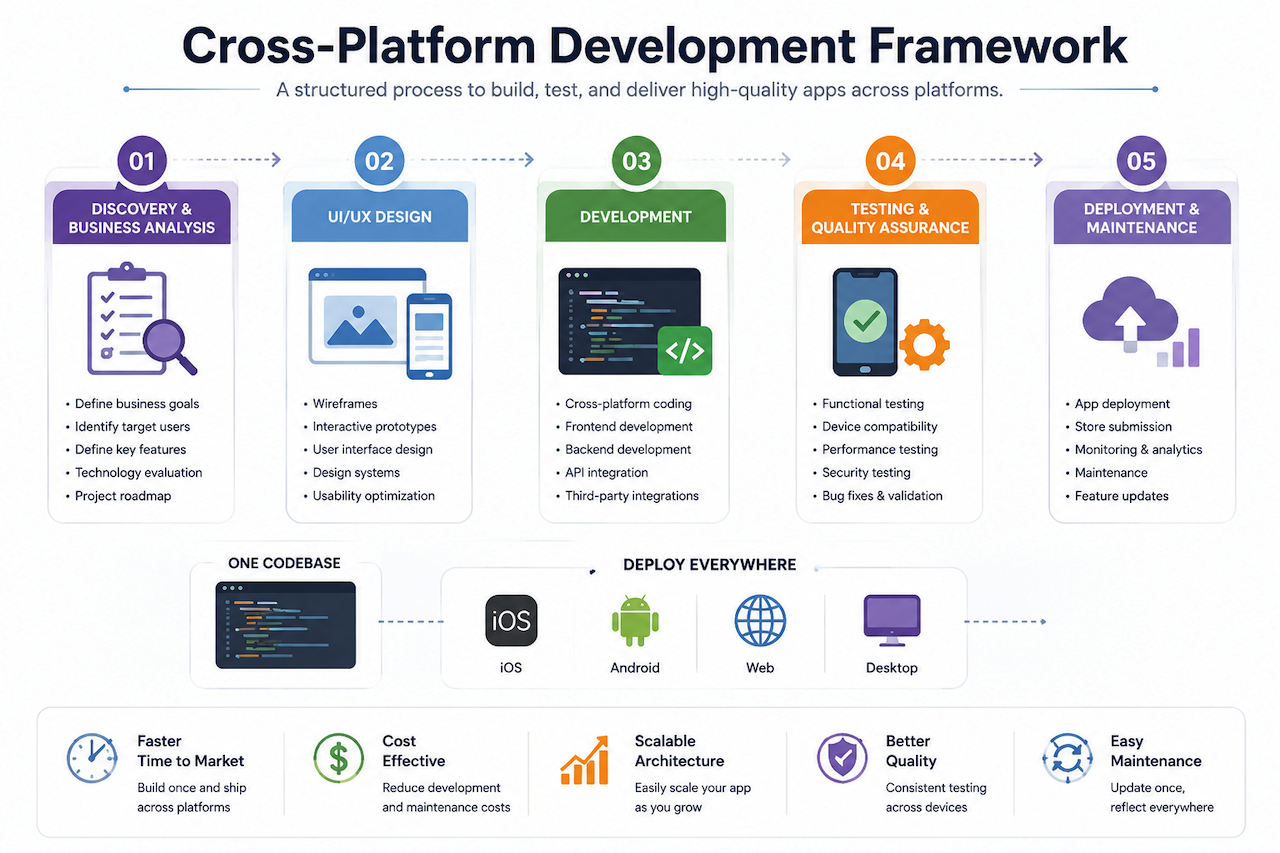
Image generated by ChatGPT.
Structured development also goes strictly with the successful development of projects.
Step 1: Discovery and Business Analysis
All work starts with product strategy development. The teams establish their business objectives, service groups, essential system functions, and required technological components. The process establishes clear requirements that prevent conflicts during development and avoid unplanned expenses.
Step 2: UI/UX Design
Designers create three types of products: wireframes, clickable prototypes, and interface systems. Strong design solutions help businesses by increasing user retention, conversion rates, and product usability. The costs to repair design errors that are identified in later stages of development become twice as expensive.
Step 3: Development
Engineers create four types of systems: frontend, backend, API, and integration systems. The development process uses Agile methodologies to produce software through multiple development cycles. The system enables teams to make quick adjustments based on test results and user feedback.
Step 4: Testing and Quality Assurance
The QA engineers test three different aspects of their work: which devices can run their application, how stable their programs perform, what their systems do under different conditions, and what security levels they maintain. The development process uses ongoing testing throughout the project, rather than limiting examination to the final testing stage.
Step 5: Deployment and Maintenance
The development teams that started work on the project continue their work after the project reached its first release. The team's focus is on two main tasks, which include maintenance and adding new features; the product's life span has a significant impact on the product's success.
Step 5: Deployment and Maintenance
Cross-platform development is considered cost-effective compared with native development; however, costs vary significantly. The major factors affecting costs include:
- Product complexity: Applications that exhibit real-time capabilities, together with advanced integration features and complex operational processes in their system design, require a higher level of engineering resources.
- Technology stack: The framework should be selected carefully because it directly affects:
- Development time
- Maintenance costs
- Scalability
- Team structure: Committed teams, concluded the speaker, are generally in a better position to ensure framework stability than other dispersed freelance assemblies.
- Design requirements: The detailed manipulation of these settings may improve the overall development time.
- Third-party integrations: Complexity is added through payment systems, analytics platforms, and external APIs.
Why Architecture Decisions Matter Early
Many companies undervalue architecture at the start of their projects. This leads to severe scalability issues down the road. Bad architectural decisions can result in:
- Poor performance
- Instability of infrastructure
- Costly refactoring
- Inability to implement proper security
Architecture allows for:
- Scale
- Maintenance
- Performance
- Accelerated future development
Professional developers always focus on architecture right off the bat.
Common Mistakes Businesses Make
Developers building applications for multiple platforms can benefit from shared-code development approaches. However, they still need to avoid several common pitfalls during the development process.
- Choosing technologies based only on trends: The common frameworks in use today do not guarantee correct results for all products under development. Businesses need technology that helps them reach their objectives, not technology that creates excitement.
- Ignoring scalability: Some companies focus on a rapid launch without considering future growth. This results in accumulating technical debts.
- Weak communication with vendors: Misaligned goalposts, unknown esoteric objectives shrouded in smoke spell delays, blown-up budgets, and casualty-plentiful puzzled looks.
- Underestimating testing: Apps need effective quality assurance testing across different devices and operating systems. The process requires complete testing of the application across various devices and operating systems.
Security and Compliance Considerations
One of the most significant considerations for the future of mobile applications would be security. The following are examples of what the application process:
- Payment details
- Healthcare-related information
- User data
- Enterprise-level systems
In turn, it is critical for organizations to consider:
- Data encryption
- Secure login procedures
- Access control
- Infrastructure security
Some industries that need particularly stringent compliance requirements include:
- Healthcare
- Fintech
Why Long-Term Maintenance Matters
The start of the app does not mark an end. This is because mobile products are continuously changing because of:
- Upgrades in operating systems
- Shifting customer demands
- New hardware releases
- Security threats
Applications will become obsolete without maintenance. Good developers ensure that companies can:
- Optimize their operations
- Provide regular updates
- Manage the infrastructure
- Develop new features
Future Trends in Cross-Platform Development
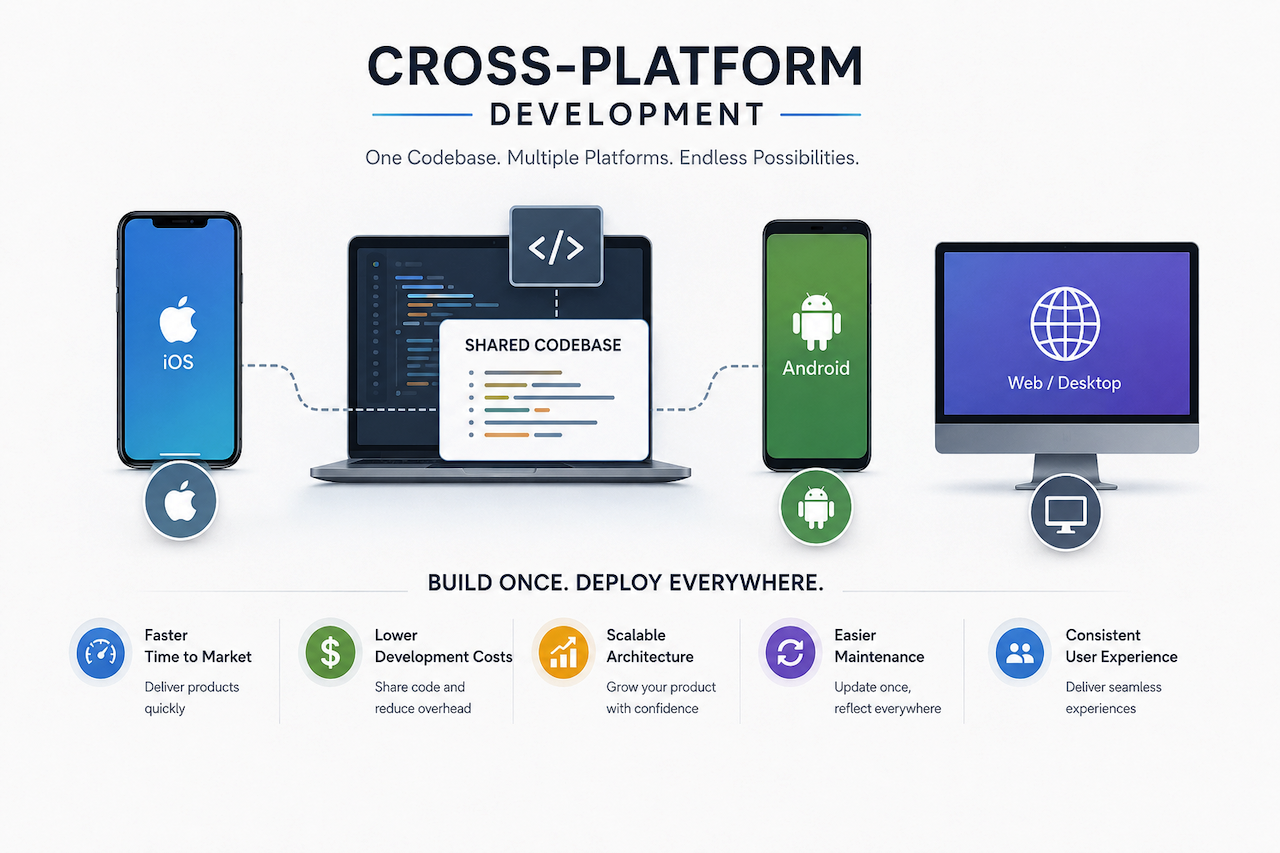
Image generated by ChatGPT.
Several trends continue shaping the market.
- AI-assisted development: Developers increasingly use AI tools for:
- Code recommendations
- Testing assistance
- Documentation creation
- Bug fixes
- Foldable and multi-device experiences: Applications are now required to support a wider variety of screen types and device form factors.
- Greater focus on performance: The top three modern frameworks continue to improve, offering new levels of rendering speed and responsiveness.
- Stronger cloud integration: The development of cloud-native mobile architectures has reached the point where they are now standard industry practice. The appeal of flexible solutions, expandable and available over various platforms, is bound to grow, considering the present market trends.
Final Thoughts
Mobile application development across multiple platforms has proven itself to be one of the most efficient approaches applied in today's software solutions. The following are some of the reasons why companies prefer cross-platform mobile development:
- It cuts costs
- It saves time
- It eases maintenanc.
- It accelerates scalability
Nevertheless, success cannot be guaranteed, as the success of any project depends entirely on its detailed planning and proper implementation. Companies that use the right technology stack and employ competent developers would definitely gain an advantage over their competitors in this rapidly evolving industry.
Share this post
Author

Read the latest articles from Yuliya Melnik
Why Cloud Optimization Is Critical for SaaS Growth

June 10, 2026
Cloud infrastructure powers nearly every modern SaaS product. It offers the flexibility to launch quickly, expand across regions, and deliver services without relying on physical hardware. However, simply deploying a SaaS platform in the cloud does not automatically guarantee efficiency.
Learn moreThe Difference Between MVP and First Product Version: A Founder’s Guide
June 10, 2026
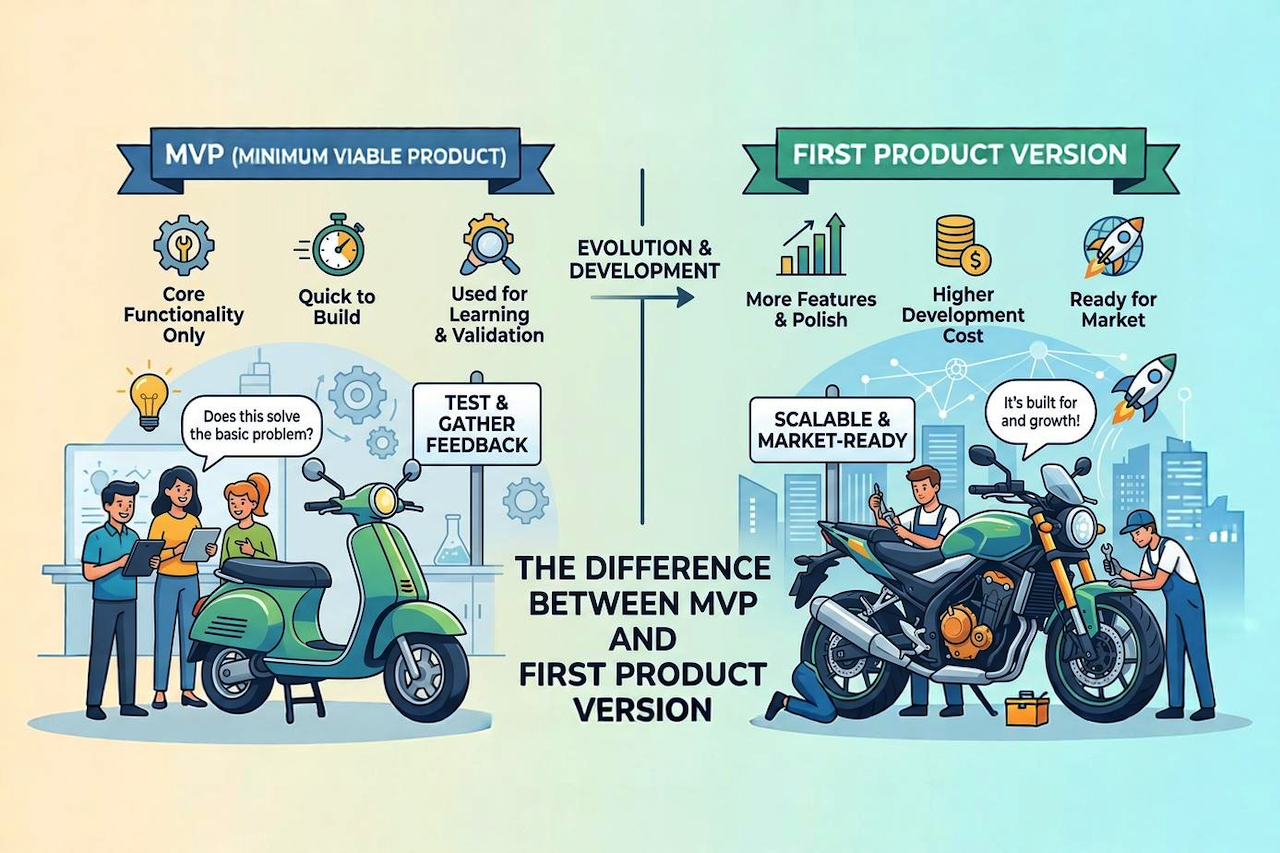
Many founders use the terms MVP and first product version almost interchangeably. But in reality, they represent two different stages of product development. An MVP (Minimum Viable Product) is used to validate a business idea with a small investment. The first product version follows that validation and o [...]
Learn moreLeave a comment
All comments are moderated. Spammy and bot submitted comments are deleted. Please submit the comments that are helpful to others, and we'll approve your comments. A comment that includes outbound link will only be approved if the content is relevant to the topic, and has some value to our readers.
Comments (0)
No comment