
Two businesses can budget the same amount for a machine learning initiative and still end up with completely different outcomes. Within four months, one ships a system ready for production, while the other is still refining prototypes by month seven. Success is not always determined by budget alone, but by understanding the factors that influence implementation expenses.
In 2026, 88% of organizations use artificial intelligence in at least one area of their business, up from 78% the previous year. Meanwhile, the global market is projected to reach $1.68 trillion by 2031 at a CAGR of 37%.
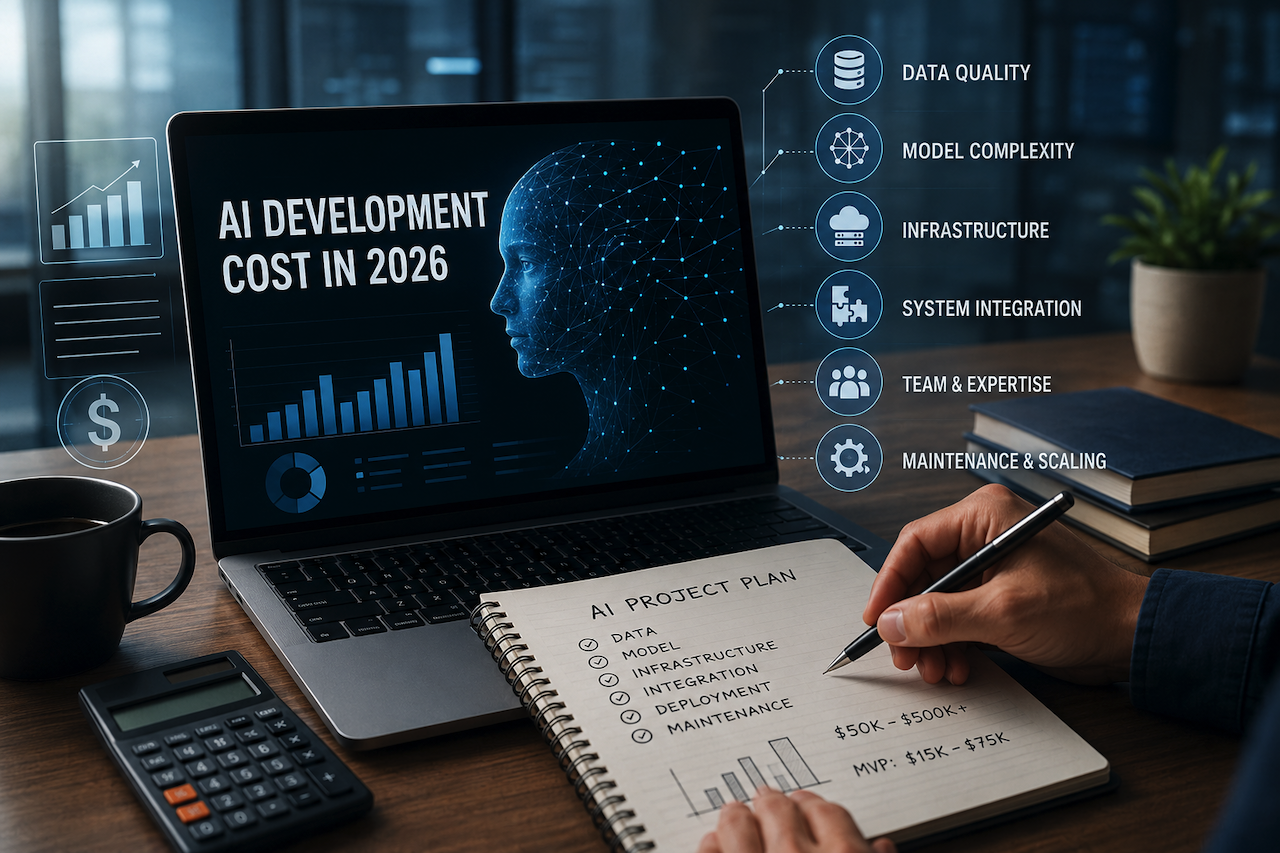
With adoption accelerating at this pace, AI development cost discussions have shifted from “Should we invest in artificial intelligence?” to “What will implementation actually require?” This blog breaks down six key factors that influence project expenses and outlines the estimated costs associated with each stage of the process.
What Factors Affect AI Implementation Costs in 2026?
Budgets for two similar software initiatives can differ by $200,000 or more. The gap is usually driven by one or more of the following factors.
1. Data Availability and Data Quality
Before training the models, the data must be cleaned, labeled, and structured. This preparation phase alone takes 40-60% of the total development effort. Organizations with clean internal datasets often have a significant cost advantage. Organizations starting without existing datasets or internal expertise need to plan for the data sourcing, data annotation tools, and expert labor.
2. Model Approach and Complexity
Using a pre-trained API is significantly less expensive than building and training a custom model from scratch. Similarly, a rule-based chatbot typically costs far less than a fine-tuned large language model. Training expenses generally depend on factors such as accuracy requirements, input complexity, and whether the system relies on a single-layer or multi-layer architecture.
3. Infrastructure and Compute
Powerful machine learning workloads require substantial infrastructure resources. GPU-based cloud instances, distributed training pipelines, and vector databases are typically billed based on usage. Production environments also generate ongoing cloud expenses through model inference, monitoring, and retraining cycles. Generative systems are especially compute-intensive, with infrastructure costs often accounting for 20% to 30% of total implementation expenses.
4. Integration with Existing Systems
Connecting intelligent automation tools to legacy infrastructure, third-party APIs, or internal platforms can significantly increase both complexity and operational spending. Inconsistent APIs, authentication requirements, and incompatible data formats frequently require additional engineering work. Solutions that rely on real-time communication between machine learning platforms and enterprise databases may experience integration expenses that exceed original budgets by 20% to 35%.
5. Team and Development Set up
Geographic location and engagement models can significantly influence overall expenses. For example, a senior machine learning engineer in North America may earn between $150,000 and $200,000 annually, while comparable technical roles in Eastern Europe or Southeast Asia often operate at substantially lower cost levels. Team composition also plays an important role, as smaller teams are generally more cost-efficient than large enterprise-scale groups. One of the key budgeting considerations is ensuring that staffing requirements align with the scope and technical complexity of the initiative.
6. Continuous Maintenance and Updates
Expenses do not end at launch. As usage grows, intelligent systems often require ongoing monitoring, periodic retraining, and infrastructure expansion. Scaling is an area many organizations underestimate during initial budgeting. Post-launch maintenance can account for 15% to 25% of the original build cost annually, making long-term operational planning an important consideration.
Cost Breakdown by Implementation Phase
Understanding expenses across each phase is important for accurate budgeting and long-term operational planning. The estimates below outline typical costs from initial discovery through ongoing maintenance and support in 2026.
| Implementation Stage | Estimated Cost | Typical Duration | Primary Tasks |
|---|---|---|---|
| Discovery and Planning | $5,000 - $30,000 | 2 to 4 weeks | Scope definition, feasibility analysis, architecture planning |
| Data Collection and Preparation | $8,000 - $70,000 | 2 to 8 weeks | Cleaned, labeled, and training-ready datasets |
| AI Model Training | $20,000 - $150,000 | 4 to 12 weeks | Trained and optimized AI models |
| UI/UX Design & Development | $10,000 - $60,000 | 3 to 8 weeks | User interface and model development |
| Integration and Testing | $10,000 - $50,000 | 2 to 6 weeks | QA testing, system integration, and performance checks |
| Deployment and Maintenance | $5,000 - $20,000/month | Ongoing | Deployment, monitoring, retraining, updates |
A production-ready custom system can cost anywhere from $50,000 to more than $500,000, depending on factors such as scale, infrastructure requirements, integration complexity, and operational demands. With tighter scope control and the use of pre-trained models, a basic MVP may be developed within a range of $15,000 to $75,000. Overall expenses can also vary significantly depending on how resources are allocated across different phases. Discovery and data collection are often underfunded, despite being two of the most important stages for reducing expensive downstream rework.
Wrapping Up
Expenses in 2026 are not fixed and can vary widely depending on technical and operational requirements. Factors such as data quality, model selection, infrastructure strategy, integration depth, staffing, and long-term maintenance all contribute to the final budget. These variables may shift based on scalability goals, infrastructure demands, and operational priorities. Strategic planning, phased execution, and realistic budgeting can help organizations build scalable systems while reducing long-term operational and financial risks.
Featured Image generated by ChatGPT.
Share this post
Leave a comment
All comments are moderated. Spammy and bot submitted comments are deleted. Please submit the comments that are helpful to others, and we'll approve your comments. A comment that includes outbound link will only be approved if the content is relevant to the topic, and has some value to our readers.
Comments (0)
No comment