
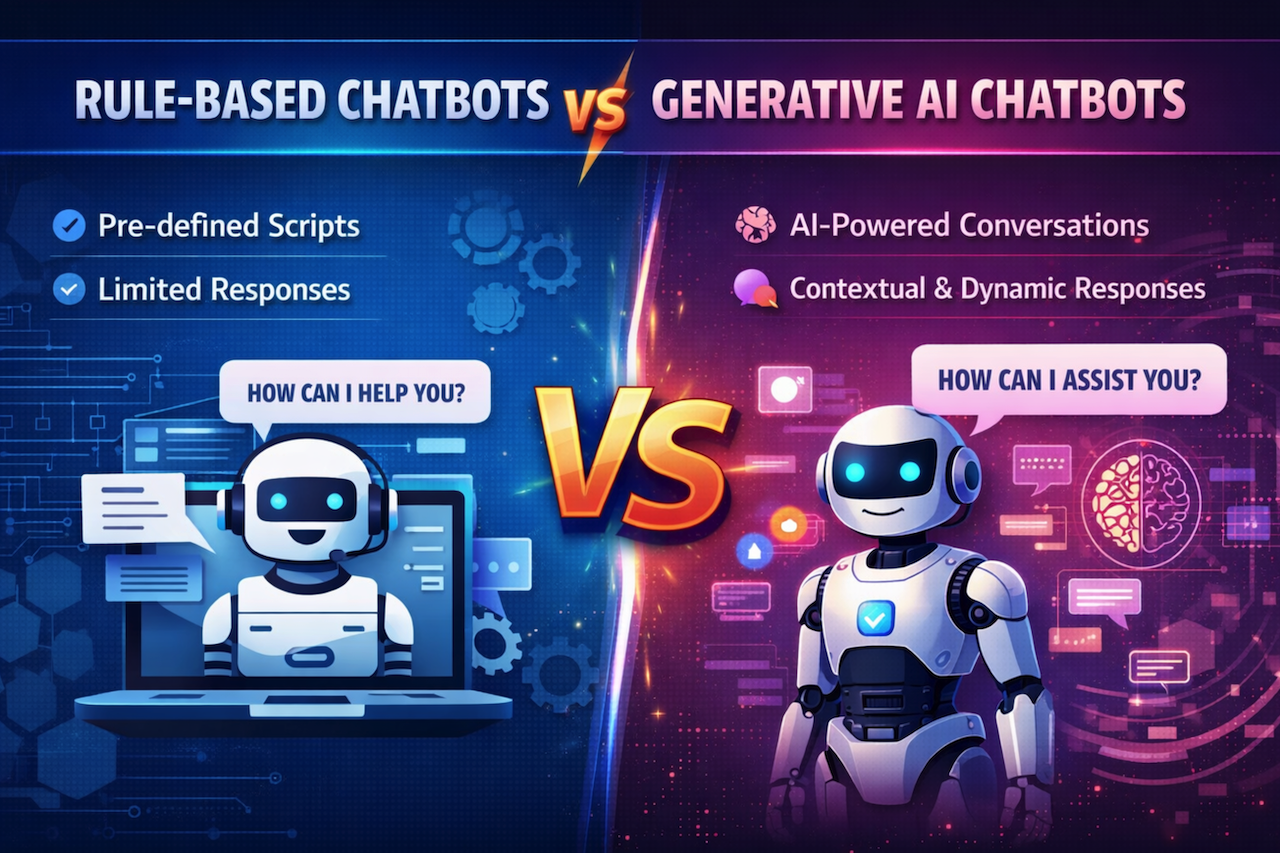
Businesses today are turning to conversational tools to handle customer interactions, improve response times, and enhance the overall user experience. Chatbots have become an integral part of online marketing, whether for customer support, lead generation, or other areas.
Despite the increasing popularity of chatbots, many businesses are confused about choosing between traditional rule-based chatbots and more advanced AI-based chatbots. The choice between the two is not merely about the technology; it can affect the organization's overall scalability, customer experience, and efficiency.
With the advancement of AI chatbot development, businesses can build more intelligent chatbots that go beyond simple responses to queries. Understanding the differences between the two is essential to choosing the right approach.
Understanding Rule-Based Chatbots
Rule-based chatbots are created on predefined logic. They track organized flows using decision trees, keywords, and if-then conditions. Every feasible user input is mapped to a specific response.
How They Work
- Users select options or type keywords
- The bot matches input with predefined rules
- A fixed response is delivered
Where They Perform Well
Chatbots that are based on rules are suitable for:
- Frequently asked questions
- Basic customer support
- Appointment scheduling
- Order status updates
They are predictable and easy to control, making them suitable for simple situations. Many companies continue to use this type of chatbot to handle repetitive tasks.
Limitations
- Cannot handle unexpected queries
- Limited conversational ability
- Requires manual updates for new scenarios
As consumer anticipations increase, these restrictions can become more noticeable.
What Are Generative AI Chatbots?
Generative AI chatbots depict the next move in conversational technology. These systems, made using generative AI technology, rely on large language models and ML to understand and respond more naturally.
How They Work
- Analyze user input in context
- Generate responses dynamically
- Learn and improve through data
Unlike rule-based systems, they are not limited to predefined scripts. This enables them to be more flexible and manage a wider range of queries effectively.
Key Capabilities
- Context-aware conversations
- Human-like responses
- Ability to control intricate queries
- Continuous improvement over time
Organizations can create chatbots that feel more like natural conversations rather than repetitive, scripted interactions by using generative AI.
Rule-Based vs Generative AI Chatbots: Key Differences
| Feature | Rule-Based Chatbots | Generative AI Chatbots |
|---|---|---|
| Response Type | Predefined | Dynamically generated |
| Flexibility | Limited | High |
| Learning Ability | No | Yes |
| Handling Complex Queries | Low | Strong |
| Setup Time | Faster | Requires more setup |
| Maintenance | Manual updates | Improves with data |
| User Experience | Structured | Conversational and natural |
Why Businesses Are Moving Toward Generative AI
As customer anticipations shift, firms need more than basic automation. They require systems that can infer intent, respond intelligently, and adapt over time.
- Better Customer Experience: Chatbots built with generative AI produce more natural conversations, enhancing interaction and satisfaction.
- Scalability: They can handle large volumes of queries without requiring constant updates or manual intervention.
- Personalization: Bots powered by AI can respond to users based on their behavior, preferences, and past interactions.
- Reduced Operational Load: AI chatbots can automate complex workflows and reduce reliance on human agents.
Where Rule-Based Chatbots Still Make Sense
Regardless of the emergence of AI, rule-based chatbots cannot be excluded. They are useful for:
- Businesses with simple workflows
- Environments where strict control is required
- Quick deployment with a limited budget
In this context, despite advancements in AI capabilities, a basic FAQ bot or internal customer support tool can still operate effectively.
When to Choose Generative AI Chatbots
Generative AI chatbots will be more suitable in businesses that:
- Handle diverse customer queries
- Need conversational and natural interactions
- Want to scale customer engagement
- Aim to improve long-term efficiency
With the right generative AI, these systems can transform how businesses interact with customers across channels.
Combining Both Approaches
Many organizations now use a hybrid model. This approach combines the control of rule-based systems with the flexibility of AI-driven responses.
How It Works
Rule-based logic handles structured queries while AI manages complex or open-ended conversations. The balance helps the businesses to remain reliable and enhance the user experience.
Practical Use Cases Across Industries
E-commerce
- Product recommendations
- Order tracking
- Customer support
Healthcare
- Appointment booking
- Patient queries
- Information assistance
Finance
- Account inquiries
- Transaction updates
- Fraud alerts
SaaS and Tech
- Onboarding support
- Troubleshooting
- User guidance
These use cases show how both chatbot types can be applied based on complexity and requirements.
Choosing the Right Chatbot Strategy
The following factors determine the selection of the rule-based and AI-driven chatbots:
- Nature of customer queries
- Budget and resources
- Level of personalization required
- Long-term scalability goals
Businesses looking for simple, task-based automation can rely on rule-based systems. Those seeking more engaging and intelligent interactions should consider using generative AI.
Concluding Thoughts
Rule-based and generative AI chatbots have different functions and advantages. Rule-based chatbots are simple and allow for control. Generative AI chatbots, on the other hand, are flexible, contextual, and smart. Digital interactions are dynamic, and numerous businesses are turning to AI-based solutions that can handle complexity and deliver improved experiences. By choosing the right chatbot approach and leveraging advanced generative AI capabilities, organizations can build efficient and scalable systems.
Share this post
Leave a comment
All comments are moderated. Spammy and bot submitted comments are deleted. Please submit the comments that are helpful to others, and we'll approve your comments. A comment that includes outbound link will only be approved if the content is relevant to the topic, and has some value to our readers.
Comments (0)
No comment