
The current cost of online fraud to consumers and businesses exceeds $12 billion a year. The most effective defense is knowing what to look for.
Online shopping has revolutionized the way we buy things; however, it has also become a breeding ground for fraud. The same conveniences that make e-commerce seamless for legitimate buyers also make it easier for scammers to operate. Fraudulent storefronts, fake payment websites, and impersonated brand emails are no longer limited to amateur scammers. They are built by professionals, maintained over time, and designed to appear legitimate at a glance.
This matters on two levels for professionals and business leaders. Personally, because you shop online and may already be aware that even experienced, careful individuals fall into these traps every day. Professionally, because procurement teams, finance departments, and clients all operate in the same environment. Understanding these scams is not optional background knowledge—it is operational awareness.
- Annual online fraud losses globally exceed $12B+.
- Approximately 1 in 4 online shoppers are targeted by scams each year.
- It takes less than 30 seconds to verify a site before purchasing.
The 5 Most Active Online Shopping Scams Right Now
1. Fake Retail Websites (Designed to Look 100% Legitimate)
Fraudulent online stores use real product images, dynamic pricing, user reviews, and professional branding, making them difficult to distinguish from legitimate retailers. These sites appear in paid search results, social media ads, and comparison platforms. In many cases, the product never arrives—or a low-quality substitute is delivered. Payment details collected during checkout are often used for further fraud. These sites typically disappear within 30 days, with domains reused for new scams.
Watch for:
- Domains registered within the last 60 days (verify using WHOIS lookup)
- Prices significantly lower than all known retailers
- No physical address or one that does not map to a real business
Action: Search the retailer name along with the word “scam,” and avoid purchasing from unfamiliar websites. When possible, use a scam-checking tool before proceeding.
2. Triangulation Fraud (A Scam That Looks Like a Real Purchase)
This is one of the most advanced and difficult-to-detect forms of retail fraud. A scammer lists a product on a legitimate marketplace (Amazon, eBay, Etsy) at an attractive price. You purchase it. The scammer then uses stolen credit card details to buy the product from a legitimate retailer and ships it to you. You receive the item and may even leave a positive review—without realizing you were part of a fraud chain.
Watch for:
- Sellers with minimal history or few reviews
- Delivery from an unexpected retailer
- Emails from retailers you did not order from
Action: If something feels off, report it to the marketplace. Even receiving the correct item does not mean the transaction was legitimate.
3. Counterfeit Goods with Authentic-Looking Branding
Counterfeit products have become increasingly sophisticated. Instead of obvious knockoffs, scammers now replicate electronics, supplements, and professional equipment with convincing packaging, certificates, and serial numbers. Beyond financial loss, counterfeit electronics can pose safety risks, and fake supplements can be harmful to health. As of 2024, counterfeit goods sold online were valued at over $500 billion globally.
Watch for:
- Prices 30–50% lower than authorized retailers
- Seller location inconsistent with the brand’s distribution model
- No verification on the brand’s official website
Action: For higher-value purchases, confirm that the seller is an authorized reseller on the brand’s official website.
4. Checkout Page Hijacking (Compromised Legitimate Sites)
In web skimming (Magecart) attacks, malicious scripts are injected into legitimate checkout pages. The site and product are real, but when you enter payment details, the information is silently captured and sent to attackers. You receive your order, but fraudulent charges may appear days or weeks later.
Watch for:
- Checkout URLs changing mid-process
- Unusual payment form behavior
- Unrecognized charges weeks after a purchase
Action: Use tokenized payment methods (Apple Pay, Google Pay, or virtual cards). Even if intercepted, tokens cannot be reused without your device.
5. Post-Purchase Phishing (The Follow-Up Scam)
After a legitimate purchase, scammers send convincing emails posing as the retailer—fake shipping updates, account alerts, or refund notices—asking you to click a link or re-enter payment details. These emails arrive when your guard is down and the purchase is still fresh in your mind.
Watch for:
- Emails from domains that do not match the retailer
- Requests to re-enter payment information
- Links that do not lead to the official site
Action: Never click links in these emails. Instead, go directly to the retailer’s website and access your account.
Your Safe Shopping Checklist
- Verify the retailer’s domain before entering payment details
- Use WHOIS lookup and scam-checking tools
- Prefer tokenized payment methods (Apple Pay, Google Pay, virtual cards)
- Ignore links in post-purchase emails—visit the retailer directly
- Confirm authorized resellers on official brand websites
- Do not trust a site just because it appears in paid search results
- Avoid deals that seem unrealistically cheap—they are often bait
The 30-Second Check That Prevents Most Scams
Every scam leaves a footprint: newly registered domains, user reports, suspicious hosting patterns, or irregular payment behavior. The challenge is that most people do not know how to quickly identify these signals.
Various online tools and verification methods, such as ScamAlerts.com, can help assess potential risks. By checking a website’s domain age, reviewing community feedback, and analyzing basic technical indicators, users can often identify suspicious activity within seconds. Even newly created scam sites may show early warning signs when examined carefully.
Taking a moment to verify a website, email, or transaction before proceeding can significantly reduce exposure to fraud. Simple checks, such as confirming domain authenticity or avoiding unfamiliar links, can help prevent costly mistakes.
Online fraud awareness is not just about personal protection—it is part of a broader due diligence mindset. Building habits around quick verification and cautious decision-making is one of the most effective ways to reduce risk in today’s digital environment.
Conclusion
Online shopping will continue to grow, and so will the sophistication of scams that target it. The difference between a safe transaction and a costly mistake often comes down to awareness and a few seconds of verification.
As these examples show, most scams are not random—they follow patterns. Whether it is a newly registered domain, an unusually low price, or a suspicious email, the warning signs are often there for those who know where to look.
By building simple habits such as verifying websites, questioning unusually good deals, and avoiding unfamiliar links, both individuals and organizations can significantly reduce their exposure to fraud. In a digital environment where scams are increasingly professional, caution is no longer optional—it is essential.
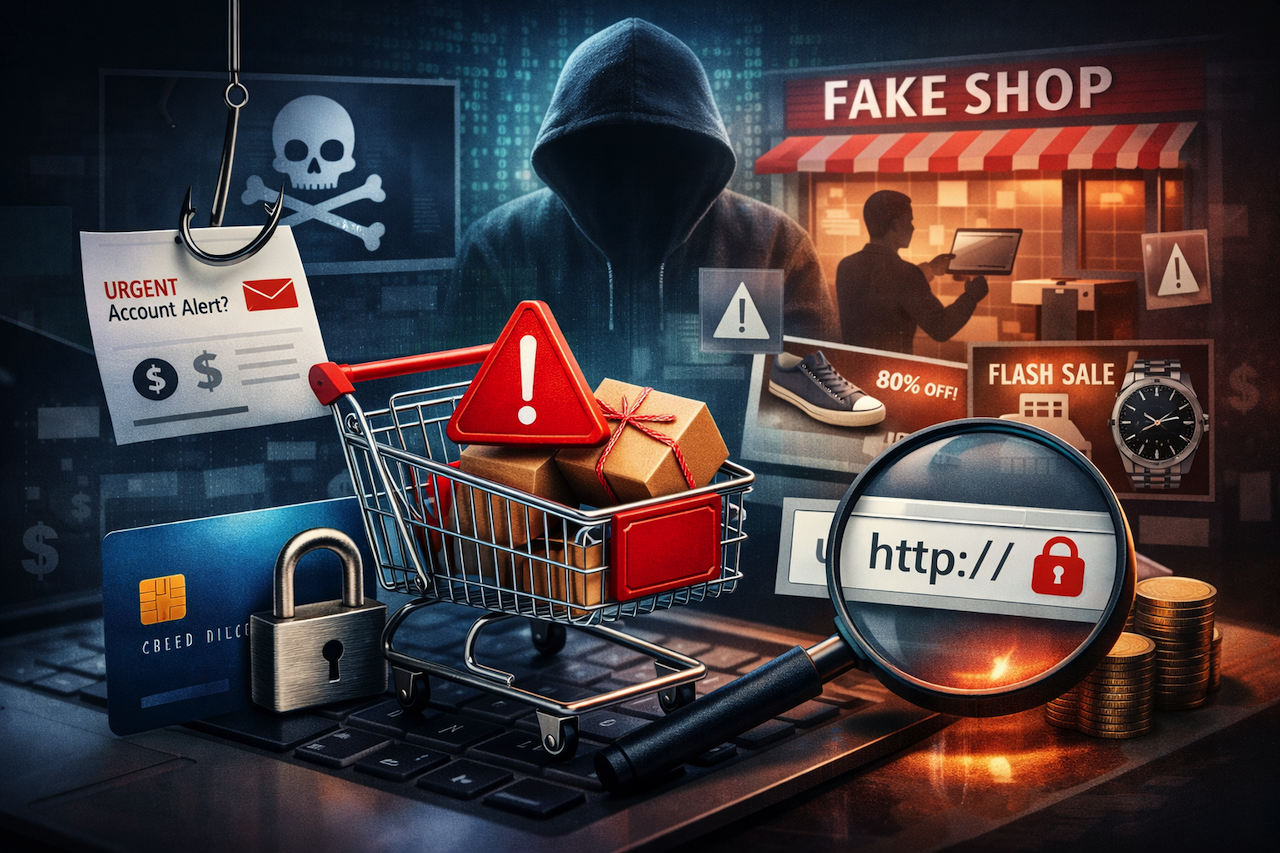
Featured Image generated by ChatGPT.
Share this post
Leave a comment
All comments are moderated. Spammy and bot submitted comments are deleted. Please submit the comments that are helpful to others, and we'll approve your comments. A comment that includes outbound link will only be approved if the content is relevant to the topic, and has some value to our readers.
Comments (0)
No comment