
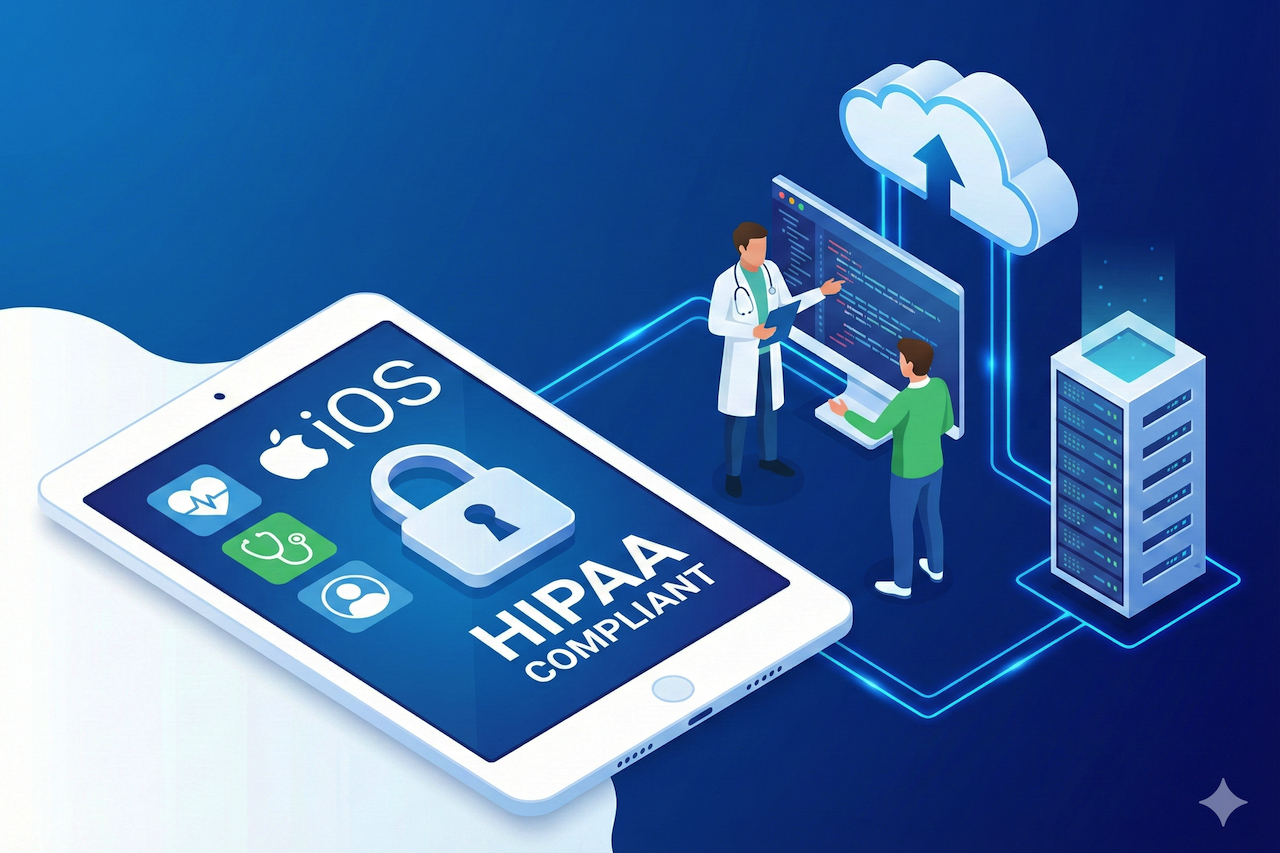
The healthcare industry is experiencing a complete digital transformation. Mobile applications now function as essential tools that enable patients to engage with their healthcare system and receive medical services.
The healthcare technology landscape in the United States is shaped by the essential role regulatory compliance plays in its development. All organizations that create healthcare applications for iOS must comply with the Health Insurance Portability and Accountability Act (HIPAA) regulations, as they are mandatory.
The guide demonstrates how to develop a healthcare iOS application that meets HIPAA requirements by providing information on architectural design security measures, development standards, and compliance requirements.
Understanding HIPAA in the Context of Mobile Health Apps
HIPAA establishes national standards for protecting sensitive patient data through its 1996 legislation. The law applies to these two groups:
- Covered Entities: Healthcare providers, insurers, and clearinghouses
- Business Associates: Third-party vendors who manage Protected Health Information (PHI) data
Any iOS healthcare application that stores or processes PHI must comply with HIPAA, which includes medical records, diagnostic reports, and identifiable appointment data.
The main components of HIPAA include:
- Privacy Rule: Governs how PHI can be used and disclosed
- Security Rule: Mandates administrative, physical, and technical safeguards
- Breach Notification Rule: Requires notification in case of data breaches
The Security Rule provides iOS developers with essential requirements by establishing standards for encryption, access control, and audit procedures.
Why iOS is a Strong Foundation for HIPAA-Compliant Apps?
The Apple ecosystem provides a secure foundation for healthcare applications to protect their systems. The iOS platform integrates several native capabilities that support HIPAA alignment:
- Hardware-backed encryption
- Secure Enclave for biometric data
- App sandboxing
- Mandatory code signing
- Strict App Store review processes
The HealthKit framework enables developers to build secure health data integration systems that comply with Apple's privacy standards. A platform's security features do not provide complete protection against HIPAA regulations. Compliance is achieved through secure development practices, robust backend architecture, and strong administrative controls.
Core Technical Requirements for HIPAA Compliance
Security measures must be implemented across all parts of the application architecture.
1. Data Encryption (At Rest and In Transit)
HIPAA requires PHI to be encrypted when stored and transmitted. Use AES-256 encryption for stored data.
- All network communications must use TLS 1.2 or later.
- Apple Data Protection APIs should be activated.
- The system should not use unsecured local storage to store PHI.
Cloud providers such as Amazon Web Services, Microsoft Azure, and Google Cloud offer HIPAA-eligible services, but a Business Associate Agreement BAA must be signed.
2. Strong Access Control & Authentication
The basic requirement for access management serves as the essential rule for compliance.
The recommended practices consist of:
- Multi-factor authentication (MFA)
- Biometric authentication through Face ID and Touch ID
- Role-based access control (RBAC)
- Automatic session timeouts
- Device-level security enforcement
PHI should be accessible only to authorized users whose access rights match their job requirements.
3. Audit Logs and Monitoring
HIPAA mandates the ability to track access to PHI.
Your iOS healthcare app must:
- Log user access events
- Record changes to medical records
- Track login attempts
- Monitor suspicious behavior
The audit logs need to be stored in a way that prevents any changes while maintaining security on HIPAA-compliant servers.
4. Secure Backend Architecture
The mobile interface requires compliance, but its requirements extend into backend development, which needs implementation of:
- Segmented databases
- Encrypted backups
- Intrusion detection systems
- Zero-trust network architecture
- Regular vulnerability scans
Developers should implement a cloud-native architecture with container security, API gateways, and encrypted storage buckets.
Secure Development Lifecycle (SDLC) for Healthcare Apps
Compliance needs to start from the first development stage of a project.
1. Risk Assessment
The process requires PHI to be identified through three phases: collection and processing, and storage. The organization needs to conduct a HIPAA risk analysis before it begins creating its production code.
2. Privacy-by-Design
The application needs to be designed so that it collects only essential user information. The organization should maintain only the necessary data for its operations.
3. Secure Coding Practices
- Prevent SQL injection through parameterized queries and secure database access controls.
- Implement protections against cross-site scripting (XSS) and other common web vulnerabilities.
- Enforce strict input validation and sanitization across all user inputs.
- Avoid hardcoded credentials and use secure key management and secret storage solutions.
4. Penetration Testing
The organization needs to conduct third-party security assessments, including vulnerability testing, before its product launches.
Integrating Emerging Technologies Securely
Modern healthcare applications increasingly incorporate artificial intelligence, wearable devices, and Internet of Things (IoT) integrations. These technologies improve patient outcomes but also introduce new security and compliance risks. When integrating emerging technologies, organizations must ensure that privacy and security remain central to system design.
Key security considerations include:
- Encrypting all communication between wearable devices, mobile apps, and backend systems.
- Verifying firmware and device integrity before enabling data exchange.
- Securing APIs to prevent unauthorized access and data leakage.
- De-identifying patient data whenever possible, especially in AI and analytics workflows.
- Ensuring transparency in AI models and maintaining clear audit trails.
- Avoiding retention of raw or sensitive training data in local or unsecured environments.
- Continuously updating compliance strategies as new technologies and regulations evolve.
UI/UX Approaches for HIPAA-Compliant Applications
Security and usability must work together in HIPAA-compliant healthcare applications. A well-designed user experience should protect sensitive data while maintaining accessibility and operational efficiency for patients and healthcare providers.
Key UI/UX considerations include:
- Clearly displaying consent forms and privacy policies to ensure transparency and regulatory compliance.
- Providing secure and user-friendly authentication, including password recovery and identity verification workflows.
- Educating users about how their health data is collected, stored, and shared.
- Minimizing friction while maintaining strong security controls.
- Ensuring accessibility and ease of use for diverse patient populations.
When patients understand how their data is protected, trust increases, which improves engagement and long-term adoption of digital healthcare solutions.
Common Mistakes in HIPAA Healthcare App Development
- Storing protected health information (PHI) on unsecured local storage or non-encrypted devices.
- Failing to establish a Business Associate Agreement (BAA) with cloud service providers and third-party vendors.
- Not implementing comprehensive audit logs to track access and changes to sensitive data.
- Overlooking the security of push notifications, which may expose sensitive patient information.
- Using third-party software development kits (SDKs) that do not meet HIPAA compliance requirements.
- Deploying analytics tools without proper risk assessments, which may lead to unauthorized disclosure of PHI.
Compliance Documentation and Administrative Safeguards
Maintaining HIPAA compliance requires strong administrative controls supported by clear documentation and ongoing governance. Organizations must establish policies, procedures, and training programs to ensure consistent protection of protected health information (PHI).
- Provide regular staff training on secure data handling, privacy, and compliance requirements.
- Develop and maintain incident response and breach notification plans.
- Document security policies, procedures, and risk management processes.
- Establish clear protocols for handling and reporting security
Cost Factors in HIPAA-Compliant iOS App Development
The cost of developing a healthcare application that meets HIPAA requirements is typically higher than that of a standard mobile app due to the additional security, compliance, and operational safeguards involved. Key cost drivers include:
- Designing a secure and scalable system architecture.
- Conducting regular compliance assessments and security audits.
- Engaging legal and regulatory experts to ensure ongoing compliance.
- Implementing HIPAA-eligible cloud infrastructure and secure data storage.
- Maintaining continuous monitoring, incident response, and system management.
Although these investments increase upfront costs, they help reduce legal and regulatory risks, strengthen patient trust, and support long-term scalability and reliability.
The Future of HIPAA-Compliant Healthcare Apps
The healthcare mobility market continues to expand as telehealth, remote monitoring, and AI-driven diagnostics become more widely adopted. At the same time, evolving regulatory frameworks will introduce more complex compliance and security requirements. Future iOS healthcare applications are expected to incorporate advanced technologies such as:
- Blockchain to support secure and transparent sharing of medical records.
- Federated learning to enable AI model training while preserving patient privacy.
- Edge computing to support real-time data processing and faster clinical decision-making.
- Zero-trust security frameworks to strengthen identity verification and continuous monitoring.
To remain compliant and competitive, healthcare platforms must adopt modular, scalable, and adaptable architectures that can respond to evolving technologies, regulatory changes, and patient expectations.
Final Thoughts
Developing a HIPAA-compliant healthcare iOS application requires more than secure login systems and encryption. Many healthcare organizations work with an experienced iOS app development agency to ensure comprehensive security planning, including architectural design, governance, and operational procedures.
Healthcare organizations can develop secure and scalable applications by integrating these components:
- Apple’s secure ecosystem
- Cloud-based HIPAA-eligible infrastructure
- Robust authentication and encryption
- Continuous monitoring and documentation
Digital healthcare innovation has reached a point where compliance requirements now create a competitive advantage rather than restricting industry growth. The development of secure, responsible applications builds trust, which serves as the foundation for success in healthcare mobility.
Featured Image generated by Google Gemini.
Share this post
Leave a comment
All comments are moderated. Spammy and bot submitted comments are deleted. Please submit the comments that are helpful to others, and we'll approve your comments. A comment that includes outbound link will only be approved if the content is relevant to the topic, and has some value to our readers.
Comments (0)
No comment