
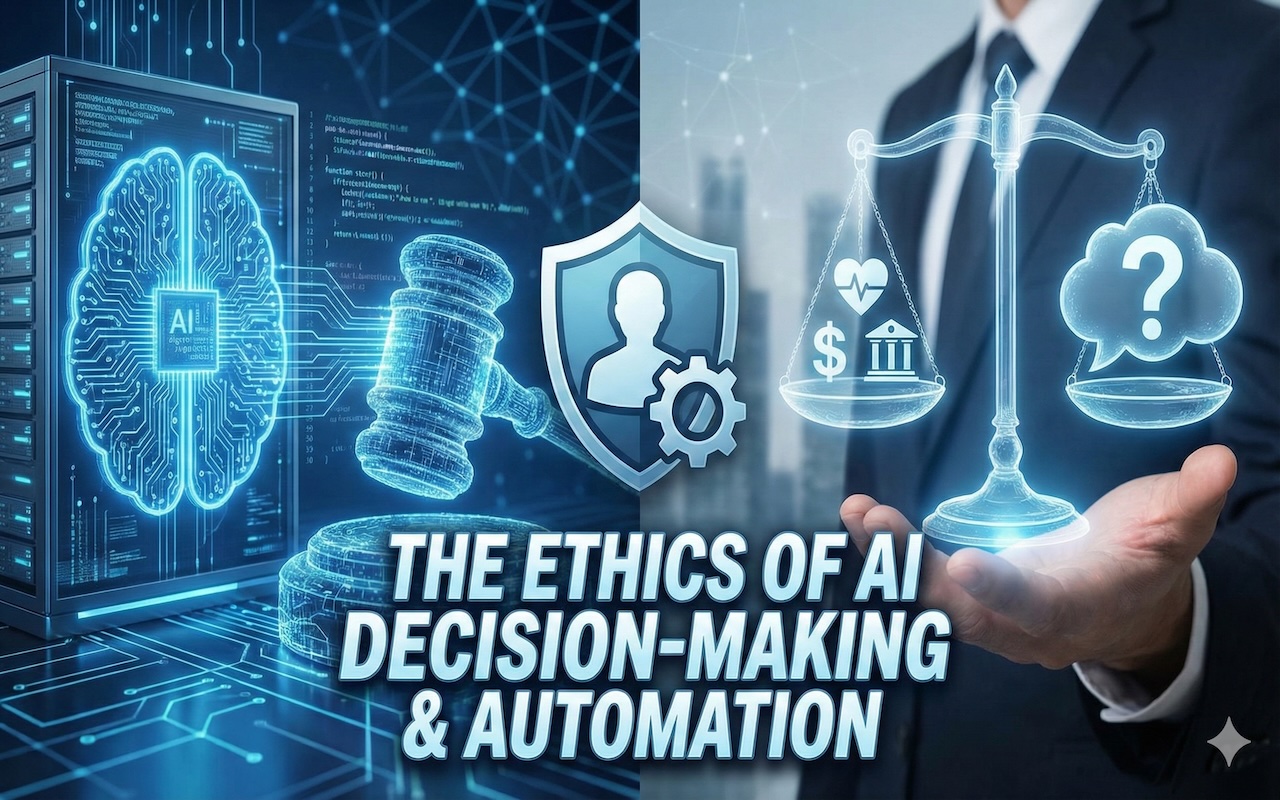
Artificial intelligence is rapidly becoming a decision-maker in modern society. From approving loans and diagnosing diseases to screening job candidates and managing traffic systems, AI-driven decision-making and automation are shaping critical outcomes that affect millions of lives.
While these technologies offer efficiency, speed, and scalability, they also raise serious ethical concerns. As AI systems gain more authority, questions about fairness, accountability, transparency, and human control become increasingly urgent.
Understanding the biggest AI ethics challenges in decision-making and automation is essential to ensure that technological progress benefits society rather than creating new forms of harm or inequality.
The Growing Role of AI in Decision-Making
AI systems are no longer limited to supporting human decisions; in many cases, they are making decisions autonomously. Organizations use algorithms to evaluate creditworthiness, predict criminal behavior, recommend medical treatments, and automate hiring processes. These systems analyze massive datasets and identify patterns far beyond human capability.
However, AI decisions are only as good as the data and rules they are built on. When AI operates at scale, even small flaws can lead to widespread ethical consequences, making oversight and responsible design critical.
Bias and Discrimination in AI Systems
One of the most widely discussed ethical challenges in AI is bias. AI systems learn from historical data, which often reflects existing social inequalities and prejudices. If biased data is used to train algorithms, the resulting decisions may reinforce or amplify discrimination.
In recruitment, biased AI systems can advantage certain genders, ethnic groups, or educational profiles. In financial services, skewed algorithms may limit access to credit for particular communities. Within criminal justice, predictive policing tools risk disproportionately impacting marginalized populations. While such effects are often unintended, their real-world consequences can be significant.
Eliminating bias is challenging because it requires not only technical fixes but also a deep understanding of social and cultural contexts. Ethical AI development must include diverse datasets, inclusive design teams, and continuous bias audits.
Lack of Transparency and Explainability
Many AI systems, particularly those based on deep learning, function as “black boxes.” They produce decisions or predictions without clear explanations of how those conclusions were reached. This lack of transparency creates both ethical and practical concerns.
When individuals are denied a loan, rejected for a job, or flagged as high-risk by an algorithm, they deserve to understand why. Without explainability, it becomes difficult to challenge unfair decisions, correct errors, or build trust in AI systems.
Explainable AI seeks to make algorithmic decisions more understandable to humans, but balancing transparency with system performance remains a significant challenge.
Accountability and Responsibility Gaps
Accountability is another major ethical concern in AI-driven decision-making. When automated systems make decisions, it is often unclear who is responsible for the outcome. Responsibility may be distributed across developers, organizations, and data providers.
If an AI system causes financial loss, medical errors, or safety incidents, assigning accountability becomes complex. Without clear responsibility frameworks, ethical loopholes may emerge where harm goes unaddressed.
Strong governance structures are essential to ensure that humans remain accountable for AI-driven outcomes.
Automation and the Loss of Human Judgment
Automation can improve efficiency, but it also raises concerns about over-reliance on machines. When organizations trust AI systems without adequate human oversight, critical judgment and contextual understanding may be lost.
AI systems may struggle with edge cases, moral reasoning, or situations requiring empathy. In healthcare, automated decisions without human review may lead to misdiagnosis. In finance or legal contexts, rigid algorithms may overlook individual circumstances.
Ethical AI requires a human-in-the-loop approach, ensuring that humans retain authority over high-impact decisions.
Privacy and Data Consent Issues
AI systems rely on large volumes of data, much of it personal or sensitive. In decision-making and automation, data is often collected, processed, and shared at scale, raising serious privacy concerns.
Many individuals are unaware of how their data is used or how automated systems influence decisions about them. Inadequate consent mechanisms and weak data protection practices can erode trust.
Ethical AI development must prioritize data minimization, robust security, and transparent data usage policies.
Inequality and Power Imbalances
AI-driven automation can exacerbate social and economic inequalities if deployed without safeguards. Large organizations with access to advanced AI tools may gain disproportionate advantages, while smaller players and developing regions lag behind.
Control over algorithmic systems can concentrate power among a limited group of decision-makers. Without inclusive governance, efficiency gains may come at the expense of social equity.
Ethical Challenges in Autonomous Systems
As AI systems become more autonomous, they are increasingly required to make real-time decisions without human input. Autonomous vehicles, robotic systems, and smart infrastructure often face scenarios involving ethical trade-offs.
Encoding ethical reasoning into machines presents philosophical, legal, and cultural challenges. There is no universal agreement on how autonomous systems should make ethical choices, making this a particularly complex area of AI ethics.
Regulatory and Governance Challenges
Regulation has struggled to keep pace with the rapid development of AI technologies. Many existing laws were not designed for automated decision-making systems, creating regulatory gaps.
Governments must balance innovation with public protection. Too much regulation may slow progress, while too little can lead to ethical and societal harm.
Developing adaptive regulatory frameworks and global standards is essential for responsible AI governance.
Building Ethical AI for the Future
Addressing AI ethics challenges requires collaboration among technologists, policymakers, ethicists, and the broader public. Ethical considerations should be integrated throughout the AI lifecycle, from data collection to deployment and monitoring.
Organizations should adopt principles such as fairness, transparency, accountability, and human oversight. Regular audits, impact assessments, and stakeholder engagement help identify ethical risks early.
Conclusion
The biggest AI ethics challenges in decision-making and automation include bias, transparency, accountability, privacy, and the preservation of human control. As AI systems increasingly influence critical decisions, ethical responsibility becomes more important than ever.
AI has the potential to improve efficiency, accuracy, and access across industries, but only when developed and deployed responsibly. Ethical AI is not just a technical requirement—it is a social obligation. By prioritizing fairness, transparency, and human values, organizations can ensure that automation serves humanity rather than undermines it.
Featured Image generated by Google Gemini.
Share this post
Author

Read the latest articles from Rosie Anna
How Will Cloud Computing and Edge Computing Change the Way Businesses Scale?

January 7, 2026
Cloud computing and edge computing are reshaping how businesses scale by making growth faster, smarter, and more cost-efficient. Instead of relying on rigid infrastructure, companies can now scale dynamically, both centrally (in the cloud) and locally (at the edge), based on real business needs.
Learn moreCan Blockchain Solutions Work Beyond Cryptocurrency in Healthcare and Finance?

December 23, 2025
Blockchain technology is often associated with cryptocurrencies like Bitcoin and Ethereum. While digital currencies were the first mainstream application of blockchain, they represent only a fraction of what this technology can offer. As industries continue to digitize and face increasing challenges around data s [...]
Learn moreLeave a comment
All comments are moderated. Spammy and bot submitted comments are deleted. Please submit the comments that are helpful to others, and we'll approve your comments. A comment that includes outbound link will only be approved if the content is relevant to the topic, and has some value to our readers.
Comments (0)
No comment