
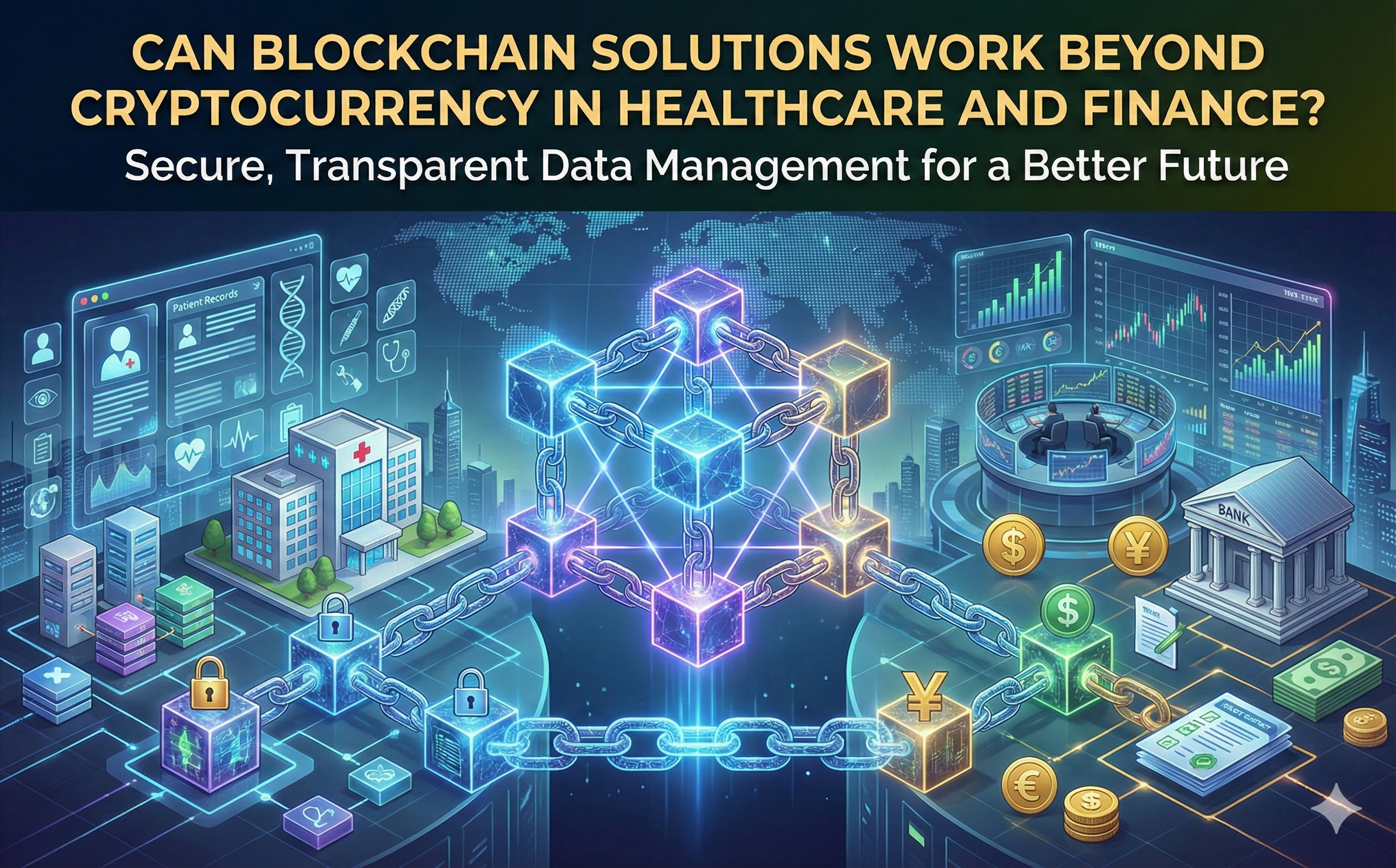
Blockchain technology is often associated with cryptocurrencies like Bitcoin and Ethereum. While digital currencies were the first mainstream application of blockchain, they represent only a fraction of what this technology can offer. As industries continue to digitize and face increasing challenges around data security, transparency, and trust, blockchain is emerging as a powerful solution far beyond cryptocurrency, particularly in healthcare and finance.
These two industries handle vast amounts of sensitive data, require high levels of trust, and operate under strict regulatory environments. Blockchain’s core characteristics make it uniquely suited to address many of their long-standing problems.
Understanding Blockchain Beyond Digital Currency
At its core, blockchain is a distributed ledger technology that records transactions across multiple systems in a secure and immutable way. Instead of relying on a central authority, blockchain uses cryptographic verification and consensus mechanisms to validate data. Once information is recorded, it cannot be altered without network consensus, making the system highly resistant to fraud and tampering.
This structure enables transparency, accountability, and data integrity—features that are critical not only for financial transactions but also for managing sensitive records, identities, and workflows across industries.
Why Healthcare Needs Blockchain Solutions
Healthcare systems around the world struggle with fragmented data, security breaches, and inefficiencies caused by outdated infrastructure. Patient information is often scattered across hospitals, laboratories, pharmacies, and insurers, making secure data sharing difficult.
Blockchain offers a new way to manage healthcare data by enabling secure, patient-centric record systems. Instead of storing medical records in isolated databases, blockchain allows authorized stakeholders to access a single, verified source of truth. Patients can control who accesses their data, improving privacy and trust.
Another major benefit is data integrity. Medical records stored on a blockchain cannot be altered or deleted, ensuring accurate medical histories. This is particularly important for diagnosis, treatment planning, and regulatory compliance.
Improving Interoperability and Collaboration in Healthcare
One of the biggest challenges in healthcare is interoperability, the ability for different systems to communicate effectively. Blockchain can act as a secure data-sharing layer that connects healthcare providers without exposing sensitive information.
This improves coordination among doctors, hospitals, and laboratories. Duplicate tests can be reduced, treatment delays minimized, and overall patient outcomes improved. In emergency care scenarios, real-time access to verified medical information can be critical.
Blockchain also strengthens collaboration in medical research. Clinical trial data recorded on a blockchain is transparent and tamper-resistant, reducing fraud and selective reporting while increasing trust in research outcomes.
Strengthening Pharmaceutical Supply Chains
Counterfeit drugs pose a serious global threat, endangering lives and undermining trust in healthcare systems. Blockchain provides end-to-end visibility across pharmaceutical supply chains.
Each step, from manufacturing to distribution and delivery, is recorded on the blockchain. This allows regulators, suppliers, and healthcare providers to verify drug authenticity instantly, improving patient safety, regulatory compliance, and supply chain efficiency.
Blockchain’s Expanding Role in Finance
In finance, blockchain is already transforming processes beyond cryptocurrency. Traditional financial systems often rely on intermediaries, manual reconciliation, and lengthy settlement times. Blockchain streamlines these processes by enabling faster, more transparent transactions.
Cross-border payments are a prime example. Blockchain-based systems can process international transfers in minutes instead of days, reducing costs and improving access to financial services, particularly in underserved regions.
Blockchain also enhances financial security. Every transaction is cryptographically secured and permanently recorded, making fraud and unauthorized changes extremely difficult. This immutable audit trail is especially valuable for compliance and risk management.
Smart Contracts and Financial Automation
Smart contracts are one of blockchain’s most powerful features. These are self-executing programs that automatically enforce contract terms once predefined conditions are met.
In finance, smart contracts can automate loan disbursements, insurance claims, and trade settlements. This reduces manual intervention, lowers operational costs, and minimizes human error, while improving transparency and speed for customers.
Financial institutions can also use smart contracts to support automated regulatory compliance, easing audit and reporting requirements.
Digital Identity and Compliance Transformation
Identity verification remains a major challenge in both healthcare and finance. Blockchain enables decentralized digital identity systems that allow individuals to verify their identity securely without repeatedly sharing sensitive personal data.
In finance, this simplifies Know Your Customer and Anti-Money Laundering processes while improving privacy and reducing onboarding friction. In healthcare, accurate identity verification helps prevent medical fraud and record mismatches.
By giving users greater control over their digital identities, blockchain supports a more secure and user-centric approach to identity management.
Shared Benefits Across Healthcare and Finance
Healthcare and finance share common challenges, including data security, trust, regulatory compliance, and operational inefficiencies. Blockchain addresses these issues by offering transparency without sacrificing privacy.
The technology reduces reliance on centralized systems, lowers costs, and increases resilience against cyber threats, while fostering trust between stakeholders who may not otherwise interact directly.
Challenges Slowing Blockchain Adoption
Despite its potential, blockchain adoption faces obstacles. Scalability remains a concern for systems processing high transaction volumes, and integrating blockchain with legacy infrastructure can be complex and costly.
Regulatory uncertainty also affects adoption, as governments and regulators continue developing frameworks for blockchain-based systems. Additionally, there is a shortage of professionals with expertise in blockchain architecture, security, and compliance.
These challenges slow progress but are gradually being addressed as the technology matures.
The Future of Blockchain Beyond Cryptocurrency
Blockchain is not a replacement for existing systems but a powerful complementary technology. Permissioned and hybrid blockchains are gaining traction, offering better scalability, governance, and compliance while retaining decentralization benefits.
In healthcare, blockchain will enable secure data sharing, transparent research, and patient-centric care models. In finance, it will support faster payments, automated compliance, and trusted digital identity ecosystems.
As standards evolve and real-world implementations grow, blockchain is moving steadily from experimentation to mainstream adoption.
Conclusion
Blockchain solutions clearly extend far beyond cryptocurrency, with healthcare and finance leading the way in real-world adoption. By improving security, transparency, efficiency, and trust, blockchain addresses some of the most persistent challenges across both industries.
Featured Image generated by Google Gemini.
Share this post
Author

Read the latest articles from Rosie Anna
How Will Cloud Computing and Edge Computing Change the Way Businesses Scale?

January 7, 2026
Cloud computing and edge computing are reshaping how businesses scale by making growth faster, smarter, and more cost-efficient. Instead of relying on rigid infrastructure, companies can now scale dynamically, both centrally (in the cloud) and locally (at the edge), based on real business needs.
Learn moreBiggest AI Ethics Challenges in Decision-Making and Automation
December 23, 2025
Artificial intelligence is rapidly becoming a decision-maker in modern society. From approving loans and diagnosing diseases to screening job candidates and managing traffic systems, AI-driven decision-making and automation are shaping critical outcomes that affect millions of lives. While these technologies offe [...]
Learn moreLeave a comment
All comments are moderated. Spammy and bot submitted comments are deleted. Please submit the comments that are helpful to others, and we'll approve your comments. A comment that includes outbound link will only be approved if the content is relevant to the topic, and has some value to our readers.
Comments (0)
No comment