
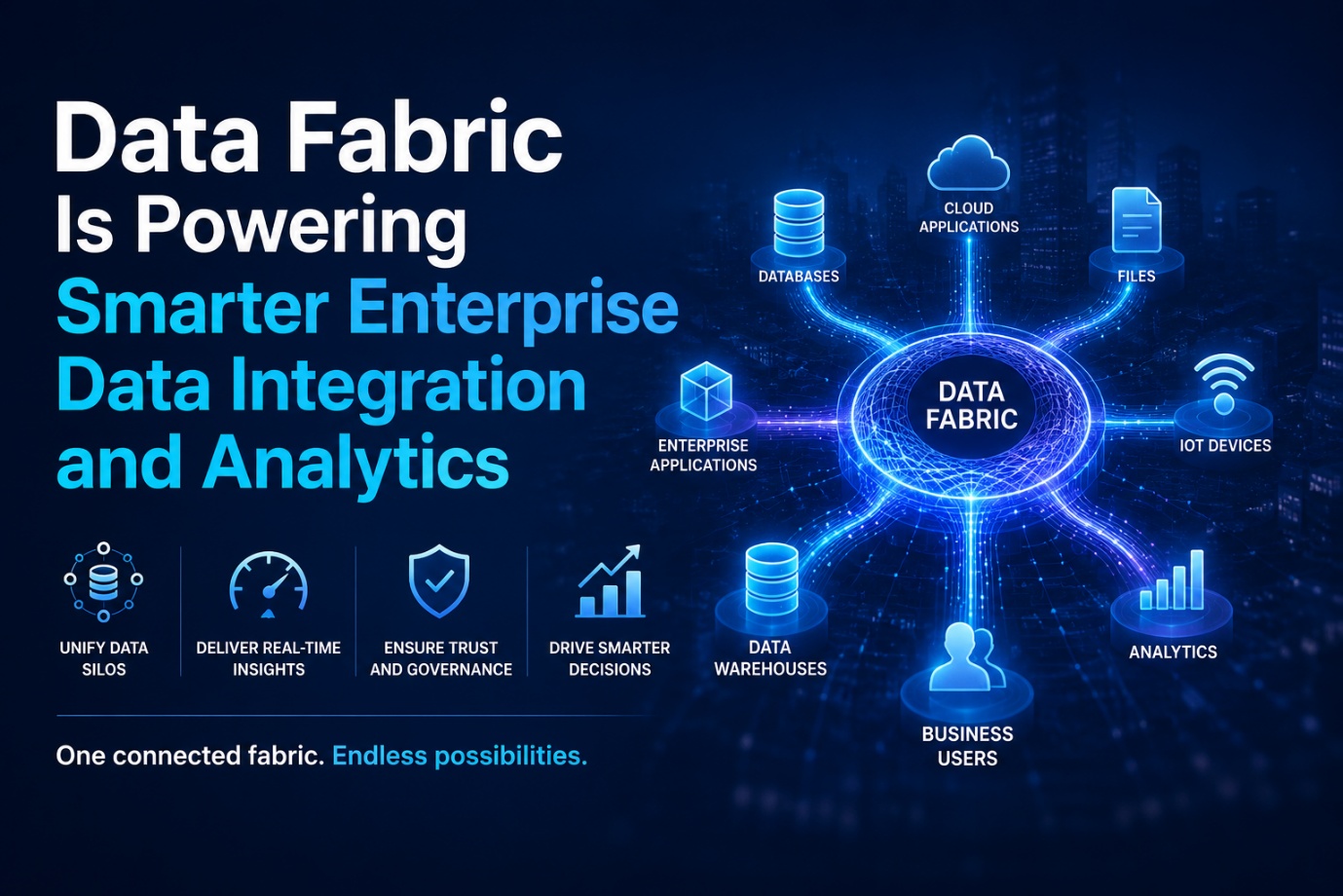
Data fabric is being recognized as the glue of contemporary data strategy for enterprises, as it allows companies to connect the dots across remote data locations, facilitate governance, and boost the speed of analysis across mixed environments. In simple terms, it is not a matter of moving data to a single huge repository but of establishing an intelligent layer that simplifies and improves the accessibility of information at scale.
Why Data Fabric Matters
The amount of data businesses have collected is much larger and more dispersed than before, as data now exists across cloud platforms, on-premises systems, and even application silos. The Information Technology Research organization has stated that approximately 60% of business data goes unused, indicating that much data is locked in separate systems. This creates an urgent need for data fabric, making it a necessity for enterprises.
Data fabric helps integrate different parts of data management, such as data integration, so that all components are unified. In addition to manual ETL processes, data fabric allows batch processing, stream processing, virtualization, etc. This is really important because nowadays analytics doesn’t rely solely on static data as it did before.
What Changes in Integration
Traditional integration methods typically address only one issue, like transferring data from one platform to another. Data fabric, on the other hand, is a more comprehensive technology that integrates data from numerous sources and categorizes, enriches, and oversees them through automated processes driven by metadata. The implication is that the integration technology is not just about transferring data but also about making it useful right after it is received.
A good analogy showing the difference is that traditional integration technologies ask the question of how data transfer occurs between two systems, while data fabrics focus on how users and analysis tools can access trustworthy data from anywhere. This matters a lot in organizations where data regarding customers, finance, supply chain, and products must all be available to create dashboards and predictive models. Also, integration saves effort by avoiding the creation of redundant pipelines for the same data.
Analytics Becomes Faster
One of the key factors contributing to the rising popularity of data fabric is the benefits of analytics, which indicate that when data is unified and properly managed, analysts spend more time applying data analytics and less time looking for data. According to research, the data fabric is a fundamental tool that can be employed for creating a real-time and historical network that enhances BI and digital transformation processes.
This implies that the role of data fabric becomes critical for companies that utilize operational reporting, forecasting, and AI-enabled data. Research finds that only 29% of technology managers believe their companies’ data has the required quality, accessibility, and security for the successful development of generative AI technologies, even though 67% of CFOs maintain that their organizations have the required data.
Market Momentum
Dataintelo data showed that the global data fabrics market was estimated to be worth 2.28 billion U.S. dollars in 2025, rising to 9.73 billion U.S. dollars in 2034 with a CAGR of 17.5 percent. Statistics indicate that companies are investing heavily in contemporary integration, as fragmented data can no longer be ignored.
| Signal | Figure | Meaning |
|---|---|---|
| Data integration market in 2025 | $18.48 billion | Large and established demand |
| Forecast for 2034 | $47.88 billion | Roughly doubling in six years |
| CAGR | 11.20% | Strong, sustained adoption |
Core Enterprise Benefits
The data fabric is valuable in various ways. Firstly, it enhances data discoverability through active metadata and catalogues that help people find the needed data quicker. Secondly, it strengthens data governance through access control, masking, and classification features linked to the data.
Some of the most obvious benefits include:
- Faster access to trusted data across departments.
- Better governance and compliance through centralized policy enforcement.
- Lower duplication of pipelines and storage through virtualization and reuse.
- Stronger readiness for AI and BI use cases because data is more contextual and current.
These benefits are not hypothetical. They become apparent when one needs to make a customer view comprising CRM, billing, support and usage data in an almost real-time manner. Without using a fabric-like layer, such a view will often take too much time and effort to become available.
Architecture in Practice
Data fabric is often described in terms of three technological concepts: data virtualization, federated active metadata, and machine learning. Virtualization enables the system to access data from different sources without physically moving it. Active metadata provides constant updates on the meaning, location, and quality of data assets, enabling searchability and manageability of the environment.
The use of machine learning enables automatic classification, anomaly detection, policy enforcement, and compliance. Such automated operations are integral to large businesses with thousands of data assets.
Business Outcome
Conclusion
The companies' aim in utilizing data fabric is to improve how business decisions are managed. Data fabric does not actually enhance data quality but rather helps keep data organized and used most effectively. As a result, the analytics process runs faster, the security of AI becomes stronger, and the integrations run smoothly.
This becomes extremely crucial in 2026 because the tendency toward greater complexity rather than clarity is evident in the business environment. Companies that can achieve data unification without too much trouble can adapt better to change.
Share this post
Author

Leave a comment
All comments are moderated. Spammy and bot submitted comments are deleted. Please submit the comments that are helpful to others, and we'll approve your comments. A comment that includes outbound link will only be approved if the content is relevant to the topic, and has some value to our readers.
Comments (0)
No comment