

Artificial intelligence is not really a thing only for huge enterprises with big budgets anymore. Now, startups often use AI to automate day-to-day work, understand customer behavior, boost decision-making, and craft nicer products with fewer resources. For young companies trying to build innovative digital solutions, teaming up with a seasoned software development startup can help turn AI-enabled ideas into scalable products while keeping things moving. As competition keeps growing in different industries, AI gives startups fresh chances to go faster, fine-tune processes, and face off with larger organizations.
Still, jumping on artificial intelligence is not only about dropping it into every single workflow, like a quick add-on or something. Startups ought to determine where AI really adds value and how it supports their existing business goals. It can be better customer engagement, yes, but also smarter internal operations, or even the chance to craft something genuinely new. In any case, AI helps startups move faster and make sharper decisions.
AI Helps Startups Make Better Business Decisions
Early stage companies often run with limited information. Founders need to grasp their customers, spot market openings, and decide where to put resources, where it actually matters, not just where it sounds good. AI powered analytics tools let startups chew through huge amounts of data and find odd patterns that are hard to catch by hand, or with the usual spreadsheets that everyone avoids.
For instance, AI can study customer conversations, buying habits, and broader market trends, to surface what users want the most. With these signals, a startup can fine tune its strategy based on evidence from the real world, instead of relying on guesses that feel convincing at the time.
This idea really clicks for technology companies building data driven products. AI helps founders locate solid opportunities, prove whether a product idea makes sense, and see how customers engage with their solution in practice.
AI Automates Processes and Saves Valuable Resources
Startups generally tend to be small companies wherein each member has to concentrate on important tasks. AI can help lighten the load through process automation of the time-consuming repetitive processes.
These include:
- AI-based chatbots for handling routine queries of the customers
- Automation of data processing and reporting
- Personalized marketing via AI
- Workflow automation
Through these processes, startups can dedicate their time to enhancing their products, engaging with their customers, and identifying new avenues.
AI automation does not eliminate human knowledge. Rather, it increases efficiency through human creativity combined with automation productivity.
AI Improves Customer Experience
Customer expectations are, pretty much, always going up. Folks want quick replies, personalized nudges, and this smooth digital kinda vibe. With AI, even startups with not a lot of money can still manage these perks, sort of right away.
Recommendation systems, predictive analytics, and conversational ai tools kind of do the heavy lifting here, helping organizations understand customer preferences and deliver more relevant, ongoing touchpoints.
For instance an online platform can use AI to guide people toward products based on what they did earlier. A SaaS company might lean on AI assistants to help customers fix problems faster, with less back-and-forth, in general. Meanwhile a healthcare startup can apply AI capabilities for stronger diagnostics and also patient support.
When startups build these more tailored experiences, customer satisfaction often climbs too, and their relationship with users tends to feel more solid, as time passes.
AI Supports Faster Product Development
One of the biggest strengths that startups have compared to bigger companies is the ability to launch a product quickly. AI can help in speeding up various aspects of the product development process.
AI-based systems can be used for:
- Code generation and verification
- Finding problems in software
- User feedback analysis
- Helping make better decisions about product design
This helps startups test ideas and roll out updates much quicker.
However, startups need to concentrate on building solid tech platforms. This is necessary in order to implement AI solutions effectively.
AI Helps Startups Compete With Larger Companies
Large companies always seemed to have a bit of advantage because, they had more employees , larger budgets , and access to deeper data. In practice, AI starts to shrink that gap, because startups can tap into powerful techs without needing enterprise-level resources, if you think about it.
A small group now can use AI tools for market discovery, content production, customer service, building software, and business analysis. So they can run the operation more efficiently, and yes compete with the established names. Not in some magic way, more like better leverage.
The big difference is not simply whether a startup uses AI, but how strategically it applies artificial intelligence, to actually solve the real problems that matter.
Challenges Startups Should Consider Before Implementing AI
There are plenty of possibilities when it comes to startups utilizing AI, but its proper implementation becomes crucial. Otherwise, it will lead to mistakes, expenses, or solutions to issues that may not even exist.
Some of the questions that should be asked in case the AI implementation is taken into account include the following:
- What kind of business issue does the startup have?
- Is there any good quality data available?
- How will AI fit into their operations?
- How will customers' confidentiality be preserved?
The company must not implement the technology just because it is trendy.
The Future of AI-Powered Startups
Artificial intelligence will keep reshaping how startups build products, serve customers, and grow as businesses, honestly it’s kinda nonstop. The companies that use AI in a strategic way can move faster, grasp their markets more clearly, and end up with solutions that feel more competitive.
Now, the really successful startups probably won’t be the ones that throw AI everywhere, all the time. They’ll be the ones who know exactly where artificial intelligence creates real leverage and then mix the technology with solid business ideas, like a good recipe.
For founders, AI is also a kind of chance to craft smarter products, fine-tune day-to-day operations, and go after markets that used to be hard to enter. If you take the right path, artificial intelligence could become one of the most powerful engines for startup growth.
Share this post
Author

Read the latest articles from Yuliya Melnik
Why Cloud Optimization Is Critical for SaaS Growth

June 10, 2026
Cloud infrastructure powers nearly every modern SaaS product. It offers the flexibility to launch quickly, expand across regions, and deliver services without relying on physical hardware. However, simply deploying a SaaS platform in the cloud does not automatically guarantee efficiency.
Learn moreThe Difference Between MVP and First Product Version: A Founder’s Guide
June 10, 2026
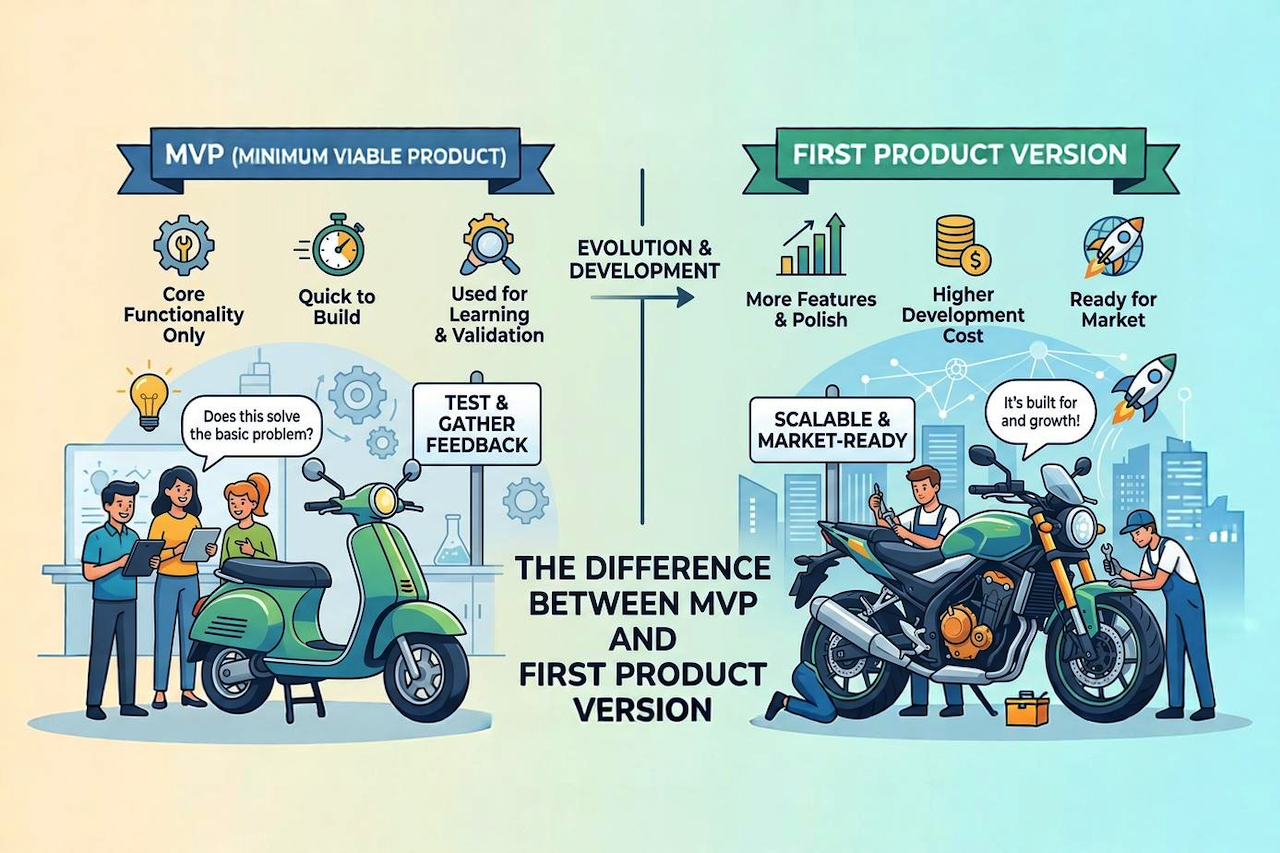
Many founders use the terms MVP and first product version almost interchangeably. But in reality, they represent two different stages of product development. An MVP (Minimum Viable Product) is used to validate a business idea with a small investment. The first product version follows that validation and o [...]
Learn moreLeave a comment
All comments are moderated. Spammy and bot submitted comments are deleted. Please submit the comments that are helpful to others, and we'll approve your comments. A comment that includes outbound link will only be approved if the content is relevant to the topic, and has some value to our readers.
Comments (0)
No comment