
In today’s fast-paced digital world, organizations need to deliver high-quality applications faster than ever before. User needs shift constantly, technologies evolve quickly, and competition is fierce. To meet these demands, many companies adopt Agile as a more responsive way to build applications.
The Agile mindset has transformed how apps are planned, built, tested, and launched in modern app development. Designed for flexibility, collaboration, and continuous improvement, Agile has become a widely used approach for businesses of all sizes seeking stronger development outcomes.
Understanding Agile Methodology in App Development
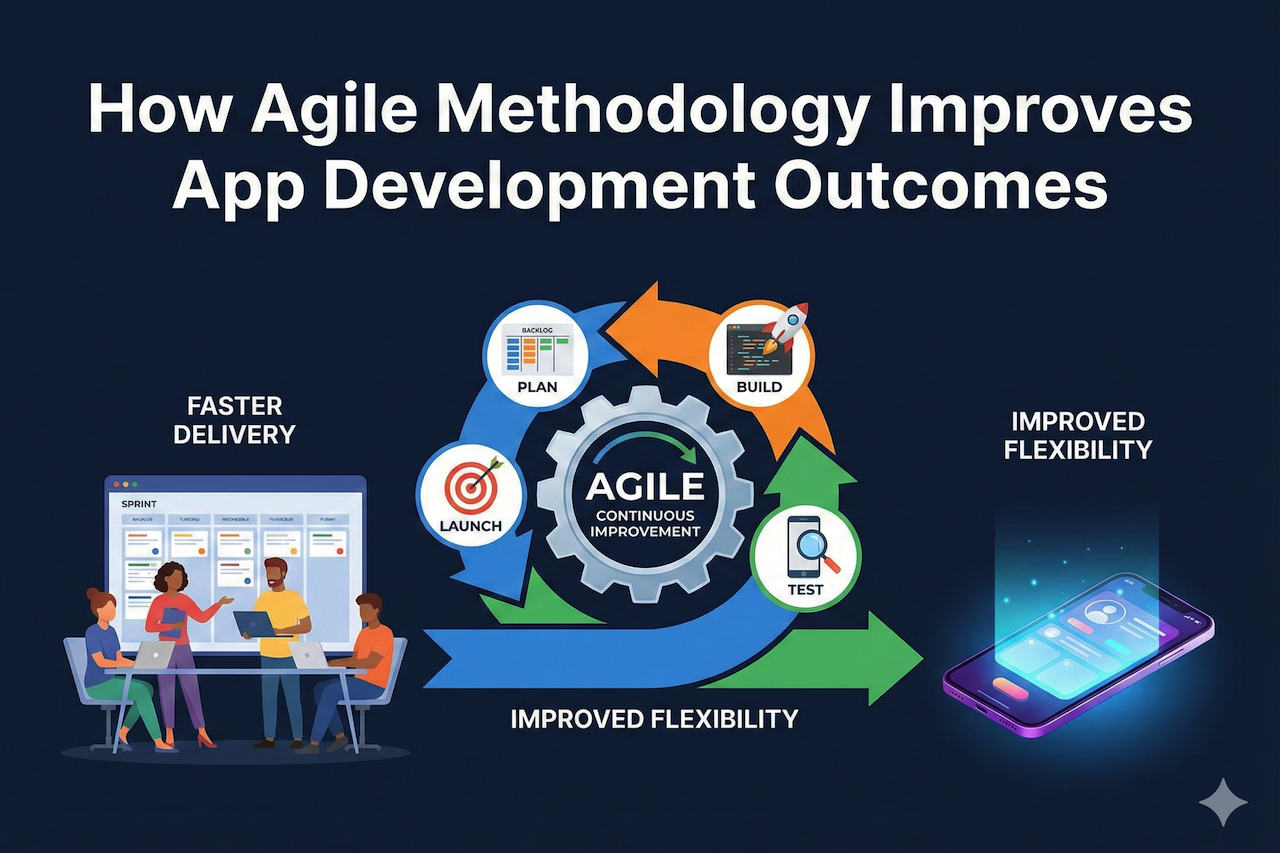
Agile is an iterative, incremental approach. Projects are divided into smaller, manageable parts (often delivered in sprints) and released step by step. Instead of waiting until the end of a long cycle, Agile teams regularly deliver functional portions of the app.
In Agile app development, the focus is on:
- Working software instead of lengthy documentation
- Customer collaboration instead of rigid contracts
- Responding to change instead of following strict plans
This approach helps ensure apps are built around real business needs and user feedback rather than assumptions made early in the process.
Faster Delivery and Time-to-Market
One of Agile’s biggest advantages is speed. Traditional models can take months before producing tangible results, while Agile supports incremental releases that deliver value early and often.
How Agile speeds up app development:
- Starts with a minimum viable product (MVP)
- Breaks work into short, focused sprints
- Incorporates feedback quickly
This helps businesses launch faster, test ideas in real markets, and stay competitive.
Improved Flexibility and Change Management
Change is inevitable during development. New user needs, technical constraints, and business priorities can emerge at any time. Agile welcomes change rather than resisting it.
With Agile, teams can:
- Adjust features mid-development
- Reprioritize work based on business value
- Adapt quickly without major disruption
This flexibility keeps the product aligned with current market demands.
Enhanced Collaboration and Transparency
Agile encourages continuous communication among developers, designers, testers, and stakeholders. Daily stand-ups, sprint reviews, and retrospectives help maintain alignment and accountability.
Benefits include:
- Clear visibility into progress
- Faster problem resolution
- Fewer misunderstandings
- Better decisions overall
Transparency strengthens trust and teamwork, which supports smoother delivery.
Higher-Quality Applications
In Agile, quality is built in from day one. Instead of leaving testing to the end, Agile integrates testing throughout the development process.
This means:
- Bugs are caught early
- Code reviews happen frequently
- Features are tested continuously
- Technical debt is reduced over time
As a result, applications tend to be more stable, secure, and reliable.
Customer-Centric Development
Agile keeps customers and stakeholders closely involved. Regular feedback helps ensure the app delivers real value.
Customer involvement helps teams:
- Validate features early
- Improve usability and performance
- Match functionality to expectations
- Reduce the risk of building the wrong product
This user-first approach can improve engagement and satisfaction.
Better Risk Management
Large development projects carry risks such as budget overruns, missed deadlines, or unmet requirements. Agile reduces these risks through iterative delivery and continuous evaluation.
Agile supports risk management by:
- Breaking work into smaller tasks
- Detecting issues early
- Tracking progress consistently
- Making data-informed adjustments
This makes projects more predictable and easier to course-correct.
Cost Efficiency and Resource Optimization
Agile can help control costs because progress and ROI can be reviewed continuously as work is delivered in stages.
Cost-saving benefits include:
- Avoiding unnecessary features
- Reducing rework
- Using resources efficiently
- Improving budget forecasting
By focusing on the highest-value work first, teams can maximize development investment.
Continuous Improvement Through Iteration
Agile is built around continuous improvement. After every sprint, teams review what worked, what didn’t, and how to improve next time.
This leads to:
- More efficient workflows
- Higher productivity
- Stronger problem-solving
- Better results over time
Each iteration can strengthen both the product and the team.
Scalability for Growing Projects
Agile can scale from startups to large enterprises. Frameworks such as Scrum, Kanban, and the Scaled Agile Framework (SAFe) help multiple teams coordinate on complex initiatives.
Scalable Agile supports:
- Consistent delivery
- Alignment with business goals
- Smoother coordination across teams
This makes it suitable for long-term growth and evolving product roadmaps.
Agile vs. Traditional Models
| Traditional Model | Agile Methodology |
|---|---|
| Fixed requirements | Adaptive planning |
| Late testing | Continuous testing |
| Limited feedback | Ongoing user feedback |
| Higher risk | Reduced risk |
| Slow delivery | Faster delivery |
This is why Agile is often preferred for modern app development.
Conclusion
Agile methodology improves app development outcomes by making delivery faster, more adaptable, and more customer-focused. Its iterative structure, collaborative workflows, and responsiveness to change help teams build applications that better match real-world needs.
In today’s digital environment, Agile is a practical approach for building scalable, high-performing applications and for supporting continuous improvement across the development lifecycle.
Featured Image generated by Google Gemini.
Share this post
Author

Leave a comment
All comments are moderated. Spammy and bot submitted comments are deleted. Please submit the comments that are helpful to others, and we'll approve your comments. A comment that includes outbound link will only be approved if the content is relevant to the topic, and has some value to our readers.
Comments (0)
No comment