
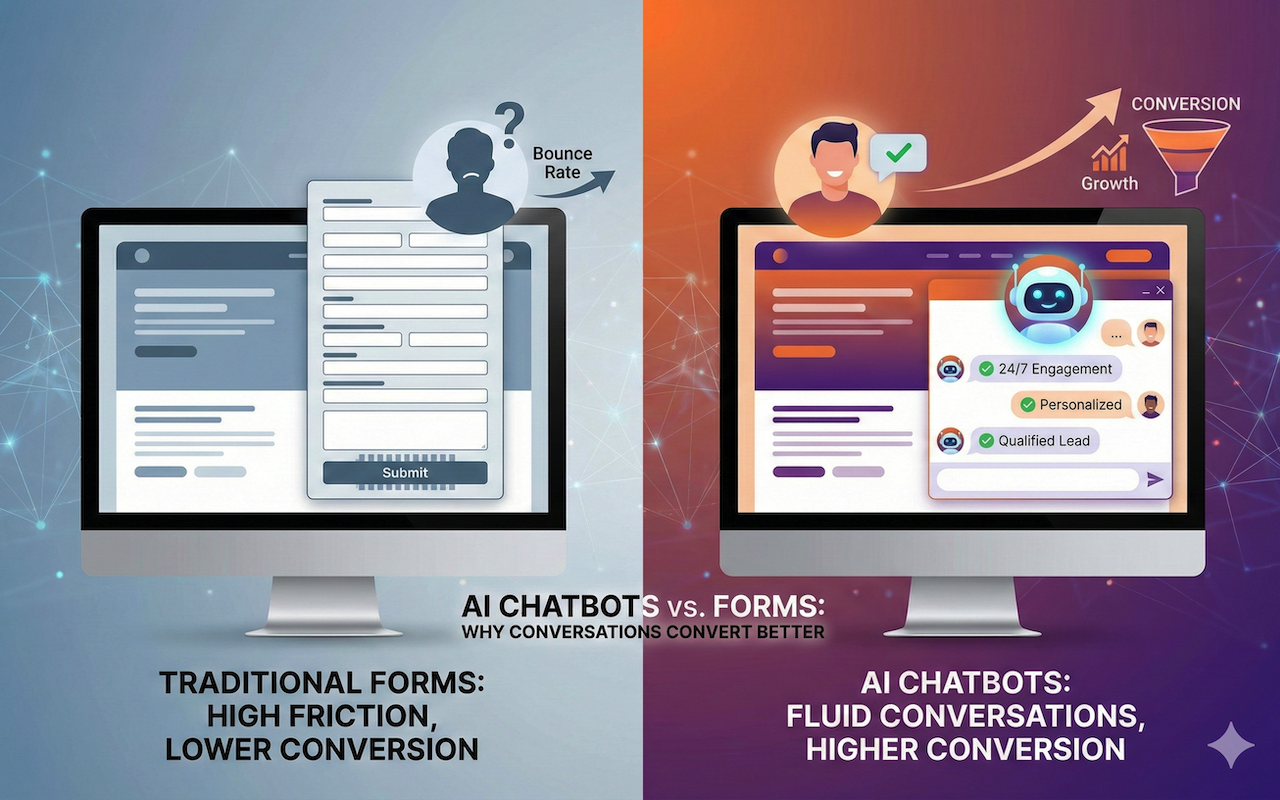
Why AI Chatbots Convert Better Than Forms on Landing Pages
You put a lot of marketing effort and cost into getting people to your landing page, but they leave without even filling out your form. Frustrating, right? Traditional lead forms feel like a hurdle because they ask for a lot of information, especially from people who aren’t yet sure they can trust your brand.
AI chatbots flip that script. They don’t force anyone to dive in headfirst. They spark genuine conversations. That, in turn, results in interactions that are more fluid, natural, and helpful.
Through this approach, chatbots become more approachable and accessible. They lower hesitation and convert visitors into leads that have real potential for business growth.
Why Use AI Chatbots for Lead Generation?
AI chatbots are efficient at conducting real-time, goal-oriented conversations with users that align with their behavior and context.
They don’t only collect information. They change how leads are generated by responding in real time and adapting to each person’s intent.
Instant, 24/7 Engagement
AI chatbots operate asynchronously and enable real-time engagement, even outside business hours. When a visitor lands on your page, the chatbot can trigger proactive messages immediately.
These triggers can be based on scroll depth, exit intent, or referral source. This approach can reduce bounce rates and capture leads at peak interest moments. It also removes the dependency on human availability.
Higher Conversion Rate
Unlike traditional forms, chatbots use natural language processing (NLP) to guide the user through a structured conversational flow. This reduces cognitive load and removes friction.
Instead of a long form, users answer one question at a time. This can improve completion rates and overall conversion metrics.
Personalized Interactions at Scale
Chatbots can make conversations feel personal by leveraging intent recognition, user attributes, and behavioral signals captured in real time. Responses can be tailored based on location, device, or campaign source.
They can also adapt using previous interaction data. This level of contextual personalization helps scale one-to-one experiences without manual effort.
Automated and Better Lead Qualification
Chatbots use logic-based flows and conditional branching to pre-qualify leads. They can apply scoring rules during conversations and filter out low-intent users early by asking targeted questions.
High-quality leads can be routed into your CRM or sales pipeline. This saves time and can improve close rates.
Unified Integration With Your Marketing Stack
Modern AI chatbots connect to CRMs, marketing automation platforms, analytics tools, and email workflows. This allows real-time synchronization of lead data across systems.
You can trigger follow-ups without delays and maintain a consistent omnichannel lead nurturing strategy.
How to Build a Lead Generation Chatbot: A 4-Step Process
The lead-generation chatbot setup can be straightforward with thoughtful design, the right tools, and a clear conversation strategy.
Step 1: Clearly Define Lead Goals and Conversation Flow
Figure out what a qualified lead looks like for you. Is it someone booking a demo, sharing an email address, or asking about your services? Map the conversation flow around that objective.
Every question should bring the user closer to conversion. Avoid unnecessary questions that can create friction or confusion.
Step 2: Select a Smart Chatbot Platform
Choose a solution that supports NLP, intent detection, and rule-based automation. It should integrate with your CRM and marketing tools.
Look for analytics, fallback handling, and human handoff. These capabilities help you scale without sacrificing accuracy.
Step 3: Build Engaging, Human-Like Interactions
Keep the tone conversational instead of relying on robotic scripts. Short questions are usually more effective than long, form-style prompts.
This is where a custom AI chatbot can make a difference. You can tailor responses to user intent and behavior. The experience should feel helpful, not sales-driven.
Step 4: Automate, Test, and Optimize
Automate lead routing and follow-up workflows when possible. Test different conversation paths and opening messages, then monitor drop-off points and completion rates.
Use performance data to refine questions and improve conversions over time.
Best Practices to Optimize Your Lead Gen Chatbot
Launching an AI chatbot isn’t the finish line. The value depends on how well you optimize it to capture conversations and turn them into qualified leads.
Create a Conversational Flow
Nobody likes filling out forms disguised as chat. Avoid long interrogations upfront. Instead, design flows that respond to user input and adapt dynamically.
A conversational structure feels more intuitive and can improve completion rates.
Prioritize High-Intent Data Over Volume
Focus on gathering information that supports qualification and follow-up. In many cases, intent, use case, and urgency matter more than demographic details.
Use progressive profiling to collect additional details later.
Make Personalization Context-Aware
Personalization works best when it reflects user intent rather than surface-level facts.
Use signals like page context, referral source, and previous interactions to tailor responses in real time.
Align Calls-to-Action With User Readiness
Every chatbot flow should guide users toward a next step, but the step should match their readiness.
For example, pricing questions may require qualification before pushing a demo CTA. Contextual CTAs feel helpful, not pushy, which reduces drop-offs.
Blend Automation With Human Support
Automation should improve the experience, not replace human interaction entirely. Enable human handoff for complex questions or high-intent scenarios.
A smooth transition between AI and humans can increase lead confidence.
Test and Refine Chat Flows Continuously
Continuous, data-driven optimization is essential. Track completions, drop-offs, and lead quality, then run A/B tests on openings, question order, and CTAs.
Small refinements can drive meaningful performance gains.
Conclusion
AI chatbots aren’t just a backup anymore. They are a practical way to capture, qualify, and convert leads directly on landing pages. When implemented well, they reduce friction, improve engagement, and support higher-quality lead capture at scale.
By focusing on conversation design and continuous optimization, you can turn simple interactions into measurable business growth.
Featured Image generated by Google Gemini.
Share this post
Leave a comment
All comments are moderated. Spammy and bot submitted comments are deleted. Please submit the comments that are helpful to others, and we'll approve your comments. A comment that includes outbound link will only be approved if the content is relevant to the topic, and has some value to our readers.
Comments (0)
No comment