
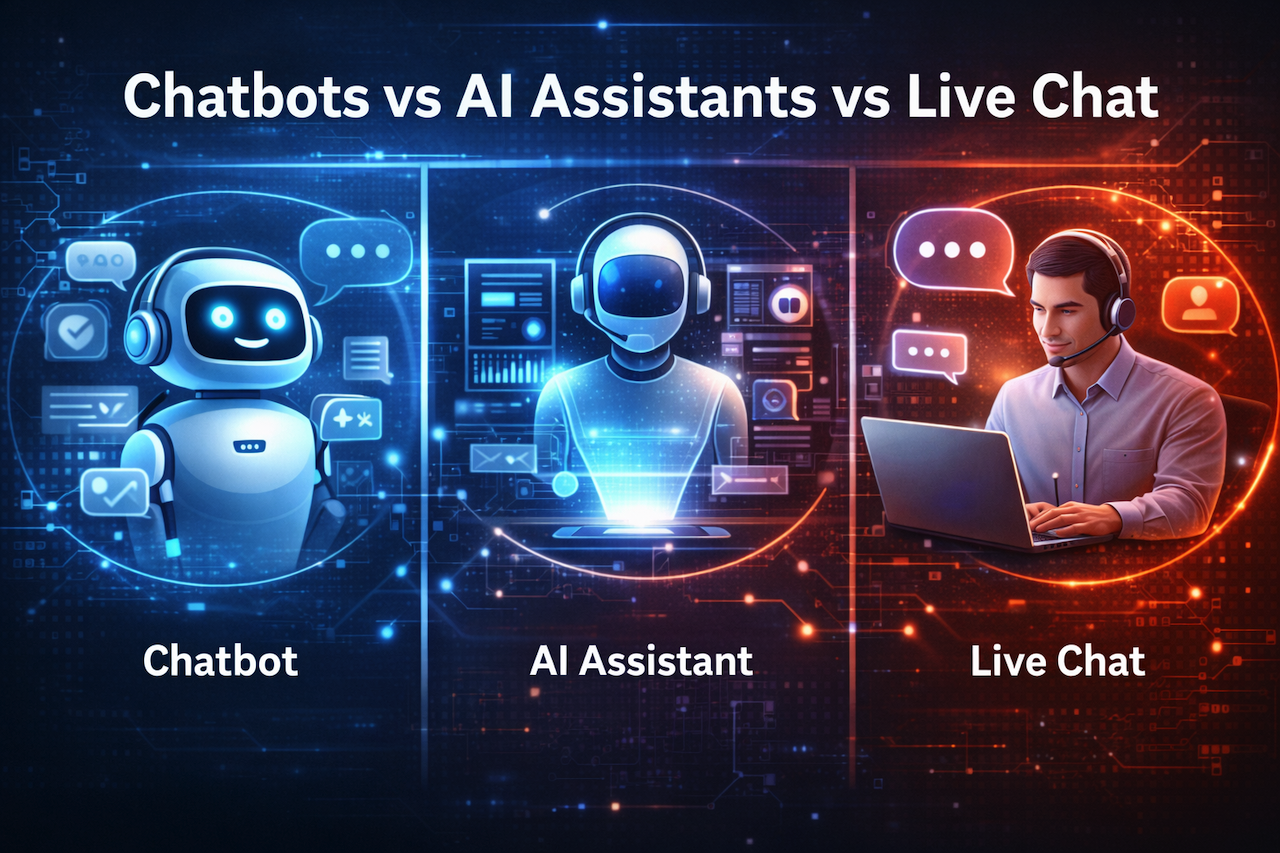
Modern users communicate with brands through AI tools, which have become a common trend. As a result of this shift, customer communication has evolved from a ticket-based, wait-heavy process to fast, AI-driven engagement across various digital channels. This has undoubtedly enabled businesses to deliver better customer support, highlighting the personalized assistance delivered quickly and efficiently. Conversational AI has helped make this a reality.
While businesses recognize that conversational AI is a valuable technology to adopt, the tools it supports serve distinct goals. Choosing the right one among them, or the right combination, is a strategic business investment in this context. Chatbots, live support (human teams), and AI assistants are models that can be selected based on specific organizational needs. An AI development team can assess whether a particular model will move in the right direction. This calls for immense research before you make the right choice.
With this perspective, this article shares the understanding and key differences among them (including their pros and cons for a business), which will help leaders make this decision.
What is Conversational AI?
Conversational AI is an intelligence-led system that helps businesses communicate with their users by leveraging natural language processing (NLP). This tool connects with customers via a generic voice or chat option and can quickly analyze the meaning and context of the user’s message.
It is designed to clearly understand user intent and respond with appropriate support and feedback in real time. At the foundational level, this intelligence layer helps businesses in the following ways:
- 24/7 support
- Improved response speed
- Reduced customer wait times
- Supports scalability and consistent CX
- Enhanced agent productivity
- Provides actionable customer insights
Helping businesses move from static to adaptive analytics-powered conversations, this form of AI powers various models that are as follows:
- Chatbots: This technology helps enterprises handle structured, rule-based interactions with customers.
- AI assistants: These tools support more complex conversations and help users with analysis and decision-making.
- Live chat systems: As the name suggests, this model involves human agents and is primarily used for complex case routing when users request specific guidance.
As we can see, these tools differ in their solution-based approach and purpose. This is why they play distinct roles (which may be interconnected) in businesses.
Overall, the goal of conversational AI integration is to improve the system’s efficiency, responsiveness, and user experience.
What is a Chatbot Application?
Essentially, chatbots are intelligent software applications built on rule-based logic, decision trees, and a lightweight NLP framework. All these technologies, when combined, help them deliver human-like responses. Mainly, they leverage ML algorithms to interpret user queries and respond smartly.
Note that although bots can understand user intent, their scope is limited to predictable use cases. This implies that, in complex scenarios, they are generally routed to connect the query with a human agent.
In chatbot app development, these systems are commonly integrated with CRM platforms, knowledge bases, websites, and mobile applications. From a business standpoint, this approach presents both advantages and limitations. These are shared below:
Pros
- They answer questions more quickly than AI assistants.
- Bots are generally automated systems, which helps them handle repetitive, high-volume queries.
- Their responses are well-controlled and easy to audit.
- Typically, they support FAQs, order status, and appointment booking.
Cons
- Bots have limited rule-based understanding and struggle with multi-step queries.
- They may showcase poor performance outside their predefined paths.
- Their maintenance generally increases as their use cases expand.
- They allow minimal personalization, which is needed for more complex cases.
- They are task-oriented automation tools that handle only predefined, repetitive customer interactions.
What is an AI Assistant?
Moving forward, let us define AI assistants and explore how they can contribute to a business’s support function. They represent the most advanced form of conversational AI, built on large language models (LLMs), contextual memory, and decision layers.
AI assistants can understand user intent in long conversations. Not only that, these tools can adapt their responses dynamically based on the business’s knowledge systems.
To provide these automated insights, the team integrates them with the company’s database, APIs, workflows, analytics engines, and enterprise applications. The model comes with a set of pros and cons that are further discussed below:
Pros
- Virtual assistants can easily manage long conversations with users.
- They have greater automation potential, which helps them resolve complex queries.
- These systems can improve through feedback over time.
- These self-learning systems ideally support sales, customer support, and internal tasks.
Cons
- AI assistants require strong data governance and architecture.
- There is a higher risk of incorrect responses with this model.
- It incurs higher computational and operational costs.
- From a compliance viewpoint, this tool needs stricter controls.
In summary, AI assistants can manage complex tasks independently, but they require stricter governance and control.
What is Live Chat Support?
Live chat support is simply conversations between human agents and users. Here, a personal connection is needed to share a specific detail the user may want, or to escalate a previously tagged user issue.
Generally, it may include message routing, agent dashboards, chat history, and escalation workflows. Conversational AI is clubbed with live chat support to provide better customer service.
It offers the following pros and cons from a business viewpoint.
Pros
- This model is meant to handle complex issues with higher accuracy.
- It builds greater trust in sensitive interactions, such as finance, healthcare, and sales.
- There is no pre-defined logic here, so the flexibility in problem-solving is relatively high.
Cons
- Agent availability is quite a concern in live chat support.
- The model incurs higher operating costs, especially during peak hours.
- There is a limit to the predefined scope if the company has not invested in global teams or automation support.
Live support is driven by human intelligence, augmented by technology. It is best suited for cases where automation tools and live support are combined to achieve cost efficiency and higher performance.
Which AI Tools Should You Pick?
Given the outlines of these three support models, they are intended for distinct business purposes. Usually, chatbots are for structured, repetitive tasks. AI assistants support more complex conversations. Live support adds a personal touch to the user conversation.
Once the technical depth of the solution a company needs is understood, the final decision should be made. Other factors, such as complexity, cost, scalability, and goal alignment, are essential to this decision.
Consulting with an AI development team can help make the right choice.
Final Thoughts
In summary, conversational AI models offer greater efficiency and support that can help a company improve its customer service quality. While chatbots are designed for more structured interactions, AI assistants enable more complex conversations that may involve multi-step queries. Live support clubs with them deliver personalized responses and support by routing the query to a human agent when needed.
So, from a business perspective, the decision is not about choosing one model over the others. But it is about investing in the right combination based on customer needs, risk tolerance, and long-term growth objectives.
Conversational AI represents the future of customer support services, where aligning automation with human expertise will become the face of this business function in 2026 and beyond.
Featured Image generated by ChatGPT.
Share this post
Author

Read the latest articles from Aliona Miller
How Chatbots Are Enhancing Customer Experience in Mobile Apps?
March 24, 2026
The banking sector has undergone a drastic revolution in the present day, driven by AI and automation. Gone are the days when users had to wait in long queues to get their financial tasks up-to-date, and personnel were handling all this pressure on their own. Today, modern banking systems address various critical [...]
Learn moreHow Can AI-Driven Personalization in UX Improve Conversion Rates?
December 8, 2025
In today’s world, user expectations are evolving faster than ever. People no longer want generic app or website experiences. Instead, they naturally expect businesses to deliver personalization and intuitive design tailored to their needs. This fundamental shift has inspired businesses to rethink their [...]
Learn moreLeave a comment
All comments are moderated. Spammy and bot submitted comments are deleted. Please submit the comments that are helpful to others, and we'll approve your comments. A comment that includes outbound link will only be approved if the content is relevant to the topic, and has some value to our readers.
Comments (0)
No comment