
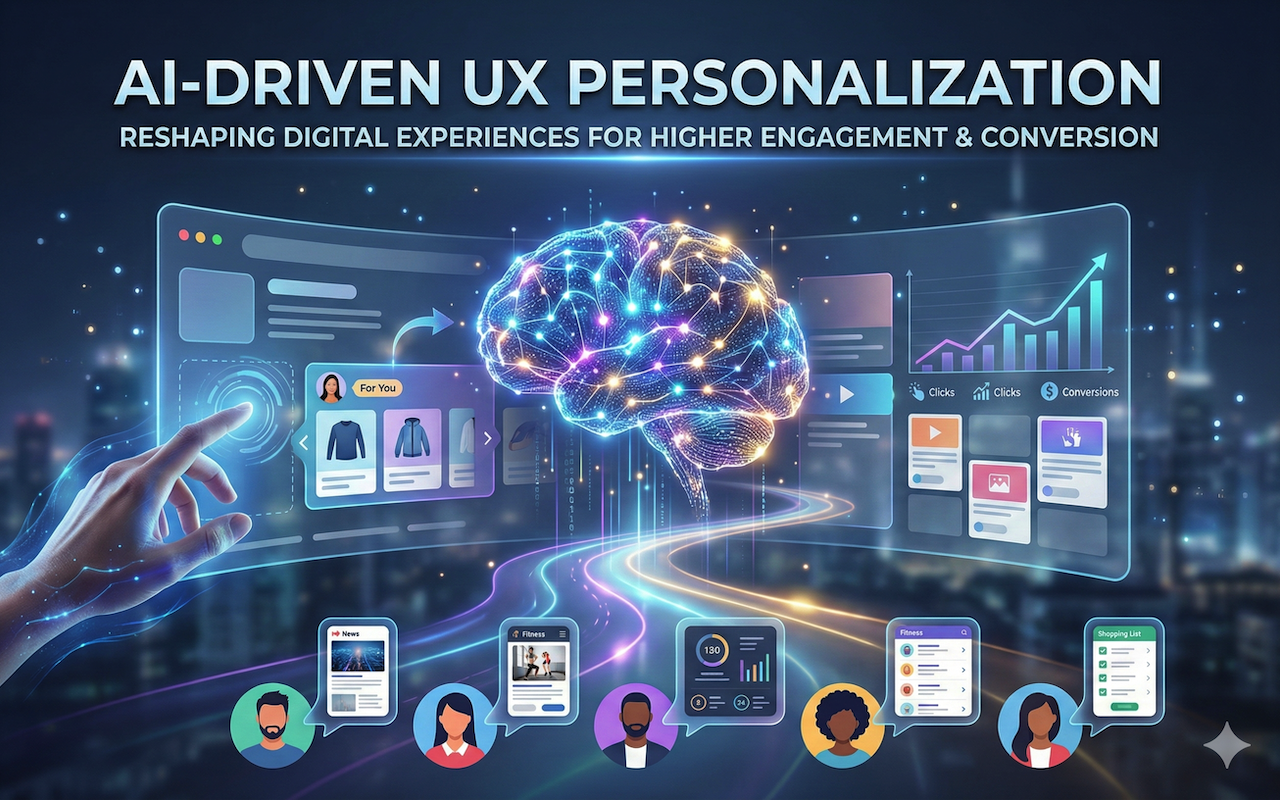
In today’s world, user expectations are evolving faster than ever. People no longer want generic app or website experiences. Instead, they naturally expect businesses to deliver personalization and intuitive design tailored to their needs. This fundamental shift has inspired businesses to rethink their UX approach, making AI-driven personalization a digital necessity.
This trend is also supported by research showing that 75% of enterprises consider personalization essential for creating meaningful user experiences. Additionally, 52% of customers believe that tailored digital experiences lead to higher satisfaction.
For business owners, this directly translates into more clicks, higher engagement, and increased revenue. AI-powered personalization in UX is a game-changer because it helps teams deliver the right content, layout, and messaging at exactly the right moment. This output can also be refined by UX experts who specialize in improving digital experiences.
With AI-driven UX changes becoming more prominent, this article explores how AI reshapes UI/UX—and how it boosts engagement and conversion rates.
What Is AI-Driven UX Personalization?
Instead of navigating the same standard layout, content, and design, users now experience apps and websites that adapt to their needs in real time. And what powers this transformation is AI.
Below is the technological foundation behind this shift:
1. Machine Learning (ML)
ML algorithms learn from each user’s activity—such as clicks, searches, and purchases—to predict their next action. This enables customized screens, tailored recommendations, and dynamic interface changes.
2. Predictive Analytics
Predictive analytics processes large amounts of historical and real-time data to forecast user behavior, including conversions and drop-offs. This allows teams to deliver timely offers and promotions.
3. Natural Language Processing (NLP)
NLP analyzes user queries and reviews to understand context, semantics, sentiment, and intent. It goes beyond recognizing words to determining what the user truly wants.
4. Recommendation Algorithms
These algorithms study user interaction patterns, allowing brands to suggest products, content, or features each individual is most likely to engage with.
5. Clustering Algorithms (Unsupervised Learning)
Clustering groups users with similar behaviors. Understanding these segments helps companies create personalized design strategies for different audiences.
6. Reinforcement Learning
Reinforcement learning continuously optimizes UX designs by learning which elements perform best and which ones need improvement.
In short, AI-driven personalization is fully data-backed and creates a uniquely tailored journey for every user. To leverage it effectively, many enterprises collaborate with mobile UI/UX design specialists and AI experts who understand how to interpret behavioral data and turn it into more intuitive user experiences.
Why Is AI-Driven Personalization Essential in Modern UX Design?
Modern UX design plays a pivotal role in shaping a user’s digital experience and AI is at the heart of this evolution.
1. Users Expect Adaptive, Real-Time Experiences
Users switch between multiple devices and platforms, and a static UX can’t keep up with this complexity.
AI analyzes user data in real time, dynamically adjusting layouts, content, and interface components.
2. Traditional UX Can’t Scale Manually
Design teams can’t manually update the experience for every individual user or preference.
AI-driven personalization enables scalable, real-time adaptation that meets growing user expectations.
3. Promoting a Frictionless Digital Experience
Navigation problems, irrelevant content, and poorly timed CTAs often create friction in a digital journey. AI identifies and resolves these issues by pinpointing friction points and personalizing the experience accordingly.
Combined with analytics and ML, minimizing user drop-offs becomes significantly easier.
AI Techniques That Power Modern UX Personalization
Modern UX personalization relies on advanced AI techniques that adapt continuously to user behavior. Understanding these techniques is essential for creating smarter, more responsive digital experiences.
1. Dynamic Content Layout and Messaging
Predictive analytics helps anticipate a user’s next move based on their current behavior.
This enables the real-time adaptation of layouts, messaging, and content across apps and websites.
These adjustments help UX systems:
- Display personalized CTAs
- Highlight offers aligned with user interests
- Reduce drop-offs by addressing pain points immediately
2. Adaptive UI Components
Adaptive UI elements use AI to understand user intent and adjust based on device, location, or behavior.
This includes:
- Rearranging layouts based on usage patterns
- Highlighting features depending on the device or platform
- Improving visibility and accessibility
- Maintaining consistency across apps, websites, and devices
Understanding user behavior across platforms is key to building adaptive interfaces that boost engagement and trust.
3. Sentiment Analysis for User Feedback
Sentiment analysis evaluates user emotions through reviews, chat interactions, and in-app feedback. It is often combined with heatmaps and behavioral analytics to provide deeper insights.
This helps teams:
- Understand user tone and context
- Identify disengagement patterns
- Implement targeted UX improvements
Because of its impact, many companies work with AI specialists to develop advanced behavioral and sentiment models.
Final Thoughts
AI-driven personalization is no longer just a UX enhancement; it is transforming how users connect with digital products. It enables automated, context-aware interactions that feel intuitive, natural, and human.
More businesses are now leveraging AI and UX expertise to create models that fuel highly personalized user experiences. For businesses, this means stronger engagement, higher retention, and increased conversion rates.
AI-driven personalization is setting new benchmarks for the next generation of digital products and its influence will only grow from here.
Featured Image generated by Google Gemini.
Share this post
Author

Read the latest articles from Aliona Miller
How Chatbots Are Enhancing Customer Experience in Mobile Apps?
March 24, 2026
The banking sector has undergone a drastic revolution in the present day, driven by AI and automation. Gone are the days when users had to wait in long queues to get their financial tasks up-to-date, and personnel were handling all this pressure on their own. Today, modern banking systems address various critical [...]
Learn moreChatbot App vs Live Chat vs AI Assistants: A Business Comparison Guide
January 28, 2026
Modern users communicate with brands through AI tools, which have become a common trend. As a result of this shift, customer communication has evolved from a ticket-based, wait-heavy process to fast, AI-driven engagement across various digital channels. This has undoubtedly enabled businesses to deliver b [...]
Learn moreLeave a comment
All comments are moderated. Spammy and bot submitted comments are deleted. Please submit the comments that are helpful to others, and we'll approve your comments. A comment that includes outbound link will only be approved if the content is relevant to the topic, and has some value to our readers.
Comments (0)
No comment