
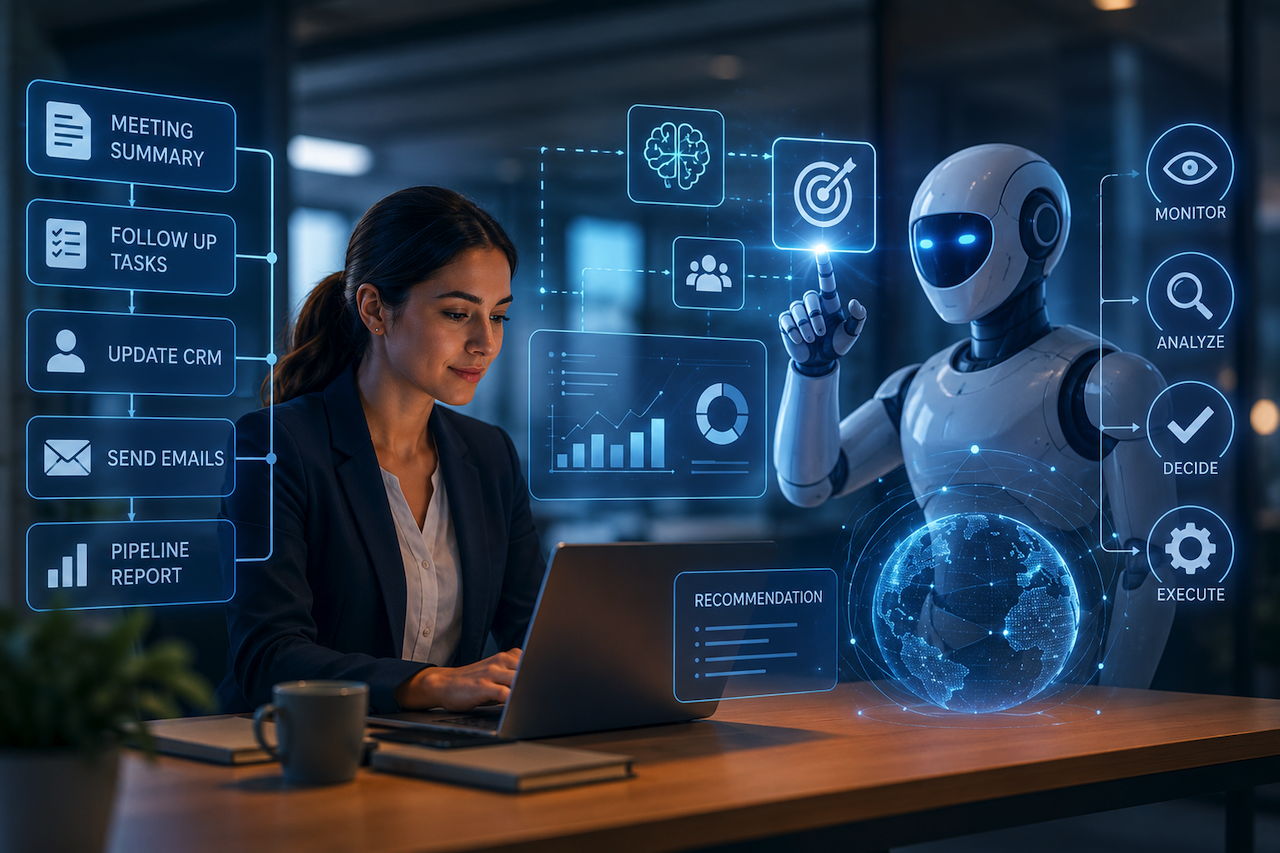
The technology is shifting from a passive tool that answers questions and creates basic content to autonomous systems that understand goals, make decisions, and act on behalf of an organization.
According to telemetry tracking from the 2026 Microsoft Work Trend Index Annual Report, this shift is already a reality: 49% of all enterprise Copilot interactions now explicitly drive complex cognitive tasks—such as advanced reasoning, data analysis, and proactive problem-solving—rather than basic chat functions.
This is where generative assistance and autonomous AI capabilities converge:
Microsoft Copilot serves as the intelligent assistant, enabling employees to work faster and make smarter decisions. Agentic AI enhances these capabilities through its ability to autonomously plan, reason, and execute multi-step tasks with minimal human intervention. Combined, these technologies create a robust framework that drives business productivity, eliminates operational friction, and builds adaptive workflows across every department.
1. Transforming Productivity Beyond Traditional Automation
Many organizations still allocate significant time to repetitive administrative tasks, forcing employees to switch between disconnected applications to find information, build reports, and manage routine communications. While Copilot drastically reduces this burden by generating content, summarizing meetings, and retrieving information, Agentic AI extends workflow ownership. It moves beyond simply suggesting the next step to completing the entire sequence of actions autonomously.
Sales Workflow Example: After a sales meeting concludes, Copilot generates the meeting notes, while the underlying AI agent automatically updates the CRM record, schedules follow-up tasks, drafts thank-you emails to participants, and updates pipeline reports. This shift reclaims valuable time, allowing employees to pivot away from administrative overhead and focus on strategic planning, innovation, and direct customer engagement.
2. Accelerating Data-Driven Decision Making
Organizations produce vast amounts of daily data, but raw data holds no intrinsic value unless it translates into actionable insights. Microsoft Copilot helps users work with this information by generating summaries, identifying trends, and answering natural-language questions. Agentic AI builds on these capabilities by continuously monitoring business systems, proactively identifying opportunities and risks, and surfacing recommendations before issues become more significant. Together, these technologies help organizations move from reactive reporting to real-time, data-driven decision-making.
Agentic AI adds a layer of continuous, proactive intelligence by monitoring core business systems to identify opportunities and risks before humans notice them. For instance, an AI agent can detect an emerging sales decline in a specific region, analyze the underlying variables, and present data-backed recommendations through Copilot before a manager even realizes a problem exists. This real-time intelligence empowers leadership to make faster, more educated decisions.
3. Creating Truly Intelligent Business Workflows
Traditional workflow automation relies on static, rigid rules. These systems work well for repetitive activities but often struggle when conditions change or unexpected events occur. Agentic AI introduces flexibility and adaptability to enterprise processes by evaluating changing circumstances and dynamically adjusting actions to optimize outcomes.
This evolution is reflected in Microsoft's deployment of computer-using agents within Copilot Studio. These agents can interact with desktop applications, websites, and legacy systems, enabling multi-step workflows to adapt to changing environments without relying entirely on static APIs. At the same time, Copilot helps keep employees informed by providing visibility into agent actions and allowing human oversight when intervention is needed.
This growing integration between Microsoft Copilot and Agentic AI demonstrates how intelligent systems are moving beyond simple automation to support more adaptive and context-aware workflows.
4. Elevating Departmental Efficiency and Customer Experiences
The combination of user-driven assistance and autonomous agents solves major operational bottlenecks across core business functions:
Customer Experience at Scale
While Copilot helps support teams instantly surface past interaction history, customer profiles, and relevant knowledge articles, Agentic AI handles the execution. Together, these technologies support a more AI-powered customer relationship management approach by helping teams deliver personalized experiences, automate routine interactions, and maintain consistent customer engagement across channels.
Knowledge Management
To combat knowledge fragmentation—where critical data is scattered across emails, documents, and isolated databases—Copilot delivers contextually relevant answers drawing from multiple sources simultaneously. Agentic AI then acts as a backend curator: automatically organizing content, mapping relationships between data points, and keeping repositories updated.
Cross-Functional Operations
Managing multi-departmental operations manually introduces delays and errors. Together, these technologies automate complex, cross-functional workflows while preserving human oversight:
| Operational Area | Autonomous Action (Agentic AI) | Human Oversight (Copilot) |
|---|---|---|
| Procurement | Validates requests, analyzes supplier info, and drafts purchase orders. | Reviews anomalies, approves high-value spend, and executes final signatures. |
| Risk and Compliance | Monitors transactions and user behaviors in real time to flag compliance breaches. | Reviews automatically generated incident summaries in plain language to take preventive action. |
Conclusion: Supporting Scalable Business Growth
As organizations scale, operational demands increase across departments. The combination of Microsoft Copilot and Agentic AI provides a foundation for sustainable growth by helping teams manage increasing complexity more efficiently. Rather than automating isolated tasks, these technologies support intelligent decision-making, streamline workflows, and execute complex processes across the enterprise.
By combining human expertise with AI-powered assistance and autonomous capabilities, organizations can build more productive, responsive, and adaptable operations.
Featured Image generated by ChatGPT.
Share this post
Author

Leave a comment
All comments are moderated. Spammy and bot submitted comments are deleted. Please submit the comments that are helpful to others, and we'll approve your comments. A comment that includes outbound link will only be approved if the content is relevant to the topic, and has some value to our readers.
Comments (0)
No comment