
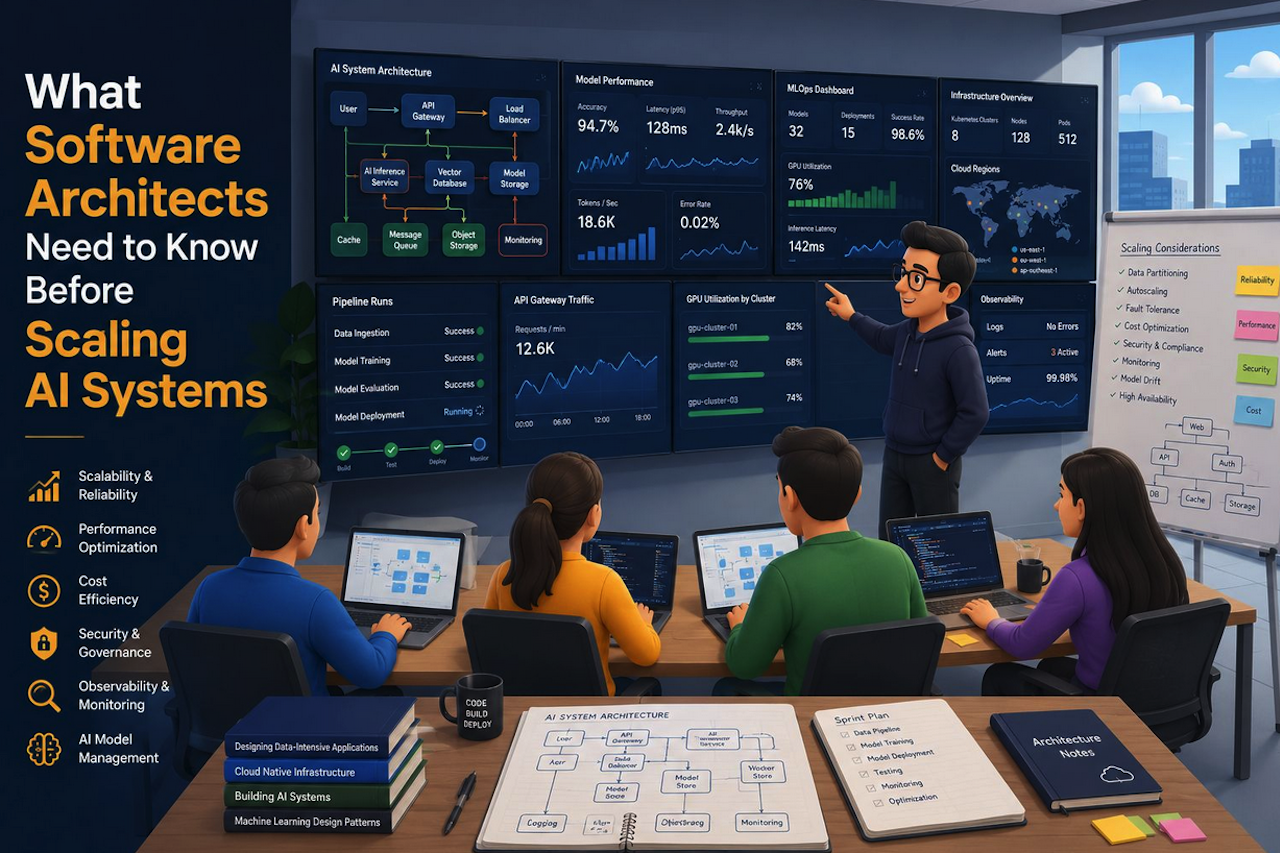
Scaling a web application is a solved problem. Add load balancers, scale horizontally, optimize database queries, and add caching. The patterns are well understood, and the tooling is mature.
Scaling AI systems is different. The problems that arise at scale in AI systems aren't the same as those in traditional software, and the solutions aren't the same either. Architects who approach AI scaling with the same mental model they use for web applications run into walls they didn't see coming.
Here's what you need to understand before you start.
The Model Is Not the Application
In traditional software, the code is deterministic. The same input produces the same output every time. You can test it, verify it, and trust it completely once tests pass.
AI models don't work this way. The same input can produce slightly different outputs across runs depending on temperature settings and sampling behavior. Model performance degrades over time as real-world data drifts away from training data. A model that performs at 94% accuracy in testing might drop to 87% six months after deployment without anyone touching the code. These characteristics are part of the broader shift that AI is bringing to modern web development, affecting everything from development workflows to intelligent user experiences.
This means your architecture needs to account for things that don't exist in traditional software design. Model versioning isn't optional; you need to track which version of a model made which prediction. Monitoring needs to include model-specific metrics, not just infrastructure metrics. Rollback plans need to include model rollback, not just code rollback.
The model is a dependency with a degradation curve. Treat it that way from the start.
Training Infrastructure vs Inference Infrastructure
Most architects designing AI systems for the first time conflate training and inference. They're completely different workloads with different infrastructure requirements.
Training is compute-intensive and burst-heavy. You run training jobs periodically, maybe weekly, maybe monthly, and they require large amounts of GPU capacity for a defined period. After training, the compute need drops to near zero until the next training run. Cloud-based GPU instances, on-demand or spot instances, make sense here.
Inference is latency-sensitive and consistent. Every time a user request hits your system, a model needs to produce a result, typically within 100-500ms for user-facing applications. Inference needs to be online at all times, sized to your traffic volume, and optimized for response time rather than raw throughput.
Mixing these on the same infrastructure creates problems. Training jobs can starve inference capacity. Sizing for training bursts means paying for idle capacity during inference-only periods.
Separate the infrastructure. Training pipeline on one resource pool, inference serving on another. This lets you optimize each independently and control costs.
The Three Scaling Bottlenecks That Catch Architects Off Guard
GPU Memory Limits
Large language models and vision models require significant GPU memory. A 7-billion-parameter model typically requires 14GB of GPU memory to load in FP16. When you try to serve that model at scale, handling concurrent requests and running batches, you hit memory limits that don't exist in CPU-based workloads. Architects need to understand model quantization, batching strategies, and model sharding before designing the serving infrastructure.
Cold Start Latency
Loading a large model into GPU memory takes time. If your system scales down to zero instances during low traffic and needs to spin up on demand, users experience significant latency on the first request after scale-up. This is a real UX problem. Solutions include minimum instance counts, model caching, and smaller, distilled models to handle requests during scale-up.
Throughput vs. Latency Tradeoff
Batching inference requests improves GPU utilization and throughput but adds latency to individual requests. A user waiting for a single response has a worse experience when their request is batched. Finding the right batching window, large enough to improve throughput and small enough not to hurt latency, is a tuning problem that requires load testing under realistic conditions.
When to Fine-Tune vs When to Use Retrieval
One of the most important architectural decisions in an AI system is whether to customize model behavior through AI fine-tuning or through retrieval-augmented generation (RAG).
Fine-tuning takes a pre-trained foundation model and continues training it on your domain-specific data. The result is a model that "knows" your domain, it speaks your terminology, understands your use cases, and produces outputs consistent with your expectations. Fine-tuning is appropriate when your use case is narrow and well-defined, when your data is proprietary and can't be exposed at inference time, or when inference latency needs to be minimized (fine-tuned models don't need retrieval calls).
RAG keeps the foundation model unchanged and instead retrieves relevant context from a knowledge base at inference time, injecting it into the model's context window. This is appropriate when your knowledge base changes frequently (fine-tuned models can't update their knowledge without retraining), when you need to cite sources (retrieved documents can be attributed), or when you want to avoid the cost and complexity of fine-tuning.
Most production AI systems end up using both. Fine-tune the model to match the domain's behavior and tone. Use retrieval for factual, up-to-date, or frequently changing information. The architecture decision is which layer handles which type of customization.
Data Pipeline Architecture
AI systems consume data continuously. Training runs need clean, labeled, domain-representative data. Monitoring needs production request data. Retraining pipelines need feedback signals.
Architects who don't design the data pipeline upfront spend months retrofitting it later. Get ahead of it.
You need a data ingestion layer that captures production requests and responses with appropriate privacy controls. You need a labeling system or a human-in-the-loop feedback mechanism for generating a training signal. You need a feature store if your models use structured features. You need version-controlled training datasets to reproduce training runs.
This is significant infrastructure. Treat the data pipeline as a first-class engineering concern, not an afterthought.
Monitoring Goes Beyond Infrastructure
Standard application monitoring, CPU, memory, latency, and error rates, is necessary but insufficient for AI systems.
You also need model performance monitoring. This means tracking prediction quality metrics (accuracy, precision, recall) on a sample of production traffic where ground truth is available. It means detecting data drift, when the distribution of inputs your model sees in production diverges from the distribution it was trained on. It means monitoring for shifts in output distribution that might indicate model degradation.
Set up alerting on model metrics before deployment. When model accuracy drops below the threshold, you need to know before users do. Without this monitoring, model degradation is silent until it becomes a visible product problem.
Start With Less Than You Think You Need
The instinct when building AI systems is to use the most capable model available. Bigger models perform better on benchmarks, so bigger must be better for production.
In practice, this is often wrong.
Larger models are slower, more expensive, harder to deploy, and harder to scale. A 70-billion-parameter model produces better outputs than a 7-billion-parameter model on hard tasks. Still, on simple classification or extraction tasks, the difference is marginal, and the infrastructure cost difference is not.
Start with the smallest model that can do the job acceptably. Scale up only when you have evidence that a larger model meaningfully improves outcomes that matter. This approach is cheaper, simpler to operate, and easier to scale.
The goal is a system that works in production, not a system that scores highest on benchmarks.
Conclusion
Scaling AI systems requires a different architectural mindset than scaling traditional software. Beyond infrastructure, software architects must account for model behavior, data pipelines, monitoring, inference performance, and ongoing model maintenance. Decisions around fine-tuning, retrieval, infrastructure separation, and model sizing can significantly affect both performance and cost.
The most successful AI architectures are not necessarily the most complex. They are the ones designed with scalability, observability, and long-term maintainability in mind from the beginning. By understanding these challenges early, architects can build AI systems that perform reliably in production and continue delivering value as workloads grow.
Share this post
Author

Leave a comment
All comments are moderated. Spammy and bot submitted comments are deleted. Please submit the comments that are helpful to others, and we'll approve your comments. A comment that includes outbound link will only be approved if the content is relevant to the topic, and has some value to our readers.
Comments (0)
No comment