
SaaS companies operate in a fast, automated world in 2026. Teams collaborate from anywhere, and decisions are driven by data. Growth teams are expected to generate more revenue with fewer resources. Product teams must ship faster. Customer success teams must work hard to retain and expand accounts.
Many SaaS companies still struggle with systems that don’t integrate. For instance, they use different dashboards, manually generate reports, enter the same data twice, and communicate in silos. The result? Execution slows down, opportunities are missed, and profits decline.
Choosing the right digital workflow software is no longer just a business decision. It’s a strategic decision about how your company scales and operates more intelligently.
This complete guide will help B2B SaaS leaders choose, test, and implement workflow software that strengthens their business—not just simplifies tasks.
Why B2B SaaS Needs Digital Workflow Software
SaaS companies rely on digital systems far more than traditional businesses. Software manages everything—from marketing automation and sales pipeline tracking to customer onboarding, product analytics, billing, and support.
When these workflows are fragmented:
- Revenue forecasting becomes unreliable.
- Sales cycles take longer.
- Customer churn increases.
- Team productivity declines.
- Data becomes inconsistent and less trustworthy.
Modern workflow automation software combines automation, AI, analytics, and collaboration. It’s not just about organizing tasks—it’s about running your business more effectively.
A strong workflow platform can help B2B SaaS companies:
- Improve sales performance.
- Increase revenue growth.
- Strengthen customer retention.
- Enhance cross-team collaboration.
- Reduce operational costs.
The question is no longer whether you need workflow software. The real challenge is choosing the right one.
Step 1: Understand Your SaaS Digital Workflow
You can’t evaluate vendors until you understand how your business operates.
- Support ticket → Escalation → Resolution → Feedback
- Product release → QA → Deployment → Customer communication
- Marketing campaign → MQL → SQL → Revenue attribution
Map how information moves between departments.
Identify Bottlenecks
Look for:
- Manual data transfers between tools
- Repeated communication or duplicate work
- Lack of real-time visibility
- Delayed approvals
- Inconsistent customer data
SaaS operations can break down quickly without clear workflows.
Audit Your Current Tech Stack
List all the tools you currently use:
- CRM
- Marketing automation platform
- Customer success software
- Help desk system
- Product analytics tools
- Project management software
- Billing platform
Then ask:
- Are these systems integrated?
- Is the data consistent across platforms?
Step 2: Define Business Goals, Not Just Features
Many SaaS companies choose software by comparing feature charts. That approach often leads to poor decisions.
Instead, define measurable business goals first.
Step 3: What SaaS Companies Should Prioritize
1. Workflow Automation
Automation is essential in 2026.
Look for:
- Event-triggered workflows
- AI-based task assignment
- Predictive lead scoring
- Automated follow-ups
- Smart customer health alerts
- AI-generated summary reports
With automation, SaaS companies can scale without increasing headcount at the same rate as customer growth.
2. Integrated Ecosystem
Your workflow software should integrate with:
- CRM systems such as Salesforce
- Marketing platforms like HubSpot
- Customer success tools
- Billing systems
- Product analytics platforms
API access and built-in integrations eliminate data silos and create a single source of truth.
Poor integration can erase any efficiency gains.
3. Scalability
SaaS businesses grow quickly. Your software must support:
- Multi-team collaboration
- Role-based permissions
- Global operations
- Advanced automation
- Enterprise-grade security
Choosing a tool that can’t scale with your ARR will cost more long term.
4. Real-Time Reporting and Advanced Analytics
Data drives SaaS performance.
Ensure the software offers:
- Real-time dashboards
- Custom KPI tracking
- Revenue attribution
- Customer lifecycle analytics
- Predictive insights
Leaders need visibility across acquisition, activation, retention, and expansion.
5. Adoption and User Experience
No matter how powerful a tool is, it fails if teams don’t use it.
Evaluate:
- An intuitive interface
- Learning curve
- Onboarding support
- Mobile access
- Customizable dashboards
Revenue is driven by adoption—not features alone.
6. Security and Compliance
B2B SaaS companies handle sensitive business data.
Look for:
- SOC 2 compliance
- GDPR readiness
- Data encryption
- Role-based access control
- Audit trails
Security weaknesses can damage trust and brand reputation.
Step 4: Budgeting and ROI Analysis
Value matters more than cost alone.
Direct Costs
- Subscription fees
- Implementation costs
- Training expenses
- Custom integrations
Hidden Costs
- Migration downtime
- Change management
- Data cleanup
- Operational disruption
Estimate ROI by Calculating
- Hours saved per employee
- Revenue increase per sales rep
- Reduction in churn
- Shorter onboarding time
If automation saves each sales rep eight hours per week and you have 20 reps, that’s 160 hours saved weekly—the equivalent of adding staff without hiring.
For SaaS companies, improving retention by just 2%–3% can significantly impact lifetime value and valuation multiples.
Step 5: Evaluate and Engage Vendors Strategically
Select vendors based on fit—not popularity.
Just because a platform is widely known does not mean it’s the right choice for your company’s stage or growth trajectory.
Early-stage SaaS companies need flexibility. Enterprise SaaS organizations require structure, governance, and scalability.
Request Personalized Demos
Ask vendors to demonstrate workflows specific to your business needs, such as:
- Lead management and routing
- Automated growth campaigns
- Customer health scoring
- Renewal forecasting
Generic demos often fail to show how the platform performs in real-world SaaS environments.
Test Real Scenarios During the Trial
When evaluating a free trial:
- Simulate real sales cycles
- Automate actual workflows
- Test integrations with your current systems
- Assess ease of use across teams
This helps prevent unexpected costs and implementation challenges after purchase.
Step 6: Plan Implementation Carefully
Even the best software will fail without proper implementation.
Involve key stakeholders early, including:
- Sales leadership
- Marketing teams
- Customer success teams
- IT and finance
Cross-functional alignment ensures smoother adoption and better long-term outcomes.
Clean and Standardize Your Data
Automation and AI rely on accurate data. Before migrating systems, standardize:
- Contact fields
- Lifecycle stages
- Opportunity definitions
- Customer segmentation rules
Invest in Structured Training
Offer:
- Role-based onboarding sessions
- Clear documentation
- Ongoing support
- Internal champions to drive adoption
Adoption is an ongoing process—not a one-time event.
Common Mistakes SaaS Companies Make
- Choosing software based solely on price
- Underestimating integration complexity
- Over-automating too quickly
- Failing to define measurable goals
- Ignoring change management
- Adding more tools instead of consolidating systems
Complex systems slow execution. Simplicity drives scalability.
Final Checklist: Choosing the Right Software
Before making your final decision, ask:
- Does this align with our growth strategy?
- Will it simplify or complicate operations?
- Can it scale with our ARR?
- Does it integrate with our existing systems?
- Can we measure ROI within six to twelve months?
If the answer is yes, you likely have a strong candidate.
Choose software that drives revenue—not just operational efficiency.
For B2B SaaS companies, digital workflow software is not merely a tool—it is a growth engine.
The right platform improves:
- Revenue predictability
- Team productivity
- Customer satisfaction
- Long-term strategic decision-making
Choosing the wrong platform creates friction, wastes resources, and slows growth.
In 2026, SaaS companies will not win by adding more tools. They will win by building intelligent, automated, and connected workflows that support sustainable growth.
Select software that simplifies operations, empowers teams, and provides clear visibility into revenue performance.
Conclusion
Digital workflow software is no longer a “nice-to-have” for B2B SaaS companies in 2026. It directly impacts how fast teams execute, how reliably leaders can forecast revenue, and how efficiently companies scale.
The best platforms simplify workflows, eliminate data silos, and support automation without sacrificing visibility, security, or adoption. When chosen carefully and implemented with clean data, cross-team alignment, and structured training, the right workflow system becomes a long-term growth advantage.
In a market where speed and efficiency determine outcomes, SaaS companies won’t win by stacking more tools. They’ll win by building connected, automated workflows that help teams move faster—and make better decisions with confidence.
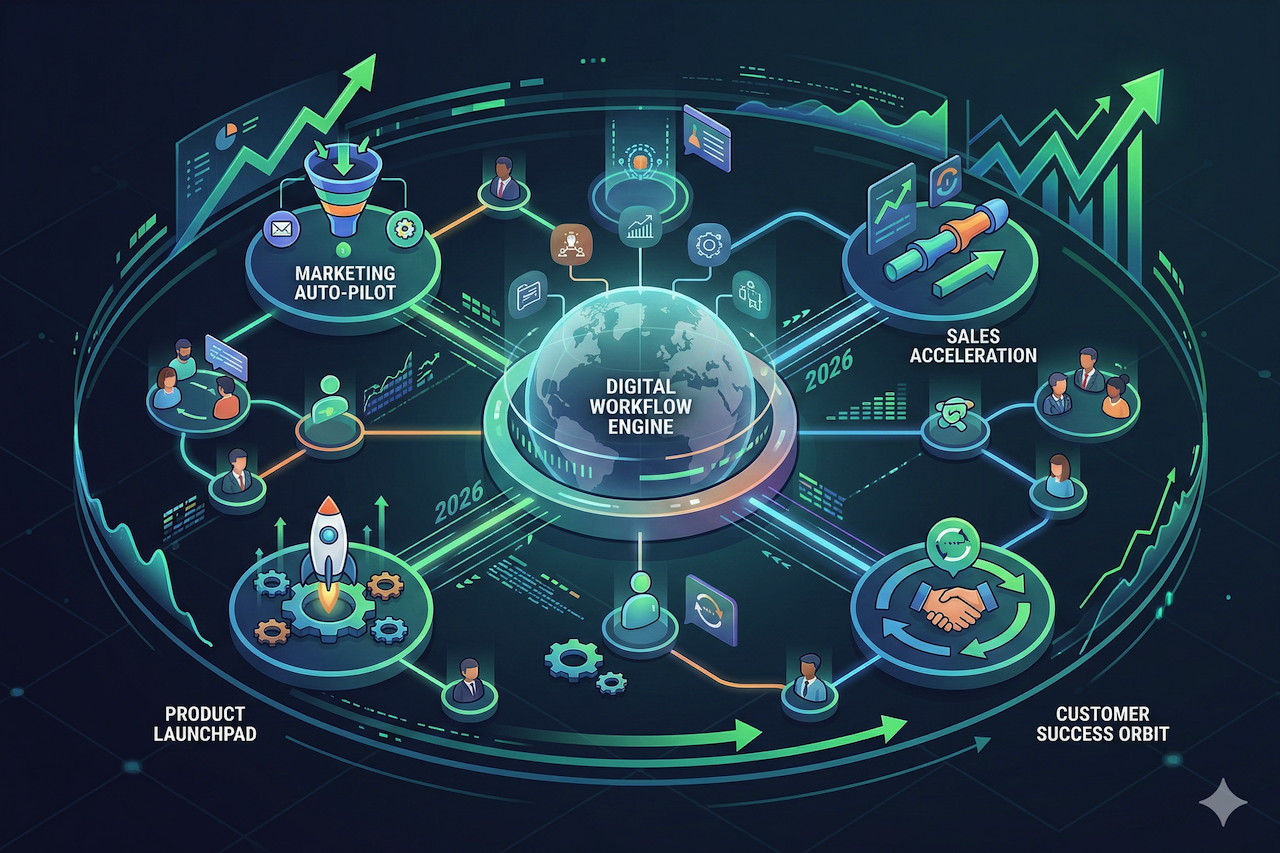
Featured Image generated by Google Gemini.
Share this post
Leave a comment
All comments are moderated. Spammy and bot submitted comments are deleted. Please submit the comments that are helpful to others, and we'll approve your comments. A comment that includes outbound link will only be approved if the content is relevant to the topic, and has some value to our readers.
Comments (0)
No comment