
| Kylie Miler | Web Development
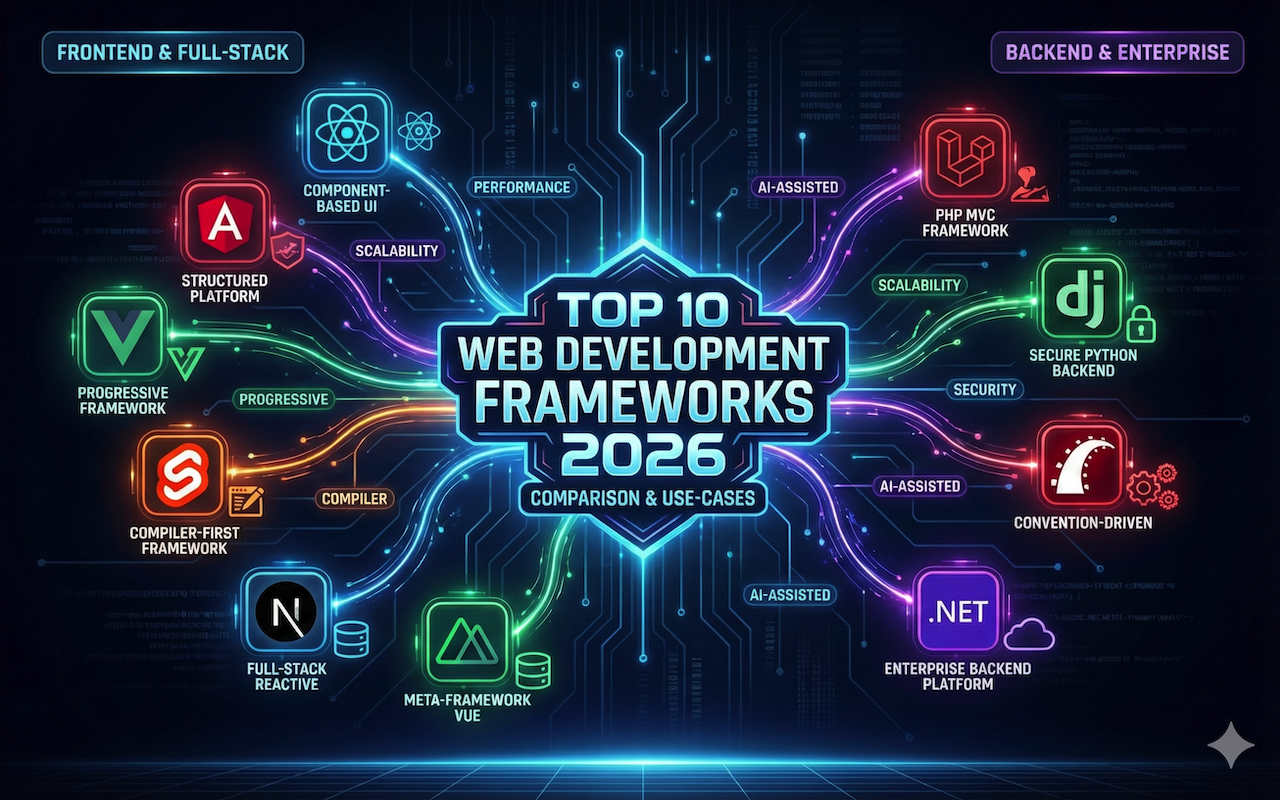
Web development in 2026 is shaped by faster deployment requirements, multi-device accessibility, real-time application performance, and security-focused architecture. Frameworks now integrate AI-assisted development, improved server-side rendering, and more scalable frontend-backend interoperability. As businesses move toward cloud-native and API-driven systems, choosing the right framework can determine everything from speed to scalability.
This article explains the top 10 web development frameworks in 2026, comparing them through performance, sustainability, community support, and the ideal use cases they are built for.
1. React
React continues to dominate frontend development in 2026 due to its flexibility, vast ecosystem, and support for component-driven UI architecture. Its strength remains in single-page applications and dynamic UI rendering. With updates like Server Components, React now supports improved SEO, faster load times, and lightweight rendering.
React is a strong choice for enterprise apps, marketplaces, dashboards, social platforms, and large-scale applications requiring modular UI and long-term scalability.
2. Angular
Angular remains a stable and opinionated framework that offers a complete toolkit in one package. Its TypeScript foundation, built-in routing, form handling, dependency injection, and CLI automation make it ideal for structured enterprise applications.
Angular is commonly used for financial apps, healthcare dashboards, ERP systems, and analytics platforms where strict architecture, reliability, and consistency matter more than development speed.
3. Vue.js
Vue has gained major traction due to its ease of integration, progressive adoption model, and lightweight build. In 2026, Vue 3’s Composition API continues to improve developer experience and performance.
It is widely used for SaaS dashboards, mobile-friendly web apps, real-time UI interfaces, and projects where teams want rapid development without the steep learning curve of Angular or the complexity of React’s ecosystem.
4. Svelte and SvelteKit
Svelte takes a compiler-first approach that reduces runtime bloat and speeds up application performance. Its popularity in 2026 comes from its minimal code, fast bundles, and easy learning curve.
SvelteKit elevates this with built-in routing, SSR, and improved backend integration. Businesses use Svelte for landing pages, interactive widgets, content-heavy sites, and applications where performance and lightweight rendering are top priorities.
5. Next.js
Next.js continues to set the standard for full-stack React applications. In 2026, its server components, edge rendering, and hybrid routing model make it one of the most powerful production-ready frameworks.
Next.js is ideal for high-traffic websites, SEO-driven platforms, multi-page company websites, blogs, e-commerce stores, and enterprise solutions that need both performance and maintainability.
6. Nuxt.js
Nuxt remains the preferred meta-framework for Vue. Nuxt 4 further improves server rendering, static generation, and API integration.
It is well-suited for SEO-sensitive platforms, multilingual company websites, content-heavy applications, and e-commerce stores where Vue’s simplicity is paired with server-side performance.
7. Laravel
Laravel is still the most widely used PHP backend web framework in 2026. Its elegant syntax, MVC architecture, built-in authentication, queues, cache drivers, and Eloquent ORM make it powerful for backend systems.
Laravel is chosen for SaaS platforms, API-driven applications, CRM systems, secure backend dashboards, and enterprise-level business software. With Laravel Vapor and cloud-native support, it works seamlessly on modern infrastructure.
8. Django
Django remains one of the most secure backend frameworks, powered by Python and designed for fast, clean, and scalable app development.
Its strengths lie in built-in security, ORM, admin panel, and rapid prototyping capabilities. Django is commonly used in fintech, research, AI tools, marketplaces, and high-security platforms where predictable architecture and data protection are essential.
9. Ruby on Rails
Ruby on Rails continues to remain relevant because of its convention-driven design and rapid development capabilities. The framework empowers developers to launch scalable MVPs and full-scale applications quickly.
Rails is widely used for startup products, booking systems, collaboration tools, and subscription platforms that require fast development, clean code, and long-term maintainability.
10. ASP.NET Core
ASP.NET Core is one of the strongest enterprise-level backend platforms. Backed by Microsoft, it supports high performance, cross-platform development, cloud scaling, and secure architecture.
ASP.NET Core is ideal for banking systems, corporate intranets, government platforms, logistics applications, and large enterprise systems that require robust security, strong typing, and long-term support.
Comparison Overview
While each framework excels in different areas, the choice in 2026 depends on the scale, performance needs, and development style of the project. React, Angular, Vue, Svelte, Next.js, and Nuxt power most modern frontends. Laravel, Django, ASP.NET Core, and Rails power stable, scalable backends.
Organizations seeking maximum speed often choose Svelte or Next.js. Those requiring strict structure select Angular or ASP.NET Core. Python-driven companies typically choose Django, while startups still rely on Rails for a quick time-to-market. Laravel dominates PHP-based development and simplifies backend operations for small-to-large businesses.
Conclusion
The web development ecosystem in 2026 continues evolving toward faster, more secure, and more modular frameworks. The best framework is not about popularity alone but about choosing one that aligns with the project's architecture, complexity, timeline, and scalability needs.
React and Next.js remain the leaders for modern frontend development, while Laravel, Django, and ASP.NET Core continue to drive secure backend architecture. Ultimately, the right choice depends on your team's expertise and the long-term goals of the web application you aim to build.
Featured Image generated by Google Gemini.
Author

Kylie Miler

0 Comments
Comments are moderated to keep the discussion useful and respectful. Spam, automated submissions, and low-value promotional comments are removed.
Leave a Comment