
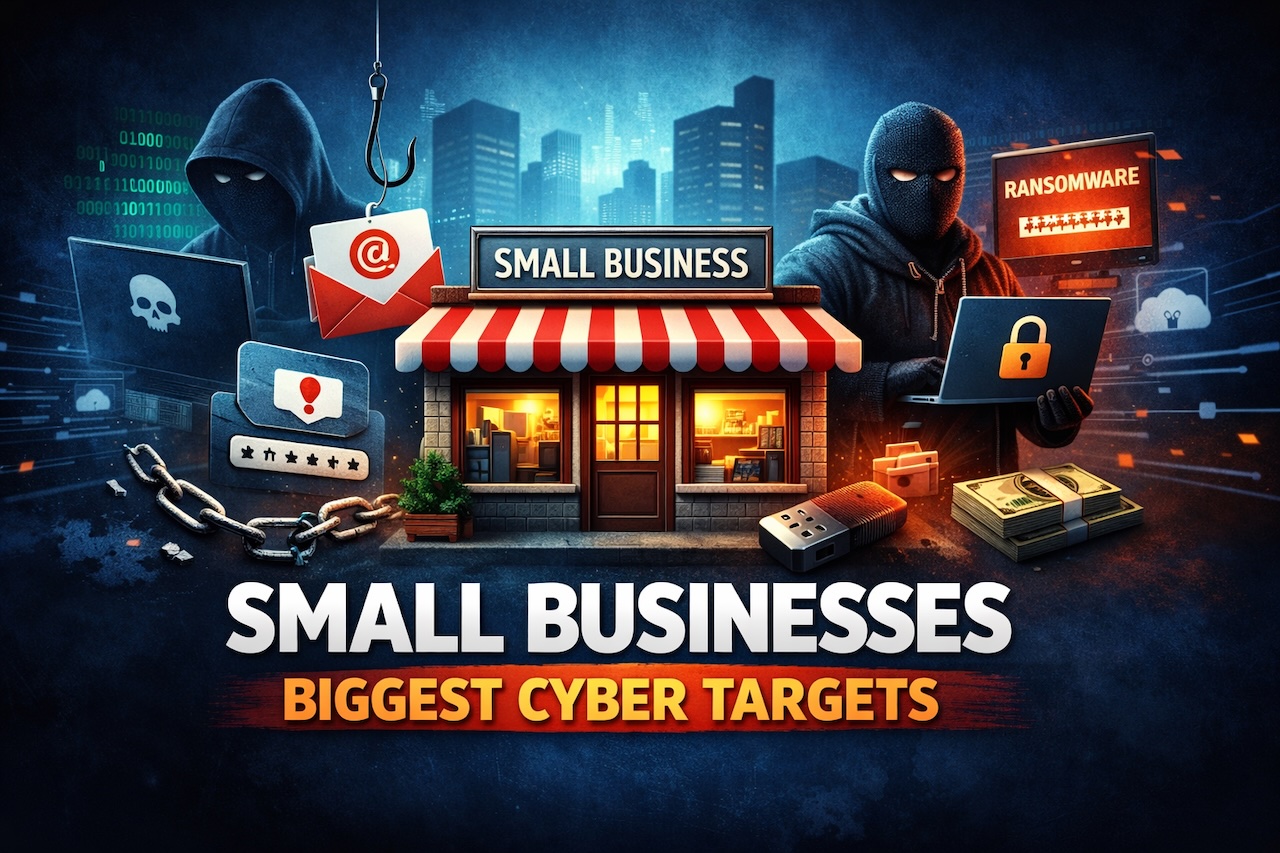
Small businesses often assume attackers are focused on large enterprises with bigger budgets, bigger brands, and more data. In reality, many attackers see smaller companies as easier, faster targets. They may have fewer layers of defense, limited internal security expertise, and weaker visibility across devices, SaaS tools, and third-party access. That makes cybersecurity for small businesses one of the most urgent business issues in 2026, not just an IT concern.
The reason is simple: cybercriminals do not always look for the largest victim. They look for the easiest path to money, credentials, customer data, or business disruption. Recent reporting shows that ransomware disproportionately affects smaller organizations, with Verizon’s 2025 SMB snapshot finding ransomware present in 88% of SMB breaches, compared with 39% in larger organizations.
Why small businesses are so attractive to attackers
1. They often have weaker defenses
Small businesses usually do not have dedicated SOC teams, mature identity governance, or deep incident response capability. The World Economic Forum’s Global Cybersecurity Outlook 2025 found that 35% of small organizations believe their cyber resilience is inadequate, a proportion that has risen sharply since 2022.
That gap matters because attackers increasingly automate reconnaissance, phishing, credential theft, and ransomware deployment. If defenses are thin, detection often comes late.
2. They still hold valuable data
Even a small company may process payment details, employee records, customer contact data, contracts and invoices, and access to larger partner or supplier environments.
In many cases, the business itself is not the only prize. It can also be a stepping stone into a bigger client or vendor network. The same Verizon SMB snapshot noted that third-party involvement in SMB breaches doubled from 15% to 30%, underscoring how supply chain exposure is growing.
3. Attackers know downtime hits smaller firms harder
Large enterprises may survive a week of disruption. Small businesses often cannot. Recovery time, lost revenue, reputational damage, and customer churn can be existential. Older Verizon guidance still captures the operational reality: many small firms take a day or more to recover from attacks, and some never fully recover.
The most common threats facing small businesses
1. Phishing and social engineering
Phishing remains one of the easiest and most effective attack methods. It works especially well in small teams where employees handle many roles and cannot always verify every request carefully. UK government data cited by Fortinet found that 43% of businesses experienced a cybersecurity breach or attack in the past year, with phishing remaining a major factor.
2. Ransomware
Ransomware is still one of the most damaging risks for small firms because it combines operational disruption with extortion pressure. As noted above, Verizon’s 2025 findings show ransomware is especially concentrated in SMB breaches.
3. Credential theft
Infostealers, reused passwords, weak MFA setups, and unmanaged devices all create openings. Verizon’s SMB snapshot also highlighted the role of stolen credentials and unmanaged devices in breach activity.
4. Shadow AI and unsanctioned tools
Small businesses are adopting AI tools quickly, but often without policy, governance, or centralized authentication. Verizon’s 2025 SMB snapshot found many GenAI accounts were tied to non-corporate emails or corporate emails without integrated authentication, suggesting usage outside company policy.
Why this matters beyond small business
At first glance, keywords like enterprise cybersecurity, cybersecurity for enterprises, and enterprise security solutions may sound irrelevant to smaller organizations. But the underlying lesson is the same: every business now operates in a connected ecosystem of vendors, contractors, cloud tools, and shared data. Small companies are no longer “too small to matter.” They are part of the enterprise attack surface.
That is why many small businesses need to borrow proven enterprise security habits, even if they cannot afford enterprise-scale tooling.
What small businesses should prioritize first
Small businesses do not need to start with a massive security stack. They need the basics done well:
- enforce MFA everywhere possible
- use password managers and eliminate credential reuse
- keep systems and SaaS permissions tightly controlled
- train staff to spot phishing and fake invoice/payment requests
- back up critical systems and test recovery
- review vendor and third-party access regularly
- centralize AI and SaaS usage under approved accounts and policies
These measures are not glamorous, but they are among the highest-value investments in cybersecurity for small businesses.
Final thought
Small businesses are major cyber targets because they combine valuable data with thinner defenses and less margin for disruption. The 2025 threat landscape makes that increasingly clear, especially in ransomware, phishing, credential abuse, and third-party exposure.
The good news is that small companies do not need enterprise-scale budgets to improve resilience. They do need clarity, discipline, and a willingness to treat cybersecurity as a business continuity issue, not a technical afterthought. That mindset is now the foundation of surviving and growing in a threat-heavy digital economy.
Featured Image generated by ChatGPT.
Share this post
Leave a comment
All comments are moderated. Spammy and bot submitted comments are deleted. Please submit the comments that are helpful to others, and we'll approve your comments. A comment that includes outbound link will only be approved if the content is relevant to the topic, and has some value to our readers.
Comments (0)
No comment