
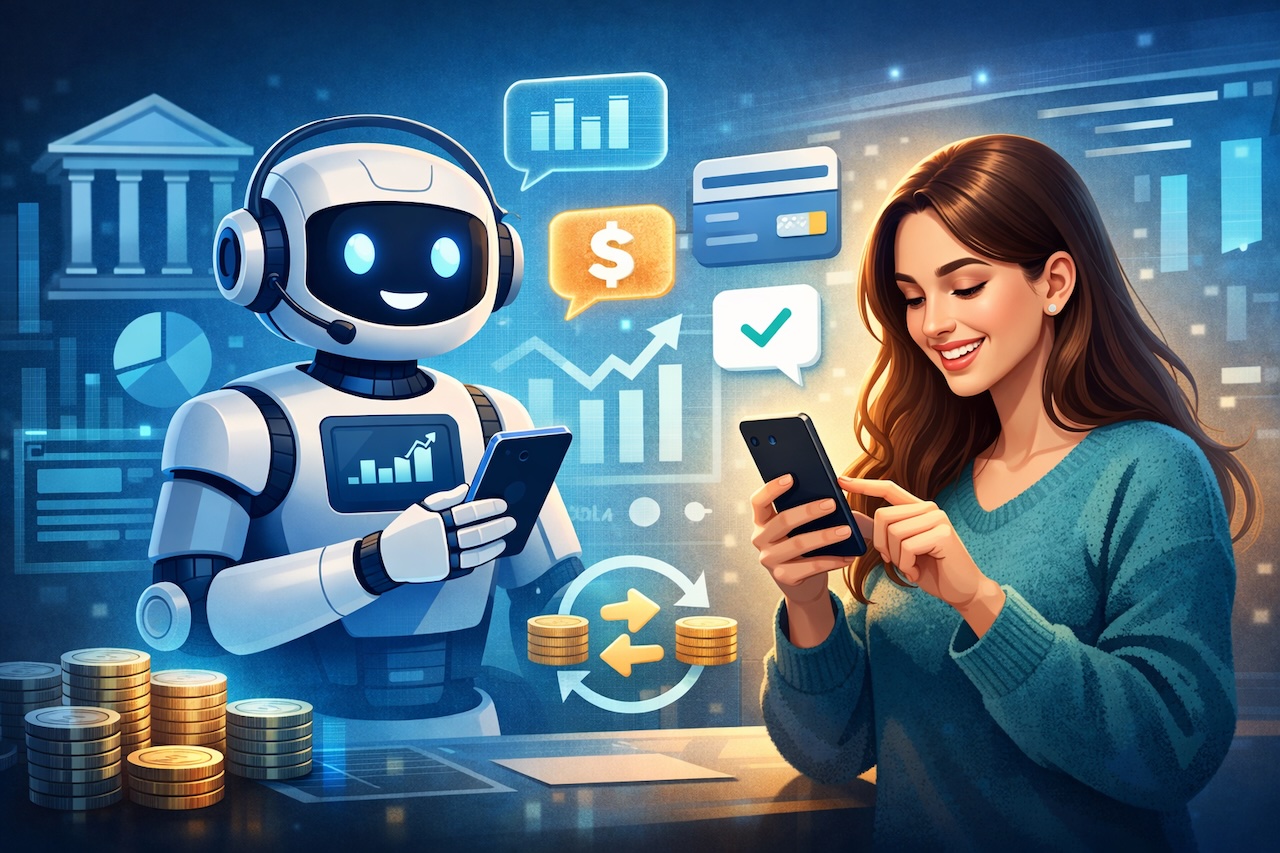
AI chatbots are transforming customer experience across all industries by enabling faster, more efficient, and more personalized interactions. The banking sector, in particular, provides a strong example of this shift. It has undergone a drastic revolution driven by AI and automation. Gone are the days when users had to wait in long queues to get their financial tasks completed while personnel handled everything manually. Today, modern banking systems address critical legacy challenges such as slower processes, heavy reliance on human intervention, and outdated technology by embedding chatbots directly into their applications.
This allows them to deliver better quality financial services, where customers are at the centre of the decision-making. Here, bots are leveraged to answer user FAQs and queries 24/7, which reduces load on human staff.
In essence, a chatbot is a conversational AI-based systems that use NLP, ML, and deep learning technologies. Driven by AI, they are trained to handle dynamic customer responses via chat and voice modes.
Furthermore, their responses are fast, accurate, and context-aware. Additionally, they can be scripted or personalized based on how the bot is trained to perform.
In this context, many companies that need custom bot solutions also consult chatbot developers to professionally manage this development. These experts have the right know-how in this field of technological development. Moreover, they can develop the right AI assistant solutions that have the calibre to learn from user interactions while responding more naturally to the users.
That being said, next-gen technology-enabled chatbots are a game-changing solution in the finance industry. And companies that aim for better speed, security, and user experiences should not wait any longer to invest in them.
With this perspective, this article examines how bots deliver these outcomes, thereby helping companies with their digital transformation goals in 2026 and beyond.
Understanding Chatbots for Fintech Apps
Chatbots are an interesting technological development. They allow user queries to be solved faster and more accurately, without putting immense pressure on human agents to be available for query resolution 24/7. This also reduces the operational costs, which implies the need for hiring fewer agents to deal with user queries.
Mainly, bots in fintech use AI-driven conversational systems to handle this load on their own. This solution uses NLP and sentiment analysis to understand the user query and respond to it contextually.
That being said, they deliver services like:
- Answering questions instantly,
- Guiding users with their financial step-by-step queries,
- Providing necessary reminders and alerts in a timely manner, and
- Simplifying complex processes for the users.
In this manner, they act like digital agents handling banking, payment, and investment queries for the users. Overall, bots assure higher efficiency, accessibility, and engagement while also focusing on the security of the fintech interactions. In essence, this reflects how it contributes to delivering better customer service for a banking organization.
How AI Chatbots Are Transforming Customer Experience in Finance Apps?
Chatbots are intelligence-driven solutions that are highly useful for all industries today. In the finance sector, it serves an incredibly important purpose. These custom app development (custom because every organization may have its specific goals, which is why the bot may need to be tweaked and created accordingly) add a blend of performance, clarity, and convenience to each and every finance service.
This directly improves the fintech enterprise’s services and operational efficiency. That being said, below are the ways in which bots bring about immense transformation in the finance industry.
24/7 Instant Financial Assistance
Well, a mobile banking application today can support users 24/7. This is due to the use of bots, which allows users to easily check their balance, transaction history, and even ask common issues at any given time. As a result of continuous and reliable support, user confidence boosts, thereby enhancing their satisfaction as well.
Technically, this is possible due to aspects like:
- Reliable cloud systems that allow bots to deliver responses in real-time.
- Use of NLP engines to identify user queries accurately.
- Automated workflows that help route the request to the right path.
- Use of backend engines that help bots connect accounts, transactions, and support systems together.
Overall, this well-planned framework ensures consistent customer support, thereby reducing dependency on human agents.
Navigation of Complex Financial Services For the Users
Many times, a user feels confused about how a financial service works. In this case, a chatbot serves as a guide that can simplify the process for the user. Here, bots help users with services in a step-by-step format that doesn’t feel rushed. Moreover, it is quite smooth and convenient. For example, if a customer wants to apply for a loan or KYC update, they can navigate the step-by-step process by conversing with a chatbot.
Technically, this is possible due to the role of the following technologies:
- The use of dialogue management systems in bots helps them to have a natural conversation flow with users.
- Here, tracking is enabled to ensure that the progress is saved, and it can be resumed by the user based on their convenience.
- Functionally, service APIs help with document uploads, verification checks, and form submissions.
Together, these elements help in simplifying complex services for the users.
Personalization of Financial Services and Support
Well, personalization is an important user expectation today. And bots deliver exactly that, thereby cutting banks’ operational costs by a high margin. In fact, a study by Juniper Research states that the savings from using bots in banking are valued at $7.3 billion globally by 2023. This is a huge jump given that this figure was estimated to be $209 million in 2019.
Adding to this line of thought, personalized user experiences in banking help users to view their spending insights in real-time, and even their offers are customized accordingly.
From a technical standpoint, this helps systems with:
- Setting user profiles based on spending behavior and the record of transactions.
- Here, recommendation engines help in sharing customized offers for each user.
- Furthermore, dynamic response systems allow space for interactive and adaptive user interactions.
Thus, personalization is a necessary add-on to the modern banking sector, and bots successfully deliver this in a cost-efficient way for the finance firms.
Sharing Proactive Alerts and Reminders With the Users
Modern-day banking apps commonly share bill reminders, low-balance warnings, and emails for unusual activity with the users. And, these are incredibly helpful for them in taking action at the right time. But, how are alerts practically provided to each user?
At its core, bots developed by professional chatbot developers leverage predictive analytics models to understand user behaviour patterns. Here, event monitoring pipelines also help in observing anomalies. And clubbed with trigger systems, they can share an automated bot notification to the customer’s device in case of unusual activity.
Hence, this helps in building their confidence in the app, which also improves user trust, reliability, and engagement.
Seamless Transactions and Improved Financial Accessibility
Today, banking apps are designed to balance performance, speed, ease of use, and security through their platform. So, with every transaction, glitches need to be avoided, and users must be able to complete their actions (like a money transfer, bill payment, and more) without any gaps.
Even due to app complexity, users may sometimes not be able to work on the platform. So, to address this concern, bots and voice commands can be used. Technically, this can be delivered efficiently by the integration of factors like:
- Secure API orchestration that helps in connecting a bot with payment systems.
- Ensuring strict authentication to maintain security.
- Enabling conversational AI and speech recognition to support user interactions in real-time.
Overall, this reduces confusion and improves customer satisfaction levels significantly. Hence, bots can be considered as a trusted solution for financial enterprises, as they certainly help them deliver fast, high-quality, reliable services.
Final Thoughts
Considering the future of the banking sector, a digital transformation is not very far ahead in the roadmap. Today, users expect apps to be fast, smart, and convenient, while also being thoroughly secure. And bots can make this possible by helping users navigate complex services, thereby ensuring better user experiences.
This is why chatbots naturally help in reducing user friction at every stage of the financial journey. Here, AI and automation help banks in scaling digitally while also maintaining a high service quality assurance. Hence, these digital solutions enhance and redefine user journeys in the fintech sector, ensuring a scalable digital capability for businesses.
Featured Image generated by ChatGPT.
Share this post
Author

Read the latest articles from Aliona Miller
Chatbot App vs Live Chat vs AI Assistants: A Business Comparison Guide
January 28, 2026
Modern users communicate with brands through AI tools, which have become a common trend. As a result of this shift, customer communication has evolved from a ticket-based, wait-heavy process to fast, AI-driven engagement across various digital channels. This has undoubtedly enabled businesses to deliver b [...]
Learn moreHow Can AI-Driven Personalization in UX Improve Conversion Rates?
December 8, 2025
In today’s world, user expectations are evolving faster than ever. People no longer want generic app or website experiences. Instead, they naturally expect businesses to deliver personalization and intuitive design tailored to their needs. This fundamental shift has inspired businesses to rethink their [...]
Learn moreLeave a comment
All comments are moderated. Spammy and bot submitted comments are deleted. Please submit the comments that are helpful to others, and we'll approve your comments. A comment that includes outbound link will only be approved if the content is relevant to the topic, and has some value to our readers.
Comments (0)
No comment